|
Regional Reviews: Raleigh/Durham Oedipus: King/Colonus
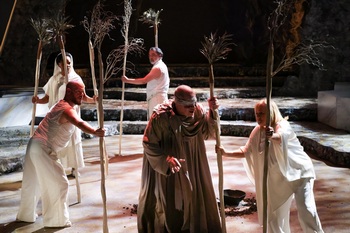
But my task at hand is to tell the story of what I saw when that show finally did open, five days late. And that, too, is fitting since Oedipus: King/Colonus is chock full of characters breathlessly telling each other what they saw offstage, a classic dramatic technique that endured well past Sophocles and into Shakespeare's time. But while most of those characters had bad news to share, I get to tell you that this production has many, many things to recommend it. As usual, PlayMakers swings for the fences, and if this show isn't a home run, it nevertheless feels like essential viewing for Triangle theatergoers. If you're familiar with Oedipus, you likely know him as the Freudian sop who killed his father and married is mother–and that's not wrong; it's just a bit incomplete. That juicy little story is the skeleton of Sophocles' Oedipus Rex, but Sophocles told quite a bit more of the original MFer's story in Oedipus at Colonus, in which the broken man gets a bit of divine compensation for his cursed life by becoming Athens's protectorate in death. And his shadow looms over Antigone, in which his two daughters try to sort out the moral and ethical dilemmas thrust upon them by their two brothers, who have killed each other in a civil war over Thebes. This trilogy, known as the Theban plays, stands among the essential tragedies of any era. Enter Carey Perloff, an impressively pedigreed arts administrator, director, and playwright with a taste for highbrow and thought-provoking material. Drawing from the English translations of Robert Blagg, Perloff has re-adapted the Theban plays into a single work that I'd estimate as 50% Rex, 45% Colonus, and 5% Antigone. In auteur mode she also directs the world premiere of this play, which is in performance (HVAC gods willing) at PlayMakers through September 27. This work plays to PlayMaker's strengths: Lex Liang's single weatherbeaten set on the thrust stage provides everything the work needs, and the episodic nature of the plot allows half the cast to play multiple roles to very good effect. Seeing Oedipus (Tony nominee Michael Hayden, assured and affecting from start to finish) all the way through in a single piece like this does a lot to deepen and complicate him as a character. He might not be a Lady Macbeth or a Nora Helmer, but he's a far cry from a sucker who wakes up on the rollercoaster of fate and can't get off. His talent for self-deception is world-class, his bitterness is a mask for his hubris, and even after he has learned his own fallibility in no uncertain terms, he withholds mercy in the pettiest of ways. Perloff can't resist making the expected hay out of the incest taboo, just as potent now as it was 2500 years ago, but she also pushes past that to ask us to think about what it means to maintain your agency when all you seem to have is bad luck. There's also a tantalizing question about subjectivity here: What do we permit ourselves to see and know about ourselves and others, and what do we selectively blind ourselves to? (It's undoubtedly heavy-handed that Oedipus is not the only blind guy in this play...) Perloff's text also seems to be very interested to treat Oedipus as an immigrant story (he flees Corinth in an attempt to foil the curse and winds up in Thebes; he trespasses on sacred ground outside Athens and is initially rejected by its caretakers), but I'm not sure how good an idea it is to look to Oedipus for insight on the immigrant experience since not many immigrants wind up ruling the country they enter. And there's also the small matter of Oedipus having committed a violent crime on his way into the country, just the bogeyman trope anti-immigration polemicists like to conjure up. But another of Perloff's choices winds up shifting the tone of the work in valuable ways. Rather than minimizing the chorus, as frequently happens in modern productions of these plays, Perloff leans into the chorus, putting more of the words in their mouths, and even (with composer David Coulter, who makes some of the music live on stage) setting a number of those speeches to song or chanted choreopoem. The chorus is our proxy in the play, verbalizing our thoughts and feelings, and revising them with us as new details emerge. In a second act scene my eyes kept returning to Jeff Aguiar's chorus member, who sat weeping in a chair, overwhelmed by the devastating revelations as they poured out around him. The chorus and its interludes are a great opportunity to discuss some of the production choices, which occasionally seem to draw on references from the middle of the last century. Those songs, essentially recitatives of speeches, reminded me of a Brecht/Weill collaboration in their artful artlessness. And at times the chorus use stylized movement that feels of a piece with Peter Brook or even Martha Graham. Speaking of Graham, many the costumes, and particularly Kreon's (the always commanding Jeffrey Blair Cornell, soon to be missed as he retires) golden robe, gave me an idea of what would have happened if Norma Kamali had costumed Graham's evening-length ballet of another Greek tragedy, Clytemnestra. I am not complaining about that in the least; Lex Liang has some truly inspired costume moments, particularly Oedipus's ankle-baring pants (if you know, you know). But all that makes it more difficult to understand why Oedipus's three children are dressed for a completely different party, possibly one thrown by Disney. This is not the only unevenness in the production. Both the text itself and various actors' readings of it swing from plainspoken to stylized, sometimes in the same speech. Perhaps the most striking way to illustrate this is to contrast two of the standout performances. In the first act, Nike Imoru's Teresias is a sensation of angled movements and mannered delivery; it is no wonder that Perloff brought Imoru down from the New York City workshop to be part of this production, and Imoru is just as mesmerizing, though not as stylized, as Theseus in the second act. But Imoru's performance of Teresias is on the opposite end of the spectrum from Julia Gibson's equally masterful but thoroughly natural monologue as the Second Messenger delivering the news of Jocasta (Tia James, also beautifully natural) and Oedipus's fate. I adored both of these moments, but they happened in very different dramatic modes. I'm wading in deep with this review because it is a world premiere. That doesn't change the fact that PlayMakers sets the bar so high that even when I quibble with productions, I am grateful to have had the experience and eager to return. The entire fiftieth anniversary season will be must-see theatre, and you would do well to begin at the beginning, with Oedipus: King/Colonus. "The gods crash in," indeed. Oedipus: King/Colonus a production of PlayMakers Repertory Company, runs through September 27, 2026, at the Paul Green Theatre at the University of North Carolina's Center for Dramatic Art, 120 Country Club Rd, Chapel Hill NC. For tickets and information, please visit www.playmakersrep.org or call at 919-962-7529. Playwright: Carey Perloff, adapting works of Sophocles, with translations by Robert Blagg Cast: (In alphabetical order) |