|
Regional Reviews: Raleigh/Durham Travesties
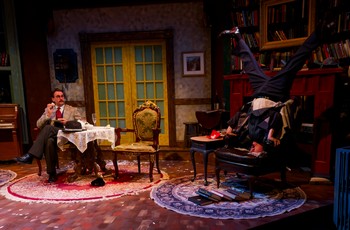
Stoppard holds an exalted place with audiences who relish theatre that puts intellect and aesthetics in the blender and hits frappé (see also: Edward Albee, Tony Kushner), but while that category is known for its dense speechifying, the challenges Stoppard presents to actors feel quite singular in their physicality and their absurdity. I'm happy to report that the cast of this production of Travesties, playing through October 25th, clearly are having the time of their lives, chewing up every line and flying off of every bit of furniture they've been given. For the uninitiated, I fear a synopsis could actually be a deterrent, but here goes: An octogenarian, historically real British diplomat by the name of Henry Carr (Steven Roten, a bit of a caricature in his aged present, but delightful in the youthful flashback version in which Carr spends most of the play) is relating his blatantly unreliable memories of a period of time in 1917 Zurich when he 1) definitely rubbed shoulders with James Joyce (Ryan Pater, gamely playing straight while those around him run with scissors), 2) definitely starred in a production of Oscar Wilde's The Importance of Being Earnest, and 3) may or may not have tangled with a soon-to-be ascendant Vladimir Lenin (Vuitton Bond, whose brooding visage is a remarkable impressionistic semblance of Lenin) and the Dadaist poet Tristan Tzara (John Jimerson, so committed and uninhibited that I literally have no idea who he is when he's not this character). Yes, there is a bit of plot that surfaces here and there: some romances between the men and various of the women in orbit around them, a pair of lawsuits Carr and Joyce really did file against each other, a loose strand about the possibility that Carr missed a chance to change the course of history. But none of that really is the point, and the perfunctory moments that turn those gears are among the least satisfying in the text as well as in this production. Between its 1974 premiere (London, then New York, two Tonys) and its 1993 revival (London), Stoppard made some revisions to the play, chief among them shortening the Act 2 opening plot-moving monologue by librarian Cecily (Edith Snow, captivating, manic, and literally swinging from a chandelier), and I believe that's the version of the text being used here. Plot aside, this play really is an elaborate set-up for a debate about what art is–or at least, what it was and had the possibility to be as the 20th century sprang coltishly into modernism–as well as the ways literature and political revolution circle each other, at times like rival fighters, at other times like frisky lovers. Stoppard's genius is to frame that debate in layer after layer of subjectivity: Carr's unreliable memory that gives us multiple versions of numerous scenes, the antipodean ways Joyce and Tzara push language to its limits, the numerous ways pieces of writing are shown to be fluid or evolving, and the mannered ways characters speak to each other, including Joycean interrogation, Joycean limericks (so many limericks!), Tzarian fragments, Leninist hortatory, and Wildean cleverness. The subjectivity of memory is a metaphor for the subjectivity of perspective, which is a proxy for the subjectivity of art, which is a foil for the subjectivity of revolution. Joyce, Tzara, and Lenin as presented here have many parallels: Each are single men at work on a text, each with a woman assisting them in some capacity. Each has an identity that is a bit slippery: Misspellings, nicknames, and mistaken identities suggest that they are not completely fixed as personas. Clothing and presentation choices are key for each of them at different moments (the excellent costumes are by Adrian Ewens). But every time they come together, especially Joyce and Tzara, they quickly repel each other like magnets switching poles as they discover a new faultline in their conflicting philosophies. Joyce and Tzara's push-pull has more than a hint of homoeroticism, making the spectre of Wilde even more potent. Over and above the lengthy, heady speeches and the sometimes absurd actions to go along with them, this play makes significant demands of the cast in the form of accents: British, Irish, Russian, Romanian, and whatever someone in Switzerland might sound like in English. In some cases a single character's accent slides around considerably as Carr's memory distorts them. Some of this cast handle those challenges more adeptly than others, but what was clear even on opening night was that the lot of them collectively have jumped off this cliff and are feeding off each other in their fearlessness and joy. Director Flora Bare is to be commended for creating an environment for this cast to thrive. More than their kinship with Albee and Kushner, Stoppard and Travesties are kissing cousins with Michael Frayn and Copenhagen, produced with great success by Burning Coal just two years ago. Though they operate in very different registers, both plays take considerable liberties in excavating a historical moment to find modern resonance, adopting the paradigms inherent in those moments as storytelling devices. These plays are big swings, and Burning Coal, celebrating its 30th anniversary this season, has shown repeatedly that it can hit home runs. Travesties, produced by Burning Coal Theatre Company, runs through October 29, 2026, at Murphey School Auditorium, 224 Polk St., Raleigh NC. For tickets and information, please visit www.burningcoal.org or call 919-834-4001. |