|
Regional Reviews: San Francisco/North Bay A Streetcar Named Desire Also see Patrick's review of The Book of Mormon
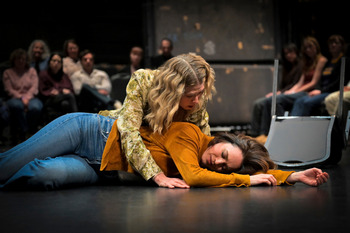
Like all the best, most interesting characters, Blanche is layered like an onion, and Williams' text carefully peels away the veneer, slowly but surely revealing the wounded, unstable, self-destructive narcissist at its core. Owen, who co-created this version of A Streetcar Named Desire (with Nick Westrate, who also directs this production), is nothing short of stunning in her portrayal of a woman who is slowly but surely revealed to be mendacious and scheming–yet still possesses enough Southern charm to keep her truths mostly hidden until the second act. The play begins with Blanche's arrival in New Orleans at the modest two-room flat occupied by her older sister, Stella (Heather Lind), and Stella's husband Stanley (Brad Koed). When she arrives, Owen plays her with a vacancy behind her eyes, almost as though Blanche is awakening from a coma and struggling regain her bearings. Having lost what remained of the family's plantation, Belle Reve, Blanche is now virtually penniless and must depend on Stella and Stanley's hospitality in order to survive. Given Blanche's bossy, superior nature (she relishes in calling Stanley "common" and a "Polack" and treats Stella almost as a servant), her tippling at Stanley's liquor supply, and her flirting with Stanley's best friend, Mitch (James Russell), that hospitality will be short-lived. This production is the first time The Streetcar Project has staged A Streetcar Named Desire in a theater, their prior efforts having taken place in barns, airplane hangars, warehouses, galleries, churches, and even private homes. The creative team has stripped the production down to its barest bones: a cast of just four actors (the play has 12 characters), no Southern accents, no props (other than a chair or two), and no set, simply the nearly empty stage of the Toni Rembe Theater, with the lighting rig and bare upstage wall and backstage spiral staircase in full view. There are also several dozen chairs placed on stage for audience seating, so the show is, I suppose, technically done in the round. There are also many moments when the characters leave the stage and continue the action in the aisles, boxes, and mezzanine of the Toni Rembe. This ascetic aesthetic serves to tighten our focus on Williams' text, which flows naturalistically during much of the action, but often ascends into poetic heights. Under Westrate's clever direction, this bare bones approach also gives us in the audience nowhere else to look: no set elements to judge or props in hand, nothing to pull focus from the performances of four highly-skilled actors. There are dozens of almost magical moments on display here. When Lind stands, fiddling absently yet somehow with purpose, at the cuff of her sweater as Koed's Stanley bullies her, there's an almost visceral quality to her attempt to busy herself in some way until this particular stressful moment passes. Owen shows us a moment when an actor playing a character does a performance of their own–as when Blanche's bursts into tears after relating the story to Stanley of the tragic end of her first marriage, and it feels just enough like Blanche is putting on a bit of a show for Stanley to elicit some small amount of sympathy from him. Owen also has a marvelous way of sometimes looking off into the middle distance when other characters are speaking, as though to let us know Blanche isn't really listening, but merely waiting for her chance to speak again. Koed rarely overplays the brutish, hyper-masculine Stanley. Even in the famous segment when he hollers "Stella!!!" after she has retreated to the upstairs neighbors' after a spat, Koed delivers some guttural vocalizations, as though he doesn't want to scream but simply can't manage to keep the rage and desire contained inside him. Russell's take on Stanley's buddy Mitch is brilliant in its own second fiddle sort of way. He manages to imbue Mitch with a quiet inner strength, even as he is manipulated by Blanche, and in a sort of awe of Stanley's machismo. As the play goes on, it's clear that Blanche's psyche is like a house of cards she has created for herself–something that must be treated with delicacy and tenderness, but that is clearly doomed to be destroyed by the wrong touch in the wrong place. When she gets to the famous line near the end of the play–"Whoever you are - I have always depended on the kindness of strangers."–it's gutting because we realize she has finally lost the last bit of support she has had, her final mooring has been loosed, and her sense of self threatens to dissolve, plunging her into a psychic abyss from which she will likely never find an escape. A Streetcar Named Desire runs through February 1, 2026, at American Conservatory Theatre, Toni Rembe Theater, 415 Geary Street, San Francisco CA. Performances are Tuesdays at 6:30pm, Wednesdays-Thursdays at 7:30pm, Fridays and Saturdays at 8:00pm, Wednesdays and Saturdays at 2:00pm and Sundays at 1:00 pm. Tickets range from $25-$130, plus fees. For ticket and information, please visit www.act-sf.org. |