|
/
Regional Reviews: San Francisco/North Bay Hell's Kitchen Also see Patrick's reviews of Mean Girls and Seussical
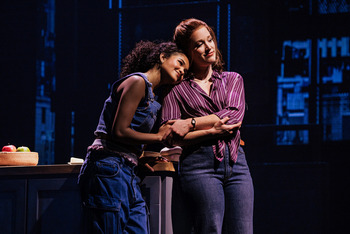
The show starts in high gear with "The Gospel." Ali (Maya Drake) introduces us to her neighborhood–Hell's Kitchen, natch–and the building where she lives: Manhattan Plaza, a high-rise with subsidized housing for performing artists and seniors. As she descends from the 42nd floor, one-bedroom apartment she shares with her overworked mother Jersey (Kennedy Caughell), she passes through different floors, each with different artists living there: dancers, pianists, a trumpeter, etc. At the ground floor Ali steps into the street where a trio of drummers smash out a rhythm on plastic buckets, and the chorus perform a vibrant, cheer-inducing dance that feels celebratory despite the gritty nature of the lyrics. Hell's Kitchen is based, ever so loosely, on the life of Alicia Keys. Though she was raised in Manhattan Plaza with a mother who worked multiple jobs, Alicia was playing piano by age six and had already been signed to a major record label at 15, while the character of Ali doesn't get her first piano lesson–from the amazing Miss Liza Jane (Roz White), more on her later–until age 17. In creating Hell's Kitchen, Keys chose to focus on the relationship between mother and daughter, charting all the adolescent angst and generational divide that separates the two, and keeps them spatting at each other for most of the two and a half hour running time. Though too much of the interactions between mother and daughter seem hackneyed, covering territory that feels incredibly well-worn (there's a lot of storming out and "I'm only looking out for your best interests" comments), the incredible musical energy that pours off the stage more than makes up for these shortfalls. The choreography (by Camille A. Brown) is wildly entertaining, mixing elements of breaking and popping with the fluid and percussive moves one might expect from Alvin Ailey's troupe, with the isolations associated with Bob Fosse. Sort of "Fosse meets Fubu." (Fubu being the the streetwear company founded by Daymond John, with clothes worn by several cast members.) As Ali works through the challenges that face many adolescents–discovering an authentic "self," rebelling against parental restrictions, exploring her sexuality–she falls for Knuck (Jonavery Worrell), one of the street drummers who at first rejects her advances, but ultimately returns her affections. But the second most important person in her life is not a teenage fling, but Ali's connection with Miss Liza Jane. After another storming into the street after a fight with her mother, Ali is caught in a downpour. Not wanting to return to her apartment, she finds herself in the Ellington Room, where Miss Liza Jane is playing the piano, as she does each day. Soon, Ali is taken under her wing, learning the basics of music theory as Miss Liza Jane very steadily and methodically imparts her musical wisdom to this nascent keyboard prodigy. Roz White fills the role of Miss Liza Jane with a sense of quiet gravitas that stands in sharp contrast to the almost frenetic pace of Keys' music and the fractious mother-daughter conflict. In many ways, Miss Liza Jane is the heart and soul of Hell's Kitchen and White's performance is the highlight of the evening. The chorus, clad (by costume designer Dede Ayite) in colorful, often-deconstructed streetwear, are a sort of megavolt battery, infusing the show with a vitality and intensity that melds perfectly with Keys' powerful music. Their moves are often unique to each performer, but when the choreography calls for unison, their steps are instantly locked in tune with each other. As Ali, local girl (raised in San Jose) Maya Drake is easily up to the task of portraying a star on the rise, so naturally does she inhabit the persona of a multi-talented 17-year-old. Not a big reach, given that seems to be exactly what Drake is. Kennedy Caughell may not be quite as believable as Ali's mother, but when she tears off Keys' "Pawn It All" in act two, it nearly brings the house to its feet, so powerfully does she inhabit the emotion of the scene and the song that supports it. All this energetic action takes place on a massive set (by Robert Brill) with soaring flats that roll in and out of place to establish a sense of midtown Manhattan, with projections (Peter Nigrini) that add color and authenticity to the street scenes. All of Alicia Keys' hits are here: "Fallin," "If I Ain't Got You," "You Don't Know My Name," Girl on Fire" and the Jay-Z anthem to New York, "Empire State of Mind," which Keys' guested on. Though all the songs (save "Seventeen") were written prior to developing Hell's Kitchen, the show never feels like a jukebox musical. That could be due to the fact that I was relatively unfamiliar with Alicia Keys' discography, or it could just be the talented Ms. Keys has a natural flair for making entertainment feel organic and natural, as if the show had always been there, waiting to be discovered. Rather like Ali herself. Hell's Kitchen runs through May 24, 2026, at BroadwaySF's Orpheum Theatre, 1182 Market Street, San Francisco CA. The show plays Tuesdays-Saturdays at 7:30pm, and Wednesdays, Saturdays and Sundays at 1:00pm. Tickets range from $57.92-$270.03. For tickets and information, please visit broadwaysf.com or call 888-746-1799. For information on the tour, visit |