|
/
Regional Reviews: San Francisco/North Bay The Lunchbox Also see Patrick's reviews of Hedwig and the Angry Inch and Dracula: A Feminist Revenge Fantasy, Really
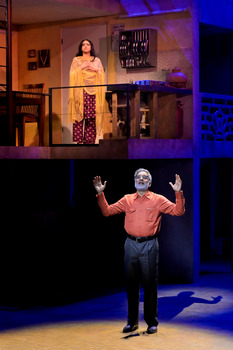
If you haven't seen the film, it's a delightful story of an epistolary relationship between a widower on the verge of retirement and a housewife in an unhappy arranged marriage. Their correspondence begins when the wife, Ila (Kuhoo Verma) drops a note to her husband into the stack of metal containers that contains the tiffin, an Indian term for a light meal or lunch. These containers are delivered across Mumbai by dabbawallahs, who use a complex but highly accurate and efficient method to make sure the lunches get delivered to the correct recipient. The system is so accurate it has received a Six Sigma designation, for only one in about six million deliveries is misdirected. So it's odd that Ila's note (and delicious food) is sent to the grumpy widower, Saajan (Manu Narayan), instead of to her husband. Saajan shocks the crew at a local food stand (who evidently had been providing his tiffin) when he compliments them on their latest meal. The expressions of surprise on their faces creates one of the tastiest bits of comedy of the evening–though those characters, and their food stand, disappear, never to be seen again. When Ila's food arrives on Saajan's desk the next day, it's almost as if fate has intervened to bring these two together, since the dabbawallah system is so storied in its accuracy. When Saajan complains (via a note sent back to Ila in the empty tiffin boxes) that the day's lunch was over-salted, Ila's upstairs neighbor, Mrs. Deshpande (Anisha Nagarajan), always referred to as "auntie," sends down some chiles to spice up the next day's meal. From this point forward, the notes are sent back and forth each day. And thus lies my main issue with The Lunchbox: while the concept of notes being sent back and forth via the dabbawallah intermediaries worked cleverly in film, it somehow lacks the dramatic drive this story needs to fully engage a live audience. The music, a mix of South Asian sounds with (at times) Sondheim-esque rhythmic structures, can be compelling, especially when the Indian musicians (specifically, the famed percussionist Rohan Krishnamurthy) get a chance to cut loose. Rather than moving the story forward, the songs tend to focus on the inner emotions of the characters, expressing verbally what often goes unsaid. The staging–the show is directed by Rachel Chavkin, with a stunning scenic design by Mimi Lien–is fantastic. Chavkin's set manages to convey a sense of both expansiveness and claustrophobia, something I imagine a visitor to the actual city of Mumbai would experience. Chavkin has created a complex of buildings that rise four stories into the fly space of the Roda Theatre, along with a three-story segment of what is supposed to be a Mumbai high-rise apartment building where Ila lives with her husband and daughter (charming Caryna Desai Shah the night I saw the show), which rotates on a turntable. It all combines to create a variety of looks and locations that help keep the story moving swiftly forward. Director Chavkin makes good use of a relatively small (13 players by my count) cast to suggest a busy, crowded city and shifts between scenes with oily smoothness. More important, she is well-served by two supporting players: Nagarajan as the bossy but lovable upstairs Auntie (with her own serious challenges) and the slightly sketchy but ultimately charming Sheikh (Aathaven Thamarajah), the young Muslim man who is stepping into Saajan's role after his retirement. Thamarajah has a wildly expressive face, and his manic energy and obsequiousness–which grates on Saajan–are both marvelously comic and heartwarming. The chorus is filled with terrific dancers and singers–the harmonies in the song "Bird of Gold" (I'm assuming that is the title, based on the lyrics–there is no song list in the program), performed by the trio of food stand workers are thrilling, and the choreography by Reshma Gajjar harkens to Bollywood musicals without veering too far in that direction. The two leads, Kuhoo Verma and Manu Narayan, are both seasoned performers, but their ability to develop chemistry is hampered by the fact that they only meet face to face in the very last moments of the show, despite being onstage together for most of the evening. This creates a large hurdle for the show to overcome, but perhaps in further development this handicap can somehow be turned into an asset. When the characters sing, "I think we forget things if we have no one to tell them to," it's both a touching reflection on the loneliness that can exist even in a city of 15+ million people and a warning to producers that audiences need characters who fully connect with both each other and an audience. The Lunchbox could use some help on that last point if it wants to find its path to the Great White Way. The Lunchbox runs through June 2, 2026, at Berkeley Repertory Theatre, Roda Theatre, 2015 Addison Street, Berkeley CA. Shows are Tuesdays, Wednesdays and Sundays at 7:00pm, Thursdays-Saturdays at 8:00pm, with matinees Saturdays and Sundays at 2:00pm. There are additional matinees Thursday, June 4 and Thursday June 25 at 1:00pm. Tickets range from $32-$157. For tickets and information, please visit www.berkeleyrep.org or call the box office at 510-647-2949. |