|
/
Regional Reviews: San Francisco/North Bay Arab Spring Also see Patrick's review of As You Like It
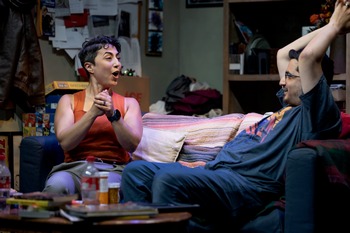
Dina seems to be a powerful attorney, with a lesbian partner and a bit of an ax to grind with her brother, who suffers from an unnamed anxiety disorder. Yusef regularly spouts self-affirming statements like "I'm right where I'd supposed to be," or "I am a strong and capable man." They meet outside their father's house, a facade by scenic designer Mikiko Uesugi that opens up to reveal the chaos inside: art lining the walls, overstuffed bookshelves, clothing piled everywhere, and boxes of cassette tapes, which will come into play later in the story. It's a bit overwhelming for the siblings and, despite the fact that they have only a few hours before the funeral, they play a game of kunkan, a card game that is a forerunner of gin rummy, with the winner getting to be in charge of the decisions. It's fortunate that Dina wins, for she has far more organizational skills than Yusef, who's idea of a plan is "Step one–bury dad. Step two–everything else." While the two make piles–sell, donate, trash–they also argue about any number of things: what to keep, the place of women in Islamic culture, and the challenges of being Muslim in America. When Dina tells Yusef her travel was a little easier than normal, as TSA didn't choose to select her for additional screening, Yusef suggests that the patdowns are easier to take "if you think about it like a free massage." The two siblings are wildly different, despite sharing the same gene pool. Yet they unite in their complicated relationships with their parents (divorced some years prior) and with the treatment they, and their fellow Muslims, have received from Americans. They remember, with much less rancor than might be expected, the aftermath of their Uncle Rumsey's funeral, when the family car was set ablaze by racist neighbors. Dina, being the girl, resents the treatment she's received over the years. "I had to justify existing," she complains, and brings up the slights she's been subjected to, as when Yusef received a convertible sports car for his 16th birthday while she received a bracelet. "A gold bracelet," Yusef reminds her, in an attempt to equalize the situations. As the pair sort through the chaos of their father's life–and their own personal chaos–they discover recordings their father had made over the course of his life. These shed some light on him, but don't seem to really move the story forward. The chaos of this family is rather sadly reflected in the structure of the play, which seems to careen from one argument or slight to the next with no real sense of a narrative arc to keep us engaged through the action. This weakness of the text is somewhat offset by strong performances from both Ishak and Razawi, who exhibit a chemistry that feels true to sibling rivalry, affection, and duty. I imagine Ibrahim (and perhaps director Nailah Unole didanas'ea Harper-Malveaux) will use this world premiere staging to tighten the script and narrow its focus to more powerfully present this family's story. Arab Spring a co-production of Golden Thread Productions and San Francisco Bay Area Theatre Company, runs through July 12, 2026, at Potrero Stage, 1695 18th Street, San Francisco CA. Performances are Thursdays-Saturdays at 8:00 p.m., with matinees Sundays at 3:00 p.m. Tickets are $20-$100 general admission. For tickets and information, please visit www.goldenthread.org or www.sfbatco.org. |