|
/
Regional Reviews: San Francisco/North Bay The Prince, Part 1 Also see Patrick's review of Hairspray
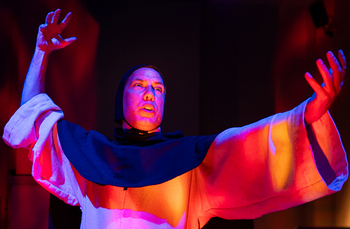
Having only a minor familiarity with The Prince, I was vastly curious to see how Graves would adapt this rather intricate, and intricately political, work for the dramatic stage. My curiosity was rewarded with a production that–despite its nearly three-hour length–was thrilling, compelling, fascinating to watch, and never once had me thinking about the time. Those three hours soared past as three actors delivered bravura performances of a wondrous work of dramatic art. The Prince, Part 1 concerns the lives and interactions of three historical characters: Machiavelli himself (Kevin Singer); the infamous monk Jerome Savonarola (Mark Farrell); and the murderous, conniving Duke Cesare Borgia (Brennan Pickman-Thoon). In the opening scenes, Machiavelli pays a visit to the hyper-zealous friar, urging him to leave Florence for his own safety, the city being up in arms over Savonarola's fervent pleas to abandon their "vanities": playing cards, makeup, mirrors, fine clothes–not to mention prostitution and sodomy. As Savonarola, Mark Farrell is nearly as incendiary as the flames that later consumed his body when the Catholic Church grew weary of his lambasts, even calling Pope Alexander VI (who had previously excommunicated him) a "demon in pope's robes." Farrell even resembles faintly a portrait of Savonarola and one can imagine his shrieking at all the ways he sees the world falling away from the teachings of Christ to crowds of Florentines. Farrell, despite his soft, even doughy, face, plays the monk with a severity and intensity that lays clear why he was such a thorn in the Church's side. (Remember, this is a period of history when popes were more political animals than the "vicar of Christ": Pope Alexander VI himself fathered multiple children and played power games from his throne in the Holy See.) Graves has written Machiavelli as a man of great intelligence and political savvy–savvy enough to realize he is the least powerful of the three characters whose actions compose the play. He dispenses wise advice, but watches almost helplessly as most of it goes unheeded. This is something he should realize, for as he clearly states, "If you leave them to their own designs, people are savages." Kevin Singer plays the role with a face that belies a mind always in thought, always examining the actions of those around him. His brow furrows and his eyes seem to pierce through the machinations of both Savonarola and Cesare Borgia as though disassembling complex machinery to see how it works. In Brennan Pickman-Thoon, Singer has a scene partner worthy of his character's insight and caution. Cesare Borgia is known to history as a man born to power, yet always lusting for more. As Machiavelli states, "Without an army, a man is just... a man." Borgia revels in the power of his forces, gleefully wielding them to take one castello after another, sometimes using the tremendous force of artillery–at that point in history a new invention. Pickman-Thoon absolutely slurps up this role, and costume designer Tammy Berlin has given him an ensemble that comes right up to the line of sexual fetishism without quite going over it: tight leather trousers tucked into engineer boots, plus a silky flowered shirt open to mid-chest, a silver cross on a silver chain, and two silver claw rings that give his index and middle fingers the appearance of talons. (His shirt changes from scene to scene, but the black leather trousers are ever present.) Pickman-Thoon's voice in almost operatic in its range: when he's mocking weakness, it rises into upper registers, then instantly deepens when he threatens or cajoles. He almost always wears an expression that communicates confidence and strength (since his father is Pope Alexander VI, he has powerful allies), but I was startled at how effortlessly his expression changed–for an instant only–into one of fear when he hears word of an army stronger than his own.. Playwright Graves, who also directed, has achieved a rather minor miracle in transforming the intimate space at Berkeley City Club. He's done nothing extravagant–in fact, most of his effects are achieved through costuming, sound effects, and lighting cues. (Graves also designed the lighting.) When Savonarola preaches, or rails against Florentines' love of their vanities, an outline of a cross appears. Later, a grid of light and shadow indicates his imprisonment. And when Borgia is luxuriating in the chaos his army has brought to a town he's sacked, a faint red glow appears at one of the open doors that gives access to a courtyard. Though there are no direct references to current dictators (or wanna-bes) or oligarchs, it doesn't take too much deconstruction to find parallels to men of today who concentrate solely on the acquisition and consolidation of personal power, regardless of its effect on the people over which they rule. But you need not think of any specific strongman while you enjoy this scintillating production of The Prince, Part 1. Its pleasures are all contained within Graves' masterful telling of the complex relationships between men of power and influence. The Prince, Part 1 runs through September 6, 2026, at Berkeley City Club, 2315 Durant Avenue, Berkeley CA. Shows are Thursdays, Fridays and Saturdays at 7:00 p.m., and Sundays at 5:00 p.m Tickets range from $35-$45, with pay-what-you-can available for the Thursday performances. There is also an opportunity to see parts 1 and 2 on the shows' final weekend, with Part 1 playing at 2:00pm and Part 2 at 7:00pm on September 5, and Part 1 at 12:00pm and Part 2 at 5:00pm on September 6. For tickets and information, please visit www.centralworks.orgor call 510-558-1381. |