|
/
Regional Reviews: San Francisco/North Bay R.O.I. (Return on Investment) Also see Patrick's reviews of Mamma Mia! and Urinetown
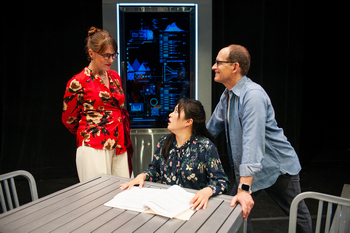
In R.O.I. (Return on Investment), the new play by Aaron Loeb (Ideation, Abraham Lincoln's Big, Gay Dance Party, First Person Shooter) at San Francisco Playhouse, variations of that vision come to life when Willa (Lauren English) shows up at the office of The Montrose Fund, a venture capital firm, in order to pitch May (Sharon Shao) seeking funding for her new company, Precure, which aims to tweak individuals' genetic code to prevent diseases like cancer or Alzheimer's from ever afflicting anyone, and to cure illnesses like these. The Willa who walks into The Montrose Fund is a far different woman than the one who walks out of it 90 minutes (and several years) later. In that first encounter, she's a bit of a bumbling buffoon, reading her pitch off of index cards and seeking an outrageous $30 billion dollars in funding. It's a bit of a ridiculous setup, asking us to imagine a Stanford PhD would be so unprepared for such an important pitch, though she has done extensive research into the fund and its employees, knowing, for instance, that May's mother has dementia. Despite the ineptitude of the pitch, May manages to see the potential value of the idea and takes it to her boss, the fund's founder and Silicon Valley veteran Paul Montrose (Anthony Fusco). May is confident but cautious, asking Paul "Do you want another Theranos?," referencing the recent real-life funding debacle built on false promises and lies. For his part, Paul plays mentor to May, referencing his time during the internet boom and how it was sometimes compared to a massive version of the Yellow Pages and beginning to explain that term to May. Paul, like so many older white men of his era, still harbors some racism, though he's aware of it enough to joke about it. When May calls him out about one of his relatively mild but un-woke comments, he replies "I'm an old man. I'm trying to do better." He then takes a brief beat and adds, "Black lives matter." When Willa's technology begins to show progress, and the promise of vast wealth rears its avaricious head, the stakes for everyone keep getting raised. There's now a board Willa must answer to, and congressional committees worried about "designer babies" and eugenics, something that doesn't seem to concern Paul in the slightest. As R.O.I. plays out, we learn more about Paul and Willa, and like them less and less. Much of this is due to Willa's embrace of conspiracy theories about "globalists" and Big Pharma, which only wants to make drugs people have to take for a lifetime and not actually cure disease. She's also got a fairly strong strain of anti-Semitism, saying things like, "Jews are loyal to other Jews first." There's a reference early on to a chip that is in development that would actually be implanted inside a person's brain, and an oblique reference to a technology not unlike today's smart glasses–both of which will become major plot points. In part because of all the technical references and the intricacies of venture funding, R.O.I. is a play that requires close attention to plumb its depths. That attention is well repaid (pay especially close attention to the very first scene, which seems innocuous enough but will resonate loudly later on) as all the threads are finally woven together over the last 20 minutes or so. The play is skillfully acted by Bay Area veterans. Fusco plays Paul with an an easy confidence that belies his savage strategic skills, as well as his clearly significant fortune. He's the sort of power broker who seems not to care about his influence, but is also willing to wield his influence and business acumen in rather unsavory ways. Sharon Shao does terrific work as May, showing us the character's drive and anxiety through a pair of expressive eyes and how she physically seems to defer to Paul until she realizes what a deep mess she's gotten herself into. Lauren English gets the meatiest of the play's roles. Although it would be easy to say she under-seasons that steak, her subtle performance actually serves to make us all the more surprised at what a conniving, vindictive harridan Willa actually is. The sympathy we may feel for her as she fumbles with her index cards in that first pitch will be cleanly scrubbed away by the play's conclusion. Bonnie Akimoto, who appears as Woman in the very last scene, will break your heart with her confusion and sense of existential loss. Director Jonathan Moscone is to be congratulated for making this detail-rich play as compact and compelling as it is. On a simple set by Bill English, the action plays out smoothly, with each scene transitioning seamlessly into the next, aided by graphics and text that appear on two large video screens at upstage left and right. R.O.I. will repay your investment in time and attention with a thought-provoking look at greed and ambition among the technocracy. R.O.I. (Return on Investment), a San Francisco Playhouse production, runs through September 5, 2026, at the Creativity Theater, 221 Fourth Street, San Francisco CA. Performances are Wednesdays-Thursdays at 7:00pm, Fridays-Saturdays at 8:00pm, with 2:00pm matinees Wednesdays and Saturdays. Tickets are $59-$74. For tickets and information, please visit www.SFPlayhouse.org or call 415-677-9596. |