|
/
Regional Reviews: San Francisco/North Bay The White Chip
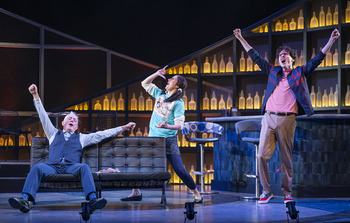
Steven is a stand-in for Daniels, a theatre professional who was at one time the interim artistic director for the Actors Theatre of Louisville–until his constant drinking cost him that gig. The white chip of the title references the token given at AA meetings to those who have been sober for 24 hours, or who have committed to giving up alcohol. This semi-autobiographical play tells how Steven had his first beer at age 12 (hated the taste, loved the effect), not long after a trip to the LDS temple to perform baptisms for the dead. The drinking continued through adolescence, and after some particularly rough times for his parents, young Steven is sent off for the summer to a sort of re-education camp at Brigham Young University. The other kids there had mostly been sent to "cure" their homosexuality, so the fact that the camp ended with the kids putting on a musical theatre show seemed a bit ironic to Steven. In high school, Steven was voted "Most Likely To Exceed," and he certainly lived up to that expectation. At Florida State University, which U.S. News & World Report had called the "biggest party school" in the nation, he had once met the challenge of downing 100 shots of beer in 100 minutes. After another college binge he jumped off a three-story building, aiming for a pile of hay–which he missed, landing him in physical therapy for months after. The White Chip is told mostly in the first person, directly to the audience. Clark is supported in the play by two other performers, who each play a dizzying array of roles: Steven's parents, girlfriends, his wife, various bartenders, friends, rehab counselors, and more. Those characters are played–with dizzying transitions–by Lyndsy Kail and Danny Scheie. The play sticks to a relatively straightforward structure, telling Steven's story pretty much chronologically. But it's the way Daniels' writing zips from plot point to plot point and the manner in which he uses the other two performers (identified as #1 and #2) that really deliver the comedy here. Scheie does a lot of the comic heavy lifting, bouncing with surety from one role to another with his incredibly plastic voice, a change of hat, or the addition of an item of clothing. But under Lance Gardner's sure-handed direction, we never for a moment feel lost. Lyndsy Kail does terrific comic work as well, but she also gets the tough job of playing Steven's mother, who is rather caustic and foul-mouthed (the family left the Mormon Church before Steven left the house to go to college) in the early scenes, but manages to transition into Steven's rock before the final curtain falls. The action is rather non-stop. For such a personal, emotionally sensitive story, director Gardner has created a show that is wildly, even intensely, physical. This pace serves to reinforce the sense of life coming at Steven at a breakneck pace, something Clark pulls off with rather stunning ease. Though he doesn't delve into the details of making theatre, we nonetheless get the sensation that Steven is always up against deadlines, always trying to make great art, despite being impaired by alcohol most of the time. Though there's never any mention of the financial toll this must have taken on him, every spare penny must have gone into the pockets of liquor store owners and barkeeps, given how voraciously his character downs the sauce. The action takes place on a silvery-gray set by Christopher Fitzer, sprinkled with black, mid-century modern furnishings. There is a large set of shelves at stage left behind a bar that contain dozens upon dozens of bottles, all clear, all unmarked, allowing our focus to remain on the three actors, but reminding us of the volumes of liquor Steven consumed before he got sober. There's one lovely moment when Steven talks about how several of his dramatic heroes–Tennessee Williams, Eugene O'Neill, and several others–were all alcoholics. As each is named, a single bottle suddenly glows red from within. There have been many plays about alcoholism or its effects on its characters–Cat on a Hot Tin Roof, Who's Afraid of Virginia Woolf?, Days of Wine and Roses and others–but none have addressed the subject with such irreverence, while still honoring the serious nature of the affliction. Go see The White Chip and you'll be laughing from start to finish, yet ending the night with an even greater sense of empathy for anyone in your life who may be struggling with addiction. The White Chip runs through September 20, 2026, at Marin Theatre, 397 Miller Avenue, Mill Valley CA. Performances are Wednesdays-Saturdays at 7:30pm, with matinees Saturdays and Sundays at 2:00pm. Tickets range from $39-$110 (plus a $6 handling fee per total order, or $8 for phone orders). For tickets and information, please visit www.marintheatre.org, or call the box office at 415-388-5208.
|