|
/
Regional Reviews: San Francisco/North Bay King Lear Also see Patrick's reviews of Peter Pan Goes Wrong, Death of a Salesman and Little Shop of Horrors
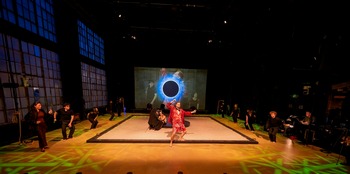
As you take your seat, your eye is first drawn to The Fool (played by Grammy winner, Guggenheim Fellow, and Pulitzer Prize nominee Rinde Eckert), who sits at the center of a circular riser, set in the middle of a square frame, perhaps 30-40 feet on a side, filled with fine sand. Upstage is a large projection screen with an image of a solar eclipse at its center. At the four corners sit four purple-robed performers, dressed as monks, standing in for Lear's 100 knights. Then, during the pre-curtain speech, a tall man dressed rather oddly in red-patterned shorts, an aloha shirt, and a short, kimono-style robe interrupts with a brashness and profanity that are startling. "Oooh, monks! Can I touch a monk?" and "Sand! Wow. Expensive." You will soon discover this is Edmund (Dean Linnard), the bastard son of the Duke of Gloucester (an excellent David Sinaiko, stepping in for Ryan Lee at the performance I saw), rival to his legitimate brother, Edgar (Tyler Aguallo). After Edmund's exit (and the conclusion of the pre-curtain speech), the play begins, establishing the central conflict. Lear (J Jha), a British king, advanced in his years and preparing for succession, decides he will divide his kingdom among his three daughters: Goneril (Sarah Kasuga), Regan (Natalie Pasquinelli), and his beloved Cordelia (Dina Zarif). To determine who will get the best, largest portion of his realm, Lear poses a test: "Which of you shall we say doth love us most?" Goneril sucks up to her father, flattering him with poetic skill but empty of emotion. Regan, who steps up to the challenge while chewing gum and speaking with almost a Valley Girl accent, one-ups Goneril's lauds: "I find she names my very deed of love; only she comes too short that I profess myself an enemy to all other joys." When the time comes for Cordelia to profess her affection, she claims "I love your majesty according to my bond; no more nor less." As you can imagine, with a vanity bordering on madness, this pleases not King Lear, who immediately disinherits his youngest daughter, setting in motion the political machinations and turf wars that will ultimately end in the deaths of Lear, his three offspring, and the villain Edmund. King Lear is ranked among the greatest of Shakespeare's works, in part because of its scale and the depths of its tragic nature. That scale is on full display here: this is a massive production, with a cast of 30 or so, and the producers and director Michael Socrates Moran make bold use of multiple cameras, on-screen graphics, and imagery. Overlaying all of this is music composed by Paul Dresher, a well-known contemporary composer who has received a Guggenheim Fellowship and has been commissioned to create works for the San Francisco Symphony, The Kronos Quartet, the Spoleto Festival, and many more. He performs the score live on the Hurdy grande, guitar, and keyboard, along with his collaborator, Joel Davel, a fellow composer who plays the marimba lumina and percussion. It's an atmospheric soundscape that helps set the mood and add emotive color to the performances on stage. The performances are almost uniformly compelling and heart-wrenching. To hear J Jha's keening over the lifeless body of his beloved Cordelia is to share a moment of terror and regret that is nonetheless life-affirming in how it reinforces the value of a single human life by showing us the void the loss of that life leaves in those left behind. Jha is on stage for most of the three-and-a-half hour running time (with two brief intermissions), and we get to see how Lear's hubris and pride slowly but inexorably transform into the madness of a man who abdicated his power, only to see his influence wane in ways he likely never expected. The other big star here is Dean Linnard's manic take on Edmund, the bastard who connives and cajoles at every moment in his quest to usurp his brother, or, barring that, to throw everything around him into a state of chaos. It's hard to look away from Linnard, for many reasons. First, at six feet, four inches, he seems to tower above his fellow performers. He is costumed (by designer Denise S. Altaffer) in some of the show's most outrageous outfits, not the least of which is the long white coat with the word "Clown" in rhinestone letters and a crown, which he wears in act three. (At this point he also appears in clown makeup that calls to mind Heath Ledger's take on the Joker.) His eyes can burn with fury, but Linnard imbues the character with a sense of uncertainty, in that you can never tell what he's going to do or say next. Rinde Eckert plays The Fool with an almost Zen-like sense of calm and balance. This would seem contradictory to the traditional idea of fools (in Shakespeare and elsewhere), but Eckert seems to use this to function almost as a focal point around which all the other action happens. Hence, his placement at center stage during walk-in. Eckert wears a rather crude sign around his neck that reads "fool," just so we are always aware of his role. The actors playing the three daughters present very different takes on their roles. Kasuga's Goneril has the privileged, authoritarian air of the eldest, always moving with purpose, as if each step she takes is all part of a greater plan of hers. Pasquinelli, on the other hand, gives us a Regan who is impetuous and maybe even a bit flighty–though no less calculating than her elder sibling. Zarif puts her rich soprano to use vocalizing Dresher's music, as well as bringing a sweetness and vulnerability to Cordelia that is perfectly in line with her character. As is often the case with Shakespeare, there are big themes at work here, themes that transcend time and history to speak to us in the 21st century. It seems clear our current President has blurred the lines between loyalty and sycophancy to a degree heretofore unseen. Just as Lear cannot discern true love from ass-kissing, we are all at risk if the body politic continues to fail to understand the difference between leadership and autocracy. Oakland Theater Project's stunning production of King Lear offers its audience a powerful lesson in the dangers of egotism and blindness (literal and figurative) in our leaders. Oakland Theater Project's King Lear runs through October 11, 2026, at Z Space, Steindler Stage, 450 Florida Street, San Francisco CA. Shows are Thursday, Friday and Saturday at 7:00 p.m., and Sunday, October 11 at 2:00 p.m. Tickets range from $12 (pay-what-you-can rate) to $114. For tickets and information, please visit zspace.org or oaklandtheaterproject.orgor call the box office at 415-626-0453.
|