|
Regional Reviews: San Jose/Silicon Valley Over the River and Through the Woods Also see Victor's review of Ada and the Engine
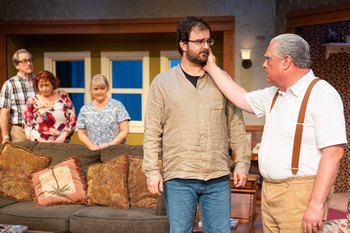
Nick, played as an often exasperated yet caring grandson by Filip Hofman, is a 30-ish marketing executive from Hoboken, New Jersey who has dinner with both sets of Italian immigrant grandparents every Sunday in the early 1990s. His parents have retired to Florida. When Nick announces that he received an offer for a better position in Seattle, the grandparents conspire to frustrate the move. And what better way than to have him fall in love with a young lady of their arrangement. Enter Caitlin, the appealing and ever-smiling Delaney Bantillo, who is the antithesis of what she regards as the dyspeptic Nick. Relationships operate differently in southern than in northern European families. Nick's modal means of communication with his grandparents is to shout with seeming hostility, to the point that you wonder if he really loves them. His frustration comes from incidents like learning that one set of grandparents want to return the VCR he bought them and give him back the money, because it was too expensive a gift. Or when he finds that the message recorder he bought them is broken and asks why, he finds that maternal Grandpa Frank threw it on the floor because he didn't like its squawking. Stereotypes run rampant in the play, but coming from a Sicilian family on my mother's side with immigrant grandparents, I can testify that I know equivalents of all of the characters in the play and all of the situations and conversations. Aida (Karen DeHart) is the hostess and maternal grandmother, who seems to only leave the kitchen to take (or give) food orders. For her, whatever the question, the answer is food, which solves everything. It's always "Can I get you something to eat?" and "no" is not an acceptable answer, which is another of Nick's frustrations. So oblivious is Aida to rejection concerning food, when Caitlin says repeatedly that she is vegetarian, Aida blithely replies "I understand. Have a piece of veal." Meanwhile, maternal grandpa Frank, played by a blustery John Mannion, is in denial about his declining ability to drive, despite repeat fender benders. Mannion turns in his best acting when more serious, and though not the philosophical type, Frank does deliver two poignant notions. In one, he says to Nick, "You're never here." That belies Nick's devotion to coming for Sunday dinner, but the comment speaks to the fact that seeing people only in one context doesn't tell you all about them or show that you care. Frank also talks about how as a kid he hated his father. When toy vendors came to his ancestral town and regaled the townsfolk with colorful and extravagant offerings, Frank's father always bought him the cheapest one. It was only as an adult that Frank had the wisdom of really understanding his father and surrounding circumstances. Emma (a bubbly Deb Anderson) is the other grandmother. She is the classic canasta-playing church lady, often sponsoring Mass cards to try to help Nick along in every way. Grandpa Nunzio (a quieter and more reflective Joseph "Joe" Walters) harbors a secret that if shared could induce Nick to reject the move. One of the charms of the show is that it is so relatable. Not only are the situations realistic, but scenic designer Ron Gasparinetti's set captures the right style and period. Of course, a person like me must ask if I enjoy the play so much only because it connects to my own ethnicity. On the negative side, am I too critical because generally the accents of some actors are not right? Judging by the audience, neither of my possible concerns matter. In addition to fine acting and scenery, Paul Skelton's lighting deserves a nod. Among other highlights, several times characters speak directly to the audience to share their thoughts, and the stage is darkened with a spot on the appropriate actor in those situations. George Psarras's sound is largely a compendium of Italian and Italian-American hit songs, which may or may not be prescribed in the playwright's notes. In any case, the one jarring exception to a nostalgic soundtrack is "Days of Wine and Roses," whose only Italian connection is that the version used is sung by Frank Sinatra. But otherwise, it's the theme song of a movie about alcoholics. Though it is totally possible to let this play wash over you and enjoy it at a mostly superficial level, the number of meaningful contrasts between the grandparents and Nick that the playwright explores or implies are profound. They render this work one of unexpected depth that informs the divergent ways they see the world. Those divides between the generations include aged vs. young; old world cultural base vs. new world; born to poor economy vs. born to rich economy; limited expectations vs. unlimited horizons; mono-religious culture vs. multi-religious culture; patriarchal society vs. shared eminence; blue collar vs. white collar; marriages arranged or of convenience vs. marriages of love; family as the enduring measure of happiness vs. career and accomplishment as goals; industrial age mentality vs. information age thinking; divided citizenship allegiance vs. born American citizen; anchored for life to a community vs. mobile. No wonder they don't see eye to eye! But whatever the generational differences, the strength of family ties does come through, and the City Lights production resonates, yielding warm feelings and lots of laughs. Over the River and Through the Woods runs through December 21, 2025, at City Lights Theater Company, 529 South 2nd Street, San Jose CA. For tickets and information please visit cltc.org. |