|
Regional Reviews: San Jose/Silicon Valley The Da Vinci Code
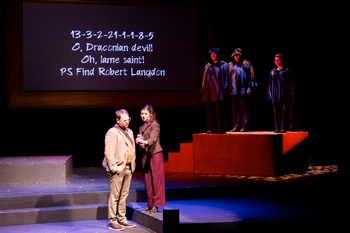
Murders, deceptions, false identities, and family mysteries combine with secret and warring, ancient religious societies involving the likes of Isaac Newton, Leonardo Da Vinci, Victor Hugo, the famed Knights Templar, and current Catholic Church clergy to produce a complicated series of crimes. Involved also are ancient symbols embedded in famous art and tombs, messages that are anagrams to hide their real meaning, and number sequences that must be rearranged to reveal a necessary clue. Rachel Wagstaff and Duncan Abel have sifted through the myriad of twists and turns, dead-ends, and surprise revelations that pack the original novel and the resulting film for the stage adaptation of this complicated, controversial story. Palo Alto Players is taking the daring step to open the West Coast premiere of the 2022-London-premiering stage version, producing a compelling and quite comprehensible two hours, thirty minutes of a story whose many twists and turns could easily leave a live audience confused and lost. Their Da Vinci Code should more than please any of the novel's eighty million readers as well as introduce its thrills, suspense, and fantastical conclusions to novices like myself who arrive with little to no prior exposure to this deadly, international quest for the legendary Holy Grail. In Paris, as an invited lecturer, famed American author and professor of religious symbology Robert Langdon is summoned to the Louvre by police captain Bezu Fache after the institution's curator, Jacques Saunière, is found murdered, lying posed like Da Vinci's limb-spread "Vitruvian Man." Shown the body and a secret message readable only by UV light, Langdon assumes that his vast knowledge of codes and symbols is why he is there. When asked by Fache why a victim would leave a coded message as he is dying, Langdon says probably to reveal the murderer. What Langdon does not yet know is that the fourth line of the message written in the victim's own blood says, "P.S., Find Robert Langdon." In Fache's mind, the murderer is standing there before him and has fallen for his trap to get him to the scene of his crime. Arriving uninvited by Fache is a member of the police department's cryptography group, with Agent Sophie Neveu claiming she has solved part of the victim's code, which includes a sequence of ten seemingly random numbers. In the meantime, she hands a phone to Langdon, telling him the U.S. Embassy is trying to contact him. The message he hears is her voice, telling him he is in great danger and needs to escape immediately. He is soon met there by Neveu, who tells him the "P.S." refers to the nickname her grandfather, the murdered Saunière whom she has not seen in ten years, always called her: "Princess Sophie." That same night, he had tried unsuccessfully to call her, leaving a message that he needed to talk to her–a "matter of life and death." Such is the set-up for what becomes a partnership between Robert and Sophie to clear his name and to help her find out why her grandfather was murdered and why he wanted so desperately to talk to her that night. After cleverly sending Fache on a wild-goose chase, Robert and Sophie combine their knowledge of codes to figure out the correct sequence of the random numbers and how to un-jumble the anagram lines of the message her grandfather left, revealing the phrase, "The Mona Lisa." This sends them first to the famed picture and then to other Louvre art works to discover more embedded codes and symbols, leading them on a wild journey involving getting into Saunière's bank deposit box, escaping pursuing cops in a stolen bank truck, meeting at midnight with a Holy Grail expert and friend of Langdon's, taking a trip in his private jet to London to search for more clues, and much more–all while Fache, the Paris police, and even the London authorities are all hot on the trail of the pair whose pictures are now plastered on TV and newspapers as suspected killers of the Louvre's famed curator. Into all this mix of mystery comes hints from Da Vinci and others that there is and has been an historical search for the Holy Grail (supposedly the chalice Jesus holds during the Last Supper) by one secret group called the Priory of Sion and that there has been another group of at least four unknown but highly influential people, the Opus Dei, who have been fighting for centuries in order to stop the Priory from ever finding the Grail that has been hidden by Opus Dei for millennia. The Grail's identity itself, as Robert and Sophie soon learn, is connected to the very foundation of the major religions of the world. So desperate are the two groups to either hide or expose the Grail's location that assassinations of each other's key figures are just part of the spills and thrills of a story that gets more complicated by the minute as our pair find themselves right in the bull's eye of being the most vulnerable to be its next victims. Christian Vaughn-Munck is stellar as the quickly likable and quite boyish Robert Langdon whose obsession with symbols totally dominates his single lifestyle. He lectures that "behind the most innocent-looking symbol"–be it in a stamp, current logo, iconic artwork, famous tomb, church's column–"there's meaning, there's a message and it's desperate to be heard." He sees his job as deciphering "the codes and symbols that help people make sense of the world." His enthused excitement when confronting a new puzzle is palpable. His unexpected and ever more dangerous adventure constantly exposes him to his most feared, claustrophobic settings. Amidst all the chases, threats, and near-misses of being caught or even killed, Christian Vaughn-Munck is a delight to watch as his Robert at first cowers in frozen fear and then rises to newly found courage to conquer the next challenge. Likewise, Alli Gamlen is wonderful as Robert's partner, Sophie, in this dangerous exploration of the secrets of history that reach all the way back to the life of Jesus and to her own possible connection to those secrets that one group wants to hide and another group wants to expose. Her Sophie is headstrong, determined, persistent in pursuit of hidden truths, and a wonderful yin of strength to Robert's yang of periodic freezes like a deer caught in headlights. Dane Lentz is the sure-of-self, intense Fache who is dogged in his pursuit of Robert/Sophie, convinced of their combined guilt and guided by his own sense of integrity and doing what is right. He is aided by his loyal side-kick, Collette (Setareh Greenwood), who often seems like she just stepped out of a TV police drama set. David Boyll is deliciously eccentric as the billionaire Sir Leigh Teabing whose knowledge of the Holy Grail leads Robert to seek his help and who joins Robert and Sophie in a jet-setting chase to avoid the cops in two countries and to seek more answers in an ancient church's clues. His butler, Rèmy (George Alexander K.), is a supposedly loyal servant whose middle-finger gestures behind Teabing's back provide obvious and funny hints that something is amiss. As it turns out, both master and servant have their own secrets that will only add more ups and downs on this roller coaster of a story where nothing and no one is quite what they seem to be. That includes a sinister, but supposedly highly devout Silas, who tortures himself with slashes and chains to emulate the pains suffered by Jesus and who is following the instructions of an unknown Teacher of who to kill next to protect the sanctity of the Church. Brandon Dean is hauntingly scary and vicious while also clearly naive and vulnerable as a young and troubled man, devoted to a doctrine that has him locked into a destination of his own destruction. It would be so easy for a staging of this story to leave audiences totally confused and even bored. Jennifer Copaken's astute and careful direction includes her creative use of movement as ensemble members become both members of a Greek-like chorus who repeat important phrases to aid our understanding as well as silent members whose dance-like moves illustrate current events occurring on stage. Accompanied by composer Anton Sabirianov's original music, the beautiful grace of the ensemble's moves and their spoken and implied-by-movement messages give the audience pause to integrate the latest surprise, discovered clue, detailed lesson about supposed history, or a strange word's definition. With a story spinning across locations in a famous museum, a bank's vault, a countryside mansion, church sanctuaries and vaults, a private jet en route across international boundaries, and more along with a plot involving coded phrases and number sequences whose decoding needs visual as well as just audible explanation, Tasi Alabastro's projections become a major and necessary element of the production's success. Without them, many needed details would be totally lost. Patrick Klein's simple but effective stage design employing steps and stepped platforms and Edward Hunter's lighting design that sets the ambiance of scenes in so many different and varied locations serve the storytelling well. Andy Lechuga's costumes help immensely in defining the sometimes bizarre, sometimes unconventional, sometimes frightening, and sometimes quite ordinary aspects of the various characters we encounter. What was missing from the matinee I attended was some needed clarity of dialogue. This was particularly true when actors were conversing facing each other, often seated (like on a jet or in a mansion). So many details and information are conveyed in the script that just missing a sentence here and there can make it quite difficult to piece together what is currently being conveyed and may be essential to understanding the plot's latest revelation, nuance, or clue. As excellent as Alli Gamlen is in her role as Sophie, her vocals were often much too soft when not facing the audience, the same being true of others, too. The sound design could well have benefited using individual mics for actors, given their tasks in delivering so many often strange yet important bits of information. My guess is that for many audience members, including myself, the underlying premise of The Da Vinci Code is a bit difficult to swallow, so outlandish it is; and the ending is somewhat anticlimactic and feels like a second and add-on ending after an earlier resolution has occurred for both the principals. But overall, director Jennifer Copaken and this excellent cast are to be commended for their ability to convey quite clearly and convincingly a whodunit mystery that involves secret and deadly cabals steeped in stringent religious beliefs, symbols and codes embedded for centuries conveying secrets not dared spoken, and challenges to the very foundations of modern civilization that have endured for more than two millennia. The Da Vinci Code runs through February 1, 2026, at Palo Alto Players, Lucie Stern Theatre, 1305 Middlefield Road, Palo Alto CA. For tickets and information, please visit www.paplayers.org or call the box office at 650-329-0891. |