|
Regional Reviews: San Jose/Silicon Valley My Fair Lady Also see Eddie's review of The Lehman Trilogy
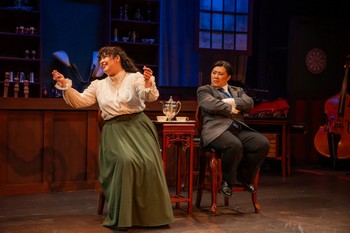
One by one, staff and patrons of a local English pub, The Pear and Rose (established 1821) arrive–some carrying an instrument like a violin or a flute, others handed a pipe or a hat as they enter, and all greeting each other with a nod or smile, clearly as friends. As the flute and piano begin to play, five local lasses begin a circle dance of varying steps and moves while others watch and approve before going about their business. And on this particular night, the purpose of these working-class, Cockney friends and pals is to tell their version from their perspective of Alan Jay Lerner (book and lyrics) and Frederick Loewe's (music) My Fair Lady, a much-loved, oft-produced musical that is usually presented more from the point of the somewhat snobby, supposedly sophisticated aristocrats featured in the story. The Pear Theatre is presenting an innovatively conceived, rambunctiously presented, and thoroughly engaging My Fair Lady as if it were local neighbors who decide to gather one night, bring from home or from behind the counter a few props and homemade costumes, and have a good ol' time putting on a show. And maybe like any neighborhood venture, performances on this night at the pub vary in quality and success; but where it most counts, some local stars emerge, and the overall experience ends up being fun and enlightening. Whether through staged or filmed versions of Shaw's 1913 play Pygmalion or of this 1956 Lerner and Loewe musical, how can anyone who has ever stepped into live theatre or watched the TNT classic movie channel not know the basic story of the sharp-tongued, Cockney flower girl of 1912 London who becomes a sophisticated princess due to a bet made between two old bachelor linguists? Out to prove to the skeptical but congenial India-dialect specialist, Colonel Pickering, that the King's English is the only factor separating the classes, Professor Henry Higgins eagerly takes on the task of teaching a young, uneducated but extremely street-smart Eliza Doolittle how to be a lady. He does so through repeated practicing of now famous and comically mocked phrases like, "The rain in Spain falls mainly on the plain." Along the way, this much-loved American musical tackles historical (and often reflects current) issues of class difference, treatment of women, and intellectual elitism. From her first squealed "aaargh" to her cries of "ohhh's" that sound somewhere between those of an alley cat and an abandoned baby on a doorstep, Corinna Laskin commands the stage as the flower girl Eliza Doolittle who transforms into a woman any society gathering of upper-class London would gladly welcome. With devilish exuberance and an eye to flirt a bit with the local boys who join her in a harmonizing quartet, her Eliza quickly wins us over in the opening "Wouldn't It Be Loverly?" with a voice that bounces, zings, and even coos as needed. The energy of her singing and dancing is contagious; her facial expressions are a kaleidoscope of shapes, moods, twists, and turns, and her next reaction is always a delightful, often hilarious, and sometimes endearing surprise. The grueling vocal exercises Eliza undergoes under the Professor's pushy prodding are punctuated with her gobbling chocolates or reading texts with her mouth full of marbles–often with the kind of comic antics that lead to one's recalling famous performances of Lucille Ball or Carol Burnett. And while there is an eventual emergence of a lady with newly learned sophisticated airs and language, her Eliza is not near as comfortable or natural singing or waltzing to "I Could Have Danced All Night" as she is she is suddenly returning to her Cockney origins at the Ascot Racecourse, going into a rage still in her ballgown against an ungrateful Professor in "Just You Wait (Reprise)," or recalling as a now-lady her inbred flower-girl spunk and spark as she pointedly sings to a flustered Higgins how she will be just fine, "Without You." Corinna Laskin's Eliza is reason enough to grab a ticket for The Pear's already-extended My Fair Lady. Along with her decision to shake up Lerner and Loewe's musical so that we are seeing it more from the angle of those who work for their meager livings versus those who live privileged lives mostly from inheritance or societal position, artistic director and also director of the production, Sara Cannon Dean, bends the role of gender by casting Professor Henry Higgins as a woman–a woman actor playing a male role. Melissa Mei Jones, a Chinese-American actor, breaks boundaries in several directions as the ego-centric, pushy, pouty, ill-mannered Higgins, who is full-steam-ahead at all times in order to win his bet. Melissa Mei Jones, like Corinna Laskin, displays scores of ways to employ her mouth, eyes, eyebrows, and overall profile to show a myriad of singular expressions. Her Higgins definitely has a more feminine demeanor overall in voice quality and volume than one normally sees in this role. She offers interesting, a bit head-scratching ways of how we are to interpret her Higgins, singing numbers like "I'm an Ordinary Man" (with repeated lines of "Let a woman in your life") or "I've Grown Accustomed to Her Face" (with lines like "She almost makes my day begin"). And while her Higgins is peppery and pompous, some of Higgins' lines are, unfortunately, partially lost (especially when Higgins is not facing one of the three sides of the stage's surrounding audience), singing with a voice that does always have the strength and volume required without mic amplification. Her Higgins also curiously seems to speak in an accent more Americanized than British, while others of the cast have more successfully taken full advantage of Kristin Hill's dialect coaching. In any production of My Fair Lady, the role of Eliza's gruff-voiced, street-honed, ale-loaded father, Alfred P. Doolittle, has a great chance to steal the show. Certainly, Ray D'Ambrosio does not disappoint one iota in carrying on that tradition. His conniving, convivial Doolittle tickles one's innards each time he seeks another farthing or two to head to the pub's bar for a round he can share with his buds–drinking pals Harry (Adam Strauss) and Jaime (Qian Zhang), who join him in a comical variety of dance merriment while singing in full Cockney, "With a Little Bit of Luck." After Doolittle has his life hilariously ruined because he comes into money and now must be respectable, the entire stage erupts into the night's biggest and best danced number, "Get Me to the Church on Time," (Lysander Abadia, choreographer) as legs kick high, couples circle and do-si-do, a trombonist twirls center stage, and a sudden somersaulting body leaps into the air. Volumes could be written about the words never spoken but with feelings/thoughts of disbelief and discomfort clearly expressed by Higgins' housekeeper, Mrs. Pearce (Sarah Thermond), especially as Higgins asks, "Why Can't a Woman Be More Like a Man?" Equally flabbergasted and quite often dismayed at Higgins is his own mother, played with deliciously aristocratic pompousness by Debra Lambert (who must rise from her role as the bar and show's pianist to transform quickly into the societal matron's role). There are times in this production when the idea of neighborhood friends putting on a show is a bit too realistic. Not all voices are up to the requirements of the well-known Lerner & Loewe songs when too much trying sometimes leads to over-singing or going a bit flat. Dancing also varies in effect but overall is quite cute if not always totally memorable. Five of the actors pick up instruments from time to time (violins, cello, flute, oboe, clarinet, bass, trombone), with Mark Wong's woodwinds being particularly noteworthy. Pianist and actor Debra Lambert also serves as music director. Positioned on one end of Pear's rather intimate rectangular space, Greet Jaspaert's re-creation of a local pub seems ready to open to the public at any time, given its authenticity and cozy invitingness. Costume designer Trish Files has dressed the cast as normal working folk of an English neighborhood while adding shawls, flowered hats, stove-pipe hats, long coats, and the like so that each can don enough of an outfit to play their assigned part. Particularly funny are the oversized flower props created by Patricia Billelo that become everything from dance partners to giant decorations for small hats. Like Eliza herself, The Pear Theatre's My Fair Lady is at times a bit rough around the edges, but at the heart it is a gratifying evening with some highlight performances to be thoroughly appreciated and enjoyed. My Fair Lady has been extended through March 14, 2026, at The Pear Theatre, 1110 La Avenida, Suite A, Mountain View CA. For tickets and information, please visit www.thepear.org. |