|
Regional Reviews: San Jose/Silicon Valley Come from Away
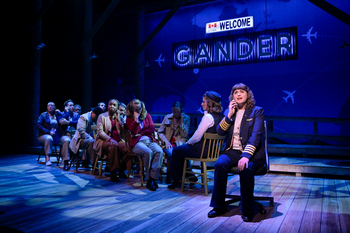
Surely, like everyone in the TheatreWorks audience of Mountain View's Performing Arts Center the night I attended, citizens of Gander, Newfoundland onstage remember where they were at 8:46 a.m. on September 11, 2001: "I'm sitting in the car" ... "I'm in the library" ... "I'm in the staff room." But, unlike the rest of us, the 9000 inhabitants of this remote island province of Canada also remember seeing thirty-eight planes land at their airport, eventually to unload into their tiny community 7000 dazed, scared, sleepy, hungry passengers and crew, all desperately in need of a hot shower and clean clothes–and news of what really happened. The repeated thump-thump of the awaiting citizens' feet blending to the frolicking beats of the opening number, "Welcome to the Rock," establishes a sense of tension, urgency, and anticipation even as members of the full company recall how normal that September morning began. Town members jerk their torsos, stomp one foot, and move with purpose as they recount in song and speech the moments leading up to the sight of the first planes. How this town and the even smaller villages around it responded over the next five days is the subject of one of the most riveting, inspiring, heart-warming, and, yes, funny musicals to come to the American stage in recent years. What makes the 100-minute, no-intermission musical especially compelling is that it is based on interviews Irene Sankoff and David Hein conducted at the tenth anniversary reunion with the citizens of Gander and with many of those who were forced to be there for those five harrowing but also life-affirming and life-changing days–with most of the real-life names and their related stories retained in the pulsating, punchy script. As in most of the musical's fifteen-plus numbers, "Welcome to the Rock" features the entire company, with all members taking theirs turns to spotlight the true-life stories of passengers, crew members, and townspeople. Each of the one dozen outstanding cast members plays one key and many other multiple roles–each flawlessly changing professions, nationalities, accents, and personalities over and again. The local Baptist church moves out its pews; a school prepares to fit 700 people where 400 students usually reside; the Lions Club looks for all the extra toilet paper it can find, while the local market, Shoppers, offers up for free anything on its shelves, from aspirin, mouthwash, deodorant, diapers, and tampons–all related by madly rushing Ganders rushing sacks of supplies and trays of food in the heart-pounding, yet also hilarious number "Blankets and Bedding." With an immediate switch of roles and the use of wooden chairs now crammed together in the shape of a crowded plane, the cast quickly relates what it was like to be on those planes in "28 Hours/Wherever We Are," receiving little-to-no news and only rumors of why they are there and why they cannot take off. The cleverly directed movements–one example of Alex Perez's multi-faceted and fascinating choreography–become a mostly seated, but totally vigorous dance of mixed boredom, discomfort, impatience, and fear. "What's happening?" is the continual refrain that frightfully pops up between sung and spoken narratives of the trapped passengers. When the passengers from countries all over the world finally begin to disembark in the middle of the night into what they describe as lines of yellow school buses, they sing with trepidation of "Darkness and Trees." The haunting harmonies become even more so as those who cannot speak English see a host of folk in military uniform waiting for them. The smiling greetings of the Salvation Army volunteers along with the big hearts and generosity of all the Gander people begin to win over the exhausted passengers. Stories in song and dialogue emerge from both visitors and hosts of how their lives have become forever intertwined and thus changed. Wave after wave of human-interest stories pour forth from those forced to visit and those stepping up to welcome. Unlikely romances form, like that between Diane, a Texan divorcee (vibrantly voiced Alison Ewing), and Nick, an Englishman (a compelling and often comical performance by Michael Gene Sullivan), try to "Stop the World" long enough to fall in love amidst the beautiful scenery in a world now full of terror. On the other hand, two gays both named Kevin (Nick Nakashima and Adam Qutaishat) find that the strain of what has happened opens relationship wounds that probably had long been festering. Throughout the many singular stories, a pervasive intensity and edge electrify the air, with everyone trying to find out what has really happened and to whom. Our eyes widen in awe before filling with tears as we watch these people respond to each other with heart, hope, and help in the midst of a terrifying tragedy. One number simply titled "Prayer" is particularly moving, as weary, worried visitors and natives gather in a church, collecting in groups with those of their similar Christian, Muslim, Jewish, and Hindu faiths to find solace in their respective meditations. As their solicitations rise to the heavens, Nick Nakashima, as Kevin T., serenely and with clear, heart-touching vocals, sings the essence of all the faiths represented: "Make me a channel of your peace; where there's despair in life, let me bring hope." Hannah (Dawn L. Troupe) finds particular solace, friendship, and comfort in one local, a woman named Beulah (Heather Orth, whose portrayed heart, warmth, and humor are near larger than life). After they discover their sons are both firefighters and like to tell corny jokes, they bond for what will likely be life. As Hannah tries to phone again and again in vain her New York-based, rescue squad son, Dawn L. Troupe's sustained, sung sequences of "I Am Here" throb to reflect Hannah's, a nation's, and a world's anxiety and worry. But amidst scenes such as the above, we in the audience surprise ourselves as we continually erupt in out-loud laughter. Universal aspects of human nature as well as cultural reactions to foreign situations are often indeed funny. A chorus line of scrubs-wearing cardologists who were on their way to a conference volunteer to become plunger-waving toilet cleaners. The persistent and stubborn Bonnie (a delightful, bursting in spirit-and-spunk Monique Hafen Adams) rejects all FAA warnings and rescues cats, dogs, and a pregnant chimpanzee from airplane holds. And, as a packed pub erupts into jigs and rum-inflamed song, a cod-kissing ceremony to initiate new Newfoundlanders is a welcomed relief for all. Each actor has numerous opportunities to capture a moment of stellar spotlight. Along with those already mentioned is Adam Qutaishat as a Muslim passenger who faces the fearful and even hateful reactions of suspicious fellow travelers only to persist to find a way to be of great help. Bob (Anthone D. Jackson) is highly fearful as a Black man among a sea of white Newfoundlanders but soon finds them color-blind and in the end, helps raise over $1M in scholarship gifts for all those who helped the likes of him. Blowing a whistle to attain quiet among chaos, Colin Thomson is Claude, a mayor so full of joy and love that any town would be lucky to have him. And capturing all the above and more for a watchful world, Kaylee Ann is excellent as the enthusiastic, rookie reporter, Janice, providing the only TV coverage on the scene for the full five days. Perhaps the performance most memorable among many superb ones comes from Melissa WolfKlain as Beverley, a pioneering, female pilot for American Airlines. She is compellingly genuine and down-to-earth, yet also a voice of reason, compassion, and calm. When she sings, "Me and the Sky," Melissa WolfKlain's soprano electrifies the atmosphere and sends shivers of admiration down our spines as she describes all the "suddenly" times her life has taken amazing shifts right up to this present, most momentous one. The grandeur and beauty of the story is enhanced by the simple but majestic scenic design of Wilson Chin with its giant, northern pine posts, its planked floor and ramps, and its use of mostly wood-backed chairs of various sorts that are in constant motion as scenes shift. Pamila Z. Gray's lighting brings to life the vast skies of the far north and the beauty and mystery of both its days and nights. B. Modern has the mammoth task of costuming a cast who must switch on the spot from flanneled and quirky locals to foreigners from many nations, religions, and professions; she excels in doing so. Christina Walton's fiddle and Tim Roberts' guitar or bouzouki often find their way on stage to blend musically and powerfully with the electric/acoustic bass of Richard Duke, the percussion of Artie Storch, and the keyboard of conductor William Liberatore. Together, their music is the lifeblood providing a continuous stream of energy that propels the musical's story of anxiety and fear, heart and hope forward. Come from Away captures in so many ways the feelings, memories, and lingering effects we all still feel of those world-shattering minutes of 9/11 and the few days following. At the same time, it is an anthem to the human spirit and the humanity that exists among all peoples of the world and yet one more example in a long line of TheatreWorks Silicon Valley productions over its fifty-five years where the company's core value of empathy for others different from ourselves shines forth. Come from Away runs through May 10, 2026, at TheatreWorks Silicon Valley, Mountain View Center for Performing Arts, 500 Castro Street, Mountain View CA. For tickets and information, please visit www.theatreworks.org or call 877-662-8978. |