|
Regional Reviews: San Jose/Silicon Valley The Cherry Orchard Also see Eddie's review of Anon(ymous)
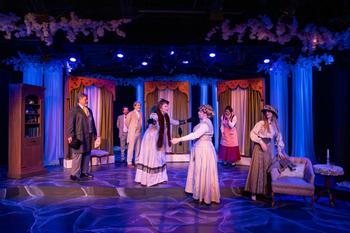
The play opens in the middle of the night when Liubov Ranevskaya arrives in her usual high-society finery to the once-palatial, now an echo of its past, home of her childhood. She comes back to the Russian provinces after previously escaping five years ago to Paris following the tragic drowning of her young son. Liubov comes back to a property in debt after having lost her fortune while abroad, and yet her refusal to quit spending money or to offering loans or hand-outs to anyone who asks demonstrates her own inability to face the reality around her. Judith Miller has a la-di-da air of an aristocrat who is now a near pauper but cannot begin to understand the truth–a Russian Scarlett O'Hara who laughs as she tosses her head, refusing to listen to anyone speaking of the obvious reality all around her. Her childlike delight in being home, her unrelenting love for a cherry orchard that no longer produces sellable crops, and her adamant rejection of any solution that does not maintain a past that is no longer possible are all expressed by Judith Miller with a stubbornness and naiveté that insists on throwing a major party without the money to pay for it and with no acknowledgment that its guests are no longer those of title, but are local clerks and merchants and even former peasants. Equally unwilling to face reality with anything but insufficient ideas of how to get money that is never coming is her brother, Gaev, portrayed by Tom Gough in a memorable, often humorous performance. His Gaev is not one for few words (ever) and is stuck in a state longing for a past that is no more. He waxes on and on in a tearful tribute to a hundred-year-old bookshelf while constantly making the bizarre comment "yellow ball to the side pocket" when he is not sure what else to say–a reference to his love of billiards and a life of former leisure that leaves him powerless to find a solution to the family's current financial woes. Gough is particularly hilarious as a drunk whose glazed eyes narrow into slits as Gaev wobbles and smirks while scorning anyone who tries to awaken him or Liubov to the fact that their family estate is soon to be no more. He raises his nose and rolls his eyes whenever local and successful merchant Lopakhin enters the room, making comments like "It smells of cheap scent in here." Brandon Silberstein time and again is the evening's tour de force as the excitable, arm-waving Lopakhin, a successful and region's richest businessman who unabashedly brags about his money and success, often speaking as if to a crowd of hundreds rather than a parlor gathering of a few. He offers a rescue plan to Liubov and Gaev with much over-blown pomp and confidence–to chop down the non-productive cherry orchard, sub-divide the property, and sell lots for vacation homes. Often his pleas for them to save themselves with his offer are totally ignored, his comments left hanging in the air as Gaev is like frozen like a statue waiting for reactions that never come. But, as his patience thins, his frustration builds, with Brandon Silberstein's Gaev also erupting into furious tirades about "you people," screaming on more than one occasion, "Why don't [didn't] you listen to me?" The one thing that causes Lopakhin to have a loss for words and to transform from big-talk bravado to shoulder-shrugging sheepishness is when either Liubov or her elder daughter, Varya, bring up a possible marriage that has been rumored as about to occur for over two years. Michele Skinner is the stoic daughter who is sometimes solid as a rock as she attempts to keep the family estate afloat financially and at other times seemingly about to collapse into uncontrolled sadness. Varya often mutters, "If only God would help," while also voicing in desperation, "If I only had a little money, I'd get out of here ... maybe to a convent." Bri Hunter is Anya, the seventeen-year-old daughter of Liubov who exudes bubbling excitement about life and its future possibilities–a great contrast to both her older sister and the reality of the family's situation. In many ways, she represents a hope the others cannot yet fathom, especially as she embraces the rhetoric and ideas of the visiting Trofimov, an impassioned, left-leaning Moscow graduate student with whom she also finds a romantic attraction. Ryan Chu is like an unrelenting bull-dog as Trofimov, a soap-box-spouting reformist who rails against intellectuals who "seek nothing, do nothing." Trofimov is also against people everywhere who are "brutish, vulgar and profoundly unhappy." Even as he says with a raised voice, "We must get back to work," he clearly cannot wait to go back to Moscow and continue his role as a perennial graduate student. It is as if Chekhov is anticipating those who will be on Russian streets a decade later, calling for revolution. Amidst this fast-decaying situation where a final auction of the generation-old family estate is clearly inevitable, are others who add to the farcical yet pity-producing environment. Joe Walters is neighboring landowner, Pishchik, also in debt and constantly seeking varying amounts of rubles from a quick-to-sympathize Liubov. Like his neighbors, the aging Pishchik is in full-state denial and quick to bellow, "I don't believe it" before drifting off in his explanation of why and falling asleep on his feet mid-sentence (another Chekhov example of the ridiculousness and the tragedy of the waning aristocracy of the times). Vinh Ton is a guitar-strumming Yepikhodov and the estate's bumbling clerk nicknamed "Catastrophe Corner," who draws chuckles as he trips, stumbles, and falls into disaster after disaster–a man who readily admits with a grin, "Every day there's something, some misfortune [for me]." When housemaid Dunyasha (Alison Starr), who too often forgets she is not the one who should be waited on by others, walks into the room, Yepikhodov becomes all googly-eyed while Dunyasha's own love-struck eyes and full grins are saved for Liubov's manservant, Yasha. Arriving from Paris with his mistress, Yasha (Iyanu Olukotun) reeks in rudeness and inconsideration as he is quick to forget his station and grab a passing glass (or two) of champagne. Also arriving is Anya's eccentric governess, Charlotta (Maria Frangos), hugging her dog (Pippa) and fluttering about like a mixture of a future age's flower child and a street-performing magician with questionable skills. Perhaps the strangest but definitely the most lovable of this menagerie of characters roaming about the household is Firs, Gaev's eighty-seven-year-old, bent-over, foot-shuffling butler. Jim Johnson's Firs is clearly only a breath away from death but is always sure to see that his master has his overcoat before going out or that his mistress gets her cup of coffee–that is if he doesn't fall asleep first on his feet. While Gary Landis deserves much credit for orchestrating seamless ins, outs, and abouts of this thirteen-member cast, providing moments for all to spotlight their bizarre personalities, the well-paced first act is followed by a second act that bogs down a bit, especially during the opening party scenes and in the elongated, final departure from the sold estate. Also, not all minor characters mine their parts to the maximum possible when I compare this production to others I have seen. Polite laughs come, but not the guffaws that characters like Charlotta, Pishchik, or Yepikhodov have the potential to elicit. What works quite well on the small stage is Seafus Chatmon's minimal but quite beautiful scenic design. Through windows that move to become room dividers, we see an orchard of cherry trees in full bloom with graceful trunks of white cloth. Carsten Koester's lighting enhances the changing sun's rays on the trees and allows the magic of twinkling stars to create a dreamy atmosphere of fallen blossoms that are like snow on the ground. Special kudos to Lisa Claybaugh for her array of costumes that reflect both an aristocracy that is hanging on to the looks of the rich when they are not and a growing middle class who dress in the modern styles of the early 20th century. Whether one has seen a number of past productions on school or professional stages or if one is a Chekhov virgin, The Cherry Orchard is always worth an evening's visit for new gems to mine in an excellent translation like that of Tom Stoppard, including this worthy production by Los Altos Stage Company. The Cherry Orchard runs through May 10, 2026, at Los Altos Stage Company, 97 Hillview Avenue, Los Altos CA. For tickets and information, please visit losaltosstage.org or the box office Thursday and Friday, 3 6 p.m., or call 650-941-0551. |