|
Regional Reviews: San Jose/Silicon Valley The Play That Goes Wrong Also see Eddie's review of Frozen
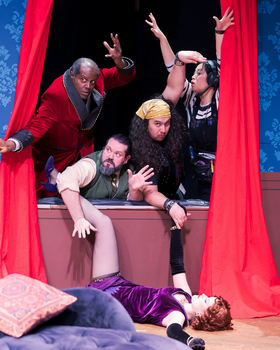
As a play within a play, The Play That Goes Wrong is a grand farce penned by Henry Lewis, Jonathan Sayer, and Henry Shields about a local theatre company that, for all its outlandish folly, is a love letter to all such troupes who pour hearts and souls into bringing live theatre to their communities. Even when everything possible goes absolutely wrong, it all comes out just right at the Hillbarn. After a number of short-handed productions due to financial shortfalls–productions such as Two Sisters (making for a much shorter evening of Chekhov), The Lion and the Wardrobe (forget the Witch), and Cat (a solo musical?)–the Cornley Drama Society has recruited enough members to stage The Murder at Haversham Manor, a 1920s whodunit, murder mystery. With a cast that includes actors who have played such roles as Angry Men 6-11 in The Twelve Angry Men, the Lame Horse in Black Beauty, and Bottom in Midsummer Night's Stamina, which featured a cast of fourteen pedaling exercise bikers for two hours, how can this staging fail? The answer: Easy. Hardly do the Cornley Players begin their masterpiece before a fireplace mantel suddenly falls off the wall at the same time a door will not open, needed props go missing, flames burst from a coal bucket, and water pours out of the wall's intercom. And that is just in the first couple of minutes as the dead body of the manor's owner, Charles Haversham, is discovered–a corpse who moves himself to get in a better stage position while grinning sheepishly at the audience, whose body is too heavy to be hauled away on a flimsy stretcher (leaving two wide-eyed men carrying only two poles out of the room with no body), and who (left behind) must then slither his murdered body across the floor like an inchworm for the required exit as the cast watches, stunned, while trying to carry on with their lines. As an inspector arrives and begins the required questioning of all present (including the dead man's fiancée, his brother, her brother, her secret lover, and of course, the butler), it becomes increasingly difficult to follow or even care to follow the unraveling of the mystery's clues. The entire production not only unravels before us but becomes an explosion of missed entrances, bungled or forgotten lines, collapsing stage segments, and actors tripping, colliding, or being knocked out by opening doors. And do not even think about stepping into that elevator, with woe being to anyone whose script says "go up to the library." Believe me, what happens to anyone caught on that second-floor ledge suspended by only one post is not to be believed. How this Hillbarn cast of eight night after night survives the two-hour constant mayhem portraying these misfit players without bruises, a broken nose, or a twisted ankle is nothing short of a miracle. Major kudos to both director Steve Muterspaugh and fight captain Paul Henry–and to whatever California insurance company dared to cover this particular production. Forget the plot and the story. It matters not. Who will ever remember who is in fact the murderer of what turns out to be two victims? What audience members will recall are scenes of bodies getting hauled, pulled, or pushed around like they were stuffed dummies; a knocked-out diva being pulled like a sack of flour through a window with arms flapping and crashing on the nearby wall; and a wide-eyed man hanging precariously on a collapsing floorboard while holding onto a desk, chair, and plant that are about to slide with him to the floor below. Or what about the image of a passed-out body being stuffed into a grandfather clock and then the grandfather clock is gently lifted onto a chaise lounge and treated by the rest of the cast as the fainted persona of the person stuffed inside? With scenes like these, is it any wonder audience members may ask, "What murder?" Each cast member plays a Cornley actor who absolutely cannot act, but in doing so, each Hillbarn cast member proves to be worthy of an Oscar. As Dennis, the Cornley actor playing Perkins the butler, Ted Zoldan walks about with bent arms, swinging them furiously in a clownish air of pomp. Perkins has words written on his arm for the lines he cannot remember, while he inserts other words like a script note of "exit." When he repeats a line over and again, he sends other cast members into a no-exit loop of their own lines that leads to a near fisticuffs of full-cast frustration–and total fun for all of us. Michael Chaplin as Cornley actor Chris tries his best to be the serious, inquisitive Inspector Carter but finds himself having to repeatedly improvise in ways that try his patience, like taking interview notes using keys as a pen and a cut-glass vase as a notebook–only two of many misplaced or missing props whose last-second substitution must be made. His Chris is the troupe's one actor who does his best to maintain decorum amidst the chaos unfolding around him and is visibly pained/embarrassed when he must interact with a "corpse" or when other actors break character, which is often. When the Inspector finally collapses emotionally and joins in the full fray of disasters, Michael Chaplin has one of the night's best scenes. Lucy Swinson is the dead Charles Haversham's fiancée, Florence Colleymoore, played by Sandra in the Cornley cast, who deliciously overacts, with each line ending in a spread-arm, frozen smile pose begging for applause. Sandra speaks with a voice like an early silent film star's first, squeaky attempt in a talkie and flitters about almost ignoring everything except her chance to be in the spotlight–that is, until she is knocked out by an opening door. After being hauled through the set's window, Florence is replaced by the fictitious company's stage manager, Annie, who up to now has had to piece together falling set pieces even as the play continues. Suddenly thrust center stage in a half-on wig and the gown of Florence barely hanging on, Vivienne Truong's portrayal of Annie becomes funnier and funnier as the stagehand warms up to being in the spotlight. Annie begins to like reading the script lines handed to her so much that she is willing to fight (literally) to keep the part when the original Florence recovers from being unconscious. Their subsequent body-flinging, head-bumping scenes rival anything the WOW (Women of Wrestling) league has ever considered doing. Florence's secret lover and dead Charles' brother, Cecil, is played unabashedly gay by Max, who cannot muster enough straight courage to do anything but pretend to kiss and hug the overeager Florence at arm's length. In his interactions with others, Max (Andrew Cope) is a combo of over-hyped cheerleader and a speed-addicted charades player; he is also quick to send to an adoring audience finger-flashing waves, big-toothed smiles, and quick curtseys. Max later appears as Arthur, the estate's gardener who just happens to have all the same gay moves and antics as Cecil. The never-dead-for-long-corpse of Charles Haversham is played in the Cornley cast by an ever-appearing-at-the-wrong-time, Jonathan, in turn providing many laugh-out-loud moments by Hillbarn's Fred Pitts. Paul Henry, whose Robert is the fictitious cast's Thomas Colleymoore, brother to glitzy and flighty Florence, has the challenge of hanging on for dear life more than once, since it seems that wherever he steps, the floor is not very stable. His hilarity peaks time and again because Robert is the one Cornley actor who truly believes he is professional and thus does all he can to ignore the impossible situations he finds himself in. Rounding out both casts is River Bermudez Sanders, who plays the light and sound technician, Trevor, who resides in his booth above the stage and clearly has much disdain and disregard for the incompetence of those below him. He is more interested in listening to his favorite band, Duran Duran, and is not at all upset when their music suddenly blasts for all to hear. When he suddenly finds himself reluctantly in the play, Sanders is a hoot as what one might name, "Trevor the Terrible." Kevin Davies and Eric Olson as scenic designers and Jenna Forder as properties designer deserve a standing ovation for creating a mansion that collapses piece by piece before our eyes in ways that astound–and to think it will all have to be reassembled before the next audience arrives. Pamila Gray's sudden lighting shifts and Jeff Mockus' effects of sounds galore heighten the humor even more while Nolan Miranda's costumes are a collection of comedic wraps–and unwraps–that satirize the period, the clumsy company, and all the quirky characters. Just as our cheeks numb from so much grinning and laughing, our attention may at times begin to wane with a storyline that means little-to-nothing in the end and with so many crazy antics and scenic disasters that we almost begin not to notice the next one. However, for anyone who has a high tolerance for physical slapstick taken to the extreme or for anyone who has not had a good laugh lately, Hillbarn's The Play That Goes Wrong is a sure-fire bet for an evening of fun that will be long remembered. The Play That Goes Wrongruns through May 29, 2026, at Hillbarn Theatre & Conservatory, 1285 East Hillsdale Blvd., Foster City CA. For tickets and information, please visit www.hillbarntheatre.org or call 650-349-6411. |