|
Regional Reviews: San Jose/Silicon Valley God of Carnage Also see Eddie's review of The Cottage
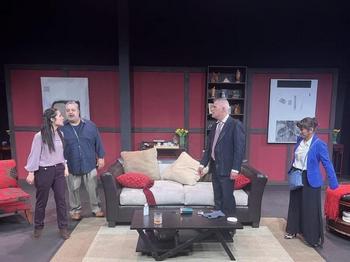
... don't tell truth" is an understatement to what we are about to witness as two sets of "helicopter" parents become outright "fighter jets" in battle in Yasmina Reza's dark, and hilarious, comedy, God of Carnage. Zooming in to try to settle matters after a playground altercation between their eleven-year-old sons (rather than leaving it to the kids themselves), what starts as a overly polite peace treaty negotiation turns to out-right war with constant shifts of who is the real enemy. The Pear is ending its 24th season with this sharply pointed jab at educated, middle-class people who want to appear civil and civilized but who have a primal, savage instinct lurking just under the surface that soon overtakes social etiquette and rational thought, the God of Carnage in us all. The Raleighs and the Novaks have never met, even though their sons, Benjamin and Henry, are in the same class. Alan and Annette Raleigh are dropping by Veronica and Michael Novak's apartment this afternoon in order to diplomatically discuss the incident of Benjamin hitting Henry with a stick on the playground. In between admiring the beautiful tulips and art work, the Raleighs suggest that a write-up by the Novaks of the fall-out is a bit harsh when Veronica and Michael say that Benjamin was "armed with a stick," to which the Novaks quickly agree to substitute with "furnished with a stick." Even though Henry has lost two teeth, the couples agree that "nothing is gained being stuck in an emotional cul de sac" as they proceed to discuss how the boys should resolve the situation and if and how they as parents should be involved. Treaty negotiations between long-warring nations have probably been easier than what ensues among these parents who in actuality have no intention of just allowing the two boys to resolve their own dispute. There are many weapons as the afternoon's skirmishes intensify. Verbal accusations, stereotypes, and insults are pointed and harmful enough, but they pale in comparison to flying tulips, a flung purse full of personals, a hair dryer turned on high, or unexpected vomit spurting over a prized art book. And then there is Nibbles the hamster who becomes a central figure of contention and an impetus for screaming demands of confession and justice. As the wars continue, who is allied with whom continually shifts. Battlegrounds pit one couple against the other, one sex against the other, wives versus husbands, or even three against one. Battles flair seemingly at the drop of a word, the scowl of a look, or the accidental bump of an arm. This minute's friend is the next minute's sworn and forever enemy. In between skirmishes, there are sudden conversations marked by philosophizing on world events, reminiscing about childhoods, or talking about art and business. This initial intermingling of civility with the war at hand eventually leads to nonstop missiles of insults and insinuations accompanied by near-uncontrolled bouts of cynicism-laced laughter, yelling matches in a combined chorus louder than a street full of angry protestors, or tears flowing in size and might worthy of a crocodile. And while these four fight, we do our parts by egging them on with our laughter. Wearing designer suit and tie and an attitude of "let's get through this as fast as possible," New York lawyer Alan (Scott Solomon) flouts his high-powered presence by barking into a cell phone that continually interrupts the already tense gathering. With four-letter words peppering his command-like advise to a big-pharma client as he paces like a storm trooper around the apartment, Alan is watched by the other three, who are stunned, then embarrassed, and finally totally enraged. But Alan pays no attention to their reactions, ending each call by jumping right back into the middle of the fray as if nothing unusual had occurred. Openly scowling about these ringing interruptions but at first remaining silent is Alan's wife, Annette. Patty Reinhart allows the sophisticated and stylish Annette's initially quiet character to emerge like the peeling of an onion, with each layer becoming more and more expressive, assertive, and finally downright aggressive–fueled along the way by her new best friend, a bottle of rum. The weaving, stumbling, and slurring that are a result of another slug do little to subdue the lion that has emerged from the lamb that once was. That his son, Henry, has a gang and that he did not allow Benjamin to join it (probably the main reason for the stick incident) actually does not bother Michael that much. In fact, he finds something that he and Alan can have a few, good-ol'-boy minutes reveling in their stories of "beating the shit" out of other kids when growing up. In the beginning of the afternoon's tête-á-tête, Richard Perez's Michael is all smiles as he does all he can to extend olive branches (trying to ignore or make light of his wife's more fiery statements of fault and needed retribution). But adding enough of his own rum, his Michael transforms from Jekyll into Hyde, declaring, "Children consume our live and then destroy them." When his wife at one point asks, "Why are you choosing to show yourself in this horrible light," Michael defiantly, triumphantly responds, "Because I feel like it." His sense of newly found freedom from societal (and spousal) expectations is written all over Michael's smug expression and his strutting around like a peacock with its tail feathers fully extended. From the get-go, Veronica is quick to quibble over words used by the other three that she believes downplay the seriousness of her son's injuries–"quibble" being a euphemism for Jaime Melendez's many ways of expressing Veronica's bursts of irritation and ire. With gritted teeth and a locked jaw of steel, eyes that almost pop out of their sockets in locked stares, and hands whose fingers point like pistols at the accused, her Veronica is on the constant prowl for her next victim–which increasingly becomes her husband. While she begins with sympathetic smiles and small talk about recipes and flowers, Veronica becomes a powerhouse of convictions that erupt in ways that seem to surprise even her. When this seemingly nice, do-good-for-the-world person finally blurts in a screaming tenor, "I don't have a sense of humor, and I don't expect to get one," those in the nearby audience feel compelled to lean back so not to catch her eye of rage and revenge. Kimberly Ridgeway directs this melee of well-mannered parents suddenly gone awry with ample employment of pauses when the four parents look at each other as if stunned by their own outrageous behaviors and/or as if in contemplation of what punch to pull next. Even with all the barrages of bicker and banter as well as the wrangles that become more and more physical in nature, staying fully engaged with and caring about the escalating and childish tantrums of these adults is not always easy. There is not much arc of character development beyond their just proving the play's title premise that sometimes humans are not much better than vicious animals. While the actors and director do elicit some big laughs along the way, The Pear's God of Carnage in the end is mildly entertaining and only partially satisfying. God of Carnage runs through June 28, 2026, at The Pear Theatre, 1110 La Avenida, Suite A, Mountain View CA. For tickets and information, please visit https://www.thepear.org. |