|
Regional Reviews: Seattle Jesus Christ Superstar
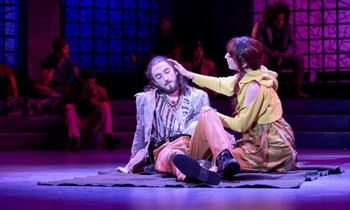
The sung-through rock opera tells the story of the Passion of Christ, from his triumphal entry into Jerusalem to his crucifixion a week later. Much of the story is represented from the perspective of Judas Iscariot, the apostle who infamously betrayed Christ to the Pharisees in the garden of Gethsemane. Judas questions the direction, methods, and influence of Christ's teachings, and his doubts distance him from Christ and the other apostles. Judas confronts Jesus about his relationship with Mary Magdalene, insisting that her past as a sex worker "doesn't fit in well with what you teach and say." Mary and Jesus' followers attempt to reassure Christ ("Everything's Alright"). Judas takes his concerns that Jesus has started "to matter more than the things [he says]" to High Priest Caiaphas and his associates. The Pharisees consider Jesus a threat to their power and decide the only option is for Jesus to die. The Pharisees give Judas thirty pieces of silver in exchange for his betrayal of Christ. After Jesus and his followers share a final meal, Jesus says that he knows Judas will betray him and that Peter will deny him three times after his arrest. As Jesus prays for comfort and understanding in the face of his imminent death and his role in God's plan, Judas leads the soldiers to Christ, kissing him as his act of betrayal. Jesus is then taken to Roman governor Pontius Pilate, who in turn sends him to Herod Agrippa, king of Judea. When Jesus refuses to perform miracles for Herod's entertainment, he angrily sends Jesus back to Pilate. The Pharisees insist that Pilate execute Jesus. Despite his reluctance and resistance to their demands, Pilate has Jesus flogged. Seeing that Jesus is resigned to his fate and that his own position of power is in jeopardy if he doesn't acquiesce to the Pharisees' demands, Pilate washes his hands of the situation and has Jesus crucified. Jesus then dies on a cross as his followers look on. While the story of the Passion has been retold many times on stage (both Jesus Christ Superstar and Godspell debuted in 1971 and ran simultaneously in New York and London), on screen and on television, Jesus Christ Superstar is set apart by its treatment of the concept of doubt. Each character experiences and reacts to some form of doubt throughout the show, and it is this doubt that propels the narrative. Judas has doubts about Jesus' growing influence. Simon has doubts that Jesus' teachings will result in a world free from Rome's influence. Peter has doubts about his personal safety due to his association with Jesus. Pilate has doubts about their political future. Mary has doubts about her feelings and love for Jesus as a person, and Jesus expresses doubts and fears in his prayer in the garden. Despite the wide range of locations depicted in the show, the sets by Parmida Ziaei are simple, industrial, and minimal. Walls form tall Romanesque arches, framing a monochromatic screen that suggests fractured stained glass. Some of the action, most notably the procession into Jerusalem in Act I ("Hosanna"), takes place in the theater itself, expanding the action and essentially including the audience. Costume designer Danielle Nieves has created a world outside of time. Jesus and the apostles' costumes, like the sets, skew toward industrial grunge, with an almost subversive androgyny to them. The Pharisees are appointed in religious garb reminiscent of outfits in "Star Trek Deep Space Nine," and Pilate's beautiful costume could be imagined as worn by Effie Trinket in Hunger Games. As eclectic as the costumes are, they combine beautifully to create a fresh setting to a well-known tale. However, When Jesus overturns the tables in fury at the temple, the money changers, vendors, and prostitutes are all dressed in semi-formal 1950ish garb, complete with hats, furs and suspenders. There is no flesh and no gambling in the Temple Square, just some jewelry sellers and people with bird cages. The effect is disorienting, as the "den of thieves" looks more like a busy but pleasant craft fair, and the era-specific attire seem out of place. The androgynous nature of the costumes is used to great effect, as both the roles of Annas and Pilate, historically male characters, are played by women. Cassi Q Kohl is a powerhouse in the minor role of Annas, assistant to Caiaphas, the High Priest. She has a strength and terrifying fury that can stand up to and complement the deep bass of her powerful colleague. Likewise, Mari Nelson is a force of nature as Pontius Pilate. Ms. Nelson owns the stage when she appears, overshadowing even Jesus as she orders his flogging. She brings complexity and depth to a character who is traditionally seen as a one-dimensional tyrant. Her voice fills the theater as she makes Pilate if not likable, at least fully human. Mary Magdalene shows her heart in all her actions and is beautifully played by Molly Sides. Ms. Sides' voice is lustrously clear and pure. Her version of "I Don't Know How to Love Him" blends the themes of love, fear, confusion, doubt, resignation, and resolve, and she makes the song uniquely her own. Hers is at once a prayer for clarity and a confession of her love. While the women in the show are all excellent and bring unique elements, the male characters are more of a mixed bag. Alexander Kilian as Jesus in the second act is brilliant. He brings all the power, drama, strength, and pathos to the showstopping "Gethsemane." He heartbreakingly portrays Jesus' pain and humiliation before Pilate and Herod and shows an understated realism in his suffering. In the first act, however, he seems a bit lost in the crowd of his followers, lacking the necessary initial charisma and stage presence to convince the audience that he is anything other than a kind, good-looking guy with a vision for a better world. Thankfully, he redeems himself in Act II. Much of the reason the role of Jesus may be initially overlooked is due to the strong stage presence of Cameron Lavi-Jones in the role of Judas. The program notes that this is Mr. Lavi-Jones' theatrical debut, and it shows. Mr. Lavi-Jones naturally commands the stage, but his Judas is lacking in depth and nuance. His Judas is most notable for his one-dimensional anger. He is confrontational, loud, and clenches his jaw so tightly one worries he will break his teeth. Even when singing the Act II hit "Superstar", Judas is simply angry. In what is at its core the question "was it all worth it?," Mr. Lavi-Jones does not invite a response or conversation but rather clenches and fumes. Make no mistake, Cameron Lavi-Jones has great authority on stage and will almost certainly benefit from more theatrical experience. Jesus Christ Superstar is a thought-provoking show due not only to its subject matter but equally to the ways in which the artistic team reinterprets the well-known story. Despite its uneven execution, this is a story worth being retold and certainly worth seeing. Jesus Christ Superstar runs through May 17, 2026, at 5th Avenue Theatre, 1308 5th Ave. Seattle WA. For tickets and information, please 5thavenue.org or call 206-625-1900. |