|
Regional Reviews: Seattle Harry Potter and the Cursed Child
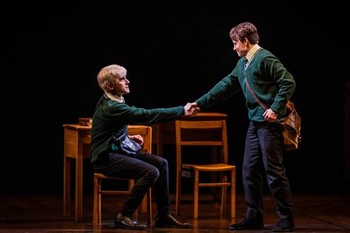
Nineteen years after the infamous battle that defeated Voldemort, the personification of evil, Harry and Ginny (Weasely) Potter's sons, James and Albus, leave platform 9¾ to board the storied train for what is Albus's first year at the wizarding school. Albus is hesitant and expresses to his father that he is nervous and afraid he will not live up to Harry's legacy and will be sorted into the Slytherin house of Hogwarts instead of Gryffindor, the house to which the rest of his family belonged. Harry reassures Albus that he was named after both the old headmaster Albus Dumbledore and Slytherin head teacher Severus Snape, both very brave and honorable men. On the train, Albus meets Scorpius Malfoy, son of Harry's childhood nemesis Draco Malfoy. Scorpius is also nervous, and aware of his father's past reputation and family's association with Voldemort. Realizing they are both outsiders, Albus and Scorpius become best friends. Harry, now working for the Ministry of Magic, is summoned to visit Amos Diggory, father of the late Cedric Diggory, who was killed by Voldemort in the Triwizard Tournament. Amos never got over the loss of his son and asks Harry to use a Time-Turner to go back in time to save Cedric. Harry refuses. When Albus and Scorpius hear of this, Albus decides to go back in time himself, to heroically fix the "mistake" his father made years ago. He and Scorpius, helped by Delphi Diggory, Amos's niece, steal a Time-Turner prototype and embark on an adventure that crosses different timelines, challenges the boys' concepts of history, loyalty and friendship, and ultimately unites the rival wizarding families. The story itself, with its twists, plots and subplots, stays true to the spirit of the original Potterverse books. While this worked spectacularly well in the books, such complexity does not translate as well to the stage. The story becomes convoluted and can't seem to decide exactly what sort of narrative it is telling. Is it a "buddy" play about two characters who find friendship despite their parents' disapproval? Is it a time-travel story about the unforeseen dangers of changing the past? Is it a family drama focusing on the trials of growing up and challenges of parenthood? Or is it perhaps simply a love letter to a fictional world that has influenced at least two generations? The answer to all these questions is: yes. However, despite its almost three-hour length, Harry Potter and the Cursed Child never quite commits to any of these categories. One can easily see thematic influences from other works: the not-subtle attraction between Scorpius and Albus can be seen in Romeo and Juliet; Ray Bradbury's short story "A Sound of Thunder" and the 1995 Bress and Gruber film Butterfly Effect both explore the potential dangers of time travel; Ron Howard's 1989 film Parenthood hilariously yet poignantly explores the myriads of issues involved in being a parent. It is when Harry Potter and the Cursed Child pays homage to its own canon that the play resonates and is its most authentic. Through the course of the show, we are reunited with almost all of the most loved (and hated) personalities in the Harry Potter world. The seeming endless cavalcade of characters seems to drive the time-travel element of the show at least as much as the relatively thin plot. Delores Umbridge, Severus Snape, Cedric Diggory, and even "He Who Must Not Be Named" all make cameos through the time distortion on stage. Special mention must be made of the actual depiction of the time travel itself. Set designer Christine Jones and lighting designer Neil Austin work in perfect creative union to make the audience feel off balance as the stage and sets seem to shimmer and shift as the timelines change. It is an unexpected and troubling sensation that, more than any other effect, involves the audience in the action on stage. Ms. Jones also brilliantly brings Hogwarts' famous moving staircases to life with the help of movement director Steven Hoggett. As the staircases rotate, join, and separate, characters seemingly climb and descend endlessly yet never meet, illustrating the difficulty Albus and Scorpius have in forming physical and emotional connections. While almost all of the major Harry Potter characters are present in the show, it is the more minor characters who really bring the show to life. Ayla Stackhouse turns the kindly Trolly Witch into a terrifying security element of the Hogwarts train itself. Abbi Hawk owns every scene she appears in as Ginny Potter. She is steely ardent, yet remains grounded and composed, even in the face of the chaos swirling around her. She has arguably the most humanity of any character in the show and displays quiet wisdom that eludes and surpasses even the frighteningly intelligent Hermione Weasley. It is, however, the scene-stealing Lauren Zakrin in the role of Moaning Myrtle, who is the highlight of the production. Ms. Zakrin infuses the dead girl in the second-floor girl's bathroom with frisky flirtatious wit and wicked frustration that thinly veils her loneliness and desire to be truly helpful. Her over the top antics as she climbs and clambers about the sink stop the action of the show and make what was a minor, mildly annoying character in the book a more (ironically) human and sympathetic figure. The real mystery of the show, and the question that is left unanswered, is: who is the Cursed Child? Is it Albus Severus Potter, played by Adam Grant Morrison? Is it Scorpius Malfoy, portrayed by David Fine? Or could it be the newly introduced character Delphi Diggory, played in this performance by Mackenzie Lesser-Roy? Albus is cursed by his and society's expectations. How can he live up to his father's reputation and those of his namesakes? Mr. Grant is convincing and likable as a confused, scared kid who is trying to find his way. His actions are understandable, if extreme, and anyone who has ever been young can relate to his struggles. Unfortunately, in this performance, his speech seemed rushed and caused his accent to be slightly difficult to understand. Because of the size of the cast and the complexity of the show itself, Mr. Grant is not given the opportunity to present a more multifaceted personage behind the less developed role. Similarly, Scorpius is cursed by his family's reputation and perhaps cursed by his possible parentage as well. Mr. Fine portrays Scorpius as unsure, beaten down, and through mannerisms and high-pitched screeches, undeniably coded as gay. Whether intentional or not, this certainly adds a dimension to his character that is unexpected, and makes him more complex, sympathetic, and multi-dimensional than the role might suggest. Mackenzie Lesser-Roy has the unenviable task of playing a new and unfamiliar role amongst a cadre of well-known and beloved characters. While her character is slightly older than Albus or Scorpius, Delphi Diggory joins the youths on their quest to correct the perceived wrongs of the esteemed Harry Potter. Ms. Lesser-Roy's Delphi is aware that she has been cursed by being fifth business in her own life and clearly yearns for the excitement and opportunities the boy's quest offers. Ms. Lesser-Roy brings humor, rage, dissimulation, and self-assurance to a role that is not fully developed, except through her associations with the other characters. For those who love the Wizarding World, Harry Potter and the Cursed Child will enchant through nostalgia alone. The special effects and magic are truly amazing, but they aren't enough to conceal the messy storyline or the uneven pacing of the show itself. Harry Potter and the Cursed Child runs through September 12, 2026, at Paramount Theatre, 911 Pine Street, Seattle WA. For tickets and information, please visit STGPresents.org or in person at The Paramount Theatre Box Office at 911 Pine Street in Downtown Seattle (Monday - Friday, 10am to 6pm). For information on the tour, visit tour.harrypottertheplay.com. |