|
Regional Reviews: St. Louis The Black Feminist Guide to the Human Body Also see Richard's reviews of A Doll's House, Part 2 and Primary Trust
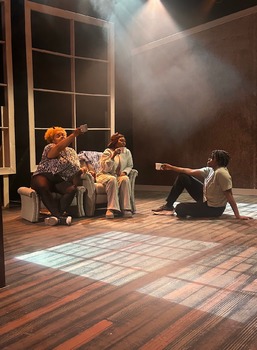
Directed for the Black Rep with pride and occasional mourning by Kathryn Ervin, three actresses ponder the complexities of being Black and female at a moment when both are under attack, over concepts like Critical Race Theory, DEI (Diversity, Equity, and Inclusion), and the same old forces that always hemmed them in. The show is occasionally a laughing "middle finger" at the false poetry of white outrage–and at all the hostility in women's lives in general, with plenty of room to be filled with self-recrimination as well. The play was commissioned by and given its world premiere in 2024 by The Vortex in Austin, Texas. Velma Austin is a zen master of theatre, here as a deeply reflective professor of women's studies. She seems to occupy every millimeter of the stage around her, even as her soul fills the hall. In director Ervin's blocking, Ms. Austin is usually at the peak of a triangle as part of a trio onstage. Three women clash together in hope and despair, in a Plato's dialog of why they're here, how they came to be, and how to hang on till they get to where they're meant to be. In the role of Dr. Beatrice "Bea" Free, Ms. Austin is tirelessly backed-up by Janelle Grace (as Cee) and Ricki Franklin (as Dee Dee), as her intellectually complex muses on stage. "A" is for audience, as we're increasingly drawn into the action. A tribute to the television show "Soul Train" in the final 20 minutes invites us up on stage to "do the hustle" and other '70s-era dance steps along with the actresses, with some quick refresher coaching (and lovely choreography throughout by Heather Beal). Black women in the audience are encouraged to write on slips of paper about their own acquired wisdom, to further enrich the experience. But even when the show's not flowing with regular and varied song and dance, it's an engrossing blank verse credo, whose middle 20 minutes go by in a flash. My new favorite song is the jump rope ditty "Donna Died," chanted by the actresses like cheeky children, in two or three renditions within the larger rumination about how a woman's devil-may-care attitude led her to a grisly storybook ending. Elsewhere, a tribute to the vicissitudes of Black hair might seem overly long if you only saw it on the printed page. But it's silky smooth in performance ("bury me with a jar of Afro Sheen!"). Don't you crave to know what other people's lives are really like? With a bit of poetry, and all the dull parts taken out, I mean. These highs and lows are similar to the heights and depths of the blues or classical music. And even when the audience seems a bit timid or shy, the actresses are full energy. Lighting designer Denisse Chavez far exceeds my expectations for a three-person show, with nearly four dozen instruments overhead, firework effects, and more. Ms. Austin is draped in beautiful gold lamé prints for a tantalizing moment by costume designer Marissa Perry, transforming her into the ultimate diva, in a cozy study at home designed by Reiko Huffman. Fans of the Black Rep will appreciate a quick shout-out to the late local actress Linda Kennedy in one of the show's moments of imagining a female Valhalla. As the playwright puts it, all their bodies have become an archive for everything they've lived. A medical crisis evokes a kind of cold comfort in white coats, exposing a pained cultural rift. But wisdom and delight (and suffering) are all braided together in the circles of the trio on stage. The Black Feminist Guide to the Human Body, produced by The St. Louis Black Repertory, runs through March 1, 2026, at the A.E. Hotchner Studio Theatre, 6465 Forsyth Blvd., St. Louis MO. For tickets and information, please visit theblackrep.org. Cast: Production Staff: * Denotes Member, Actors' Equity Association |