|
Regional Reviews: St. Louis The Half-Life of Marie Curie Also see Richard's reviews of 9 to 5 the Musical and Rosencrantz and Guildenstern Are Dead
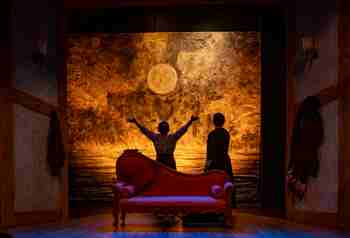
Two of the original Orange Girls, Meghan Baker and Michelle Hand, fill the stage with lighthearted disdain for a world full of two-faced men in 1912, playing Curie and her friend Hertha Ayrton. Disdain came, especially, for those who disinvited Dr. Curie from picking up her second Nobel Prize in person in Stockholm, following an extramarital affair she'd had. The two actresses shock us with their inventiveness and insights, after an escape from a scrum of French reporters howling outside Curie's door. Each real-life character would go on to make important contributions to the West in World War I. And on stage, the two performers engage in a fantastic complicity with one another, as their creations unfold continuously. But the main thing is, the Orange Girls are back! This is their first show since 2009, and the sense of granular detail in their work is squared, shock after shock, for the perspective gained since then. Free will and female independence are held up, not just by the torrent of friendly banter and natural argumentation, but it's also held up in the form of a slow-burning amulet: a vial of radium Dr. Curie carries with her, becoming the entire symbol of dangerous female independence at the time, green and glowing, even as we feel our own Fitzgeraldian romanticism toward her, like Nick Carraway from our spot out in the audience. The amulet is part of the reason her fingers are burned, and part of the cause of her strange aches and pains, after years of trailblazing research, beginning with the discovery of radioactivity itself in partnership with her husband Pierre (in this scenario, she's a strong believer in actualization). Of course she's not Fitzgerald's Daisy Buchanan. And this broken-hearted French heroine pays the price of her freedom. But something terrible has been torn out of her, and her life would come to an end some twelve years later, in 1924, at the point when the marrow of her bones could no longer produce red blood cells in the volume needed to sustain life. These days, she'd probably be a billionaire for all her genius. In Gunderson's play, which premiered at the Minetta Lane Theatre in 2019, Curie is content merely to rip the veil of darkness from an unseen world and open up new avenues of scientific exploration. The perfect woman, by any man's measure, though oddly chilled–balanced here by the wonderful Ms. Hand. On top of that, in Ms. Baker's performance, we see a permanent piercing quality in her eyes, and a kind of weariness, as well, from a life spent gazing into the unknown. "Nothing in life is to be feared," she famously said, "it is only to be understood. Now is the time to understand more, so that we may fear less." Here, she seems to realize such a hopeful vision would have to go on without her. She reels off fathoms of anchor-rope into the deep, till a kind of scrubbing action seems to mimic, in the mind. Ms. Hand, as Dr. Ayrton (born Sarah Marx, 1854-1923), recites a thunderous poem of self-expression by Algernon Charles Swinburne, "Hertha," to throw a bright spotlight on both women's suddenly unforgettable lives. She gets most of the show's thirty or so perfect comic rejoinders, although Ms. Baker has several sly laugh lines as well. Two of Dr. Ayrton's own notable achievements are mentioned here, but one has special resonance within the story. In the early days of electricity, she was vexed by the loud guttering hum of oxygen burning inside of primitive lightbulbs. And in the play's opening monologue, she explains how a brilliant arc of light fills the space between two separate points inside the sealed glass of a bulb. Such is the radiance of their friendship. The timbered set is another plush, luxuriant heirloom jewelry box by Patrick Huber. Denisse Chavez, Teresa Doggett, and Maria I. Straub-David heighten the faraway moment with lights, costumes, and props. Andy Cross has painted a magnificent, impressionistic skyline upstage. And the dialogs between the two women spark brightly, even as that vial of radium is held aloft for an instant, like a lantern: a perfect symbol of an immortal figure leading us out of darkness at her own great expense, but writing her own story. A Diogenes who would draw honest men closer to her. "Life is not easy for any of us," she's quoted as saying. "But what of that? We must have perseverance and above all confidence in ourselves. We must believe that we are gifted for something and that this thing must be attained." The Half-Life of Marie Curie, produced by The Orange Girls and St. Louis Actors' Studio, runs through April 19, 2026, at Gaslight Theater, 360 N Boyle Avenue, St. Louis MO. For tickets and information, please visit www.stlas.org. Cast: Production Staff: * Denotes Member, Actors' Equity Association |