|
Regional Reviews: St. Louis Terms of Endearment Also see Richard's review of Sweeney Todd: The Demon Barber of Fleet Street
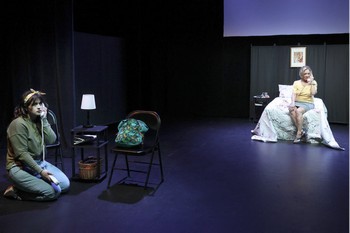
But till then? More "happy little trees," please. The play by Dan Gordon is based on the novel by Larry McMurtry and the 1983 movie by James L. Brooks, completing a vast cycle of re-use. It went straight to "bus and truck" productions after beginning its theatrical life at the York (England) Theatre Royal in 2007. But, narratively, this production seems a bit blind to the usual standards of moving around, and (due to the writing) to introspection and layered lives–blind even to the existence, back then, of long telephone cords, which would have encouraged a broader use of the performance space in this play. I'm given to understand there's a sort of built-in presumption of intimacy around the beloved movie version, which I'm sure is reinforced by lots of close-up camera angles. But even in this smallish studio theater, it's spread pretty thin till the final half hour. The play mostly relies on phone conversations between a grown mother and daughter, Aurora (Deb Dennert) and Emma (Kelsey Belt). Ms. Dennert seems to have a complete understanding of all the tonalities of life on stage, and Ms. Belt has a quiet, kind persona that easily draws us in. And yet Emma and her husband (the very reliable Jeremy Schnelt) seem to be acting in a "close-up" style that tends to evaporate beyond the first row. Mr. Schnelt is unrecognizable here from his role in Clayton's Ordinary People three years ago, and does very well as Emma's selfish young husband, especially in his final scenes. Elsewhere, Amie Bossi is lots of fun as Emma's old friend Patsy. Mark Coble is brash and winning as a retired astronaut next door (in Texas), and Ms. Dennert's withering take-downs of his romantic overtures are surprisingly good–as is Mr. Coble's description of an historic lunar mission, years earlier. His little speech about space travel, playing the role of a fictional NASA veteran, places us in a speeding capsule racing over Earth's companion. The lack of movement and framing also robs the characters of potential psychological life in the early going. That said, Savannah Carmichael adds reassuringly high quality performances, orbiting the main action in multiple roles. And there's a fine snarky doctor in act two played by the withering Sean Monarch. The lighting design is by Nathan Schroeder, and the play of light and dark is fine for a normal story, with the occasional transition from day to night. But with so much dead space before us, it almost seems like the show should have been lit in "pin spots," bright pools of light, to enhance the relative isolation of mother and daughter, as if on their own separate planets. Many of the scenes are played out in phone calls from different states of the Union, or at least from different "blocks" on the stage. And the rest are performed in little two-person transactions that titillate the audience in broad thematic ways, showcasing dishy or confrontational relationships, presumably for an audience that lacks those things in real life. With that in mind, the whole thing seems to be built around a lot of very personal little "serotonin-releasing" encounters, women squabbling or laughing privately, and perhaps foremost, upbraiding the menfolk in various primal reckonings. And yet the show is lit for crowd scenes, or at least for more physical business. The lighting designer Mr. Schroeder is a wonderful guy, in my experience. But at this level of theater I've also found you can't really argue with the lighting person once the instruments are hung. To most non-technical theatre people, of course, ladders are scary, and electricity is still a kind of magic. Happily, the show becomes its own great powerhouse in the final three or four scenes, for reasons you probably know already, even if you're only vaguely familiar with the story. In one of the final pas de deux, Ms. Belt hits all the right notes as Emma in an overwhelming monologue with her mother at her side, as the show soars to its climax. Around the same time, Ms. Dennert finds the production has finally grown up and theatrically matured around her, to match her own scale and scope as her character assertively takes charge of her own fate, in spite of the men around her. Terms of Endearment, produced by the Clayton Community Theatre, runs through August 2, 2026, at the A.E. Hotchner studio theater (at the other end of the lobby from the Edison Theatre), 6465 Forsyth Blvd., St. Louis MO. For tickets and information, please visit www.placeseveryone.org Cast: Production Staff: |