|
Past Articles What's New on the Rialto New York Gilbert & Sullivan Players' Utopia, Limited
Resuscitating a Neglected Operetta By Mark Dundas Wood
On the other hand, the duo's two final collaborations–Utopia, Limited or, The Flowers of Progress and The Grand Duke or, The Statutory Duel–along with G&S's very first collaboration, Thespis (the music of which has mostly been lost), have very seldom been staged. That said, things have shifted a bit in recent decades. The Mikado, often hailed as the G&S masterpiece, has fallen out of favor in many quarters because of perceived racism (or, at least, cultural insensitivity) in its presentation of things Japanese. Meanwhile, there seems to be renewed interest in those largely forgotten titles. New York City's 100-plus-year-old Blue Hill Troupe presented The Grand Duke in 2025. And this month, New York City's New York Gilbert & Sullivan Players (NYGASP) will perform a full production of Utopia, Limited for the very first time. (The company presented "concert" versions of the piece in 1993 and 2010.) Directed by recently tapped NYGASP Artistic Director James Mills, the operetta will have three performances on the weekend of April 18 and 19 at Hunter College's Kaye Playhouse in Manhattan, complete with new sets and costumes. This operetta was originally mounted in 1893 at London's Savoy Theatre by the longtime G&S affiliate, impresario Richard D'Oyly Carte. The script is notable for its satire on British governmental rules and customs. The "Utopia" in Utopia, Limited is a small island nation with a contented citizenry and a good-natured, benign sovereign: King Paramount. The king's eldest daughter, Zara, has traveled to England to study, while her two younger sisters have been taught at home by a character named Lady Sophy, who has schooled them in British etiquette. When Zara returns to England, she brings with her a group of Englishmen (The Flowers of Progress), who are tasked with assisting in a thorough anglicization of the island's culture. At the end of the first act, the Anglophilic Utopians have decided to follow the Flowers' advice to enact governing policies that treat the nation of Utopia as a business concern: specifically, a limited partnership.
When I consulted a few critical studies about the G&S career, I didn't find much unbridled cheerleading for Utopia, Limited. Influential G&S commentator and historian Audrey Williamson, in her 1952 study, "Gilbert and Sullivan Opera: An Assessment," shares some of the 1893 critics' problems with the operetta. Among the flaws she identifies is an underdevelopment of most of the characters. She does appreciate the keenness of the operetta's political satire, but laments that it succeeds primarily in Gilbert's libretto, not so much in his lyrics. "It has funny lines and nice tunes, but is almost nonfunctional as an opera," writes Gayden Wren in his "A Most Ingenious Paradox: The Art of Gilbert and Sullivan" (2001). Wren cites, among other blemishes, plotlines that are introduced but don't seem to go anywhere. Carolyn Williams opens the chapter on Utopia in her 2011 book "Gilbert and Sullivan: gender, genre, parody" by boldly (and maybe hyperbolically) declaring the piece "an anti-colonialist, anti-capitalist comic opera." She finds things to like in the libretto but feels that Gilbert wimps out in the show's final moments with a "forced and precipitous" ending. Reading all of this, you might be convinced that Utopia, Limited deserves to be the abandoned vehicle it has mostly been for well over a century. But hold on, now. Not so fast. There was one highly respected cheerleader who weighed in quite positively back in 1893: playwright and critic George Bernard Shaw. He wrote that he enjoyed Sullivan's music in Utopia "more than that of any previous Savoy operas." He favorably compared some of the operetta's compositions to those of Mozart. Also, I myself had the rather rare privilege of having seen, in person, a full production of Utopia, Limited 30 years ago, in Portland, Oregon. It was presented as a dinner-theatre offering by a semiprofessional company called Cabaret Magnifique, in a Chinese restaurant and cocktail lounge known as The Jasmine Tree. The restaurant's proprietor, Jimmy Chan, a true G&S enthusiast, directed the show and played the role of King Paramount. I found it energetic, funny, and enjoyable. Reviewing it for The Oregonian newspaper, I remarked on the pointedness of the satire and found Sullivan's music "comically charming one minute, pulse-stirring the next." So, yes. Not so fast! James Mills had a long history as a performer with NYGASP before replacing longtime Artistic Director Albert Bergeret this season. In the 2010 concert version of Utopia, Mills was cast in the role of Tarara, the island's "public exploder." He had long wanted the company to produce a full version of this show, and he was happily surprised to have the opportunity to helm a production of it in his very first season as AD. He feels that the lack of enthusiasm for Utopia has been largely due to the simple fact that few people know its storyline or are familiar with its melodies. Everyone just assumes it's no good. He is hopeful that this production can turn the situation around so that Utopia can at last take its place beside some of the better appreciated G&S operettas and perhaps even be added to NYGASP's ongoing operetta rotation. But Mills did have some trepidations as he prepared to direct the show. For one thing, he found content in the script that can be seen as exoticizing island life in the South Seas in much the same way The Mikado has been seen as exoticizing (and, arguably, diminishing) Japanese culture:
Little else has been trimmed from the NYGASP working script, but those passing references to the South Seas were deleted. (And don't expect grass skirts or coconut-shell brassieres in this iteration.) One other tweak from Mills and company: In the original staging, there are scenes involving the Flowers of Progress that were originally presented as a minstrel show sequence. (Such entertainments were popular in late 19th century London.) For obvious reasons, that wouldn't fly these days. NYGASP's version changes the number to a British Music Hall bit, complete with straw hats and canes. On the plus side, Mills soon happily discovered that Utopia, Limited has–inadvertently, it seems–plenty to say about 2026 politics and culture in the U.S. and elsewhere: "There are the topics of colonization, [of] countries that have...influence over another country, [of] autocratic leaders who have bureaucrats that are basically controlling them from behind the scenes."
Both Gilbert and Sullivan faced considerable challenges during the creation of this operetta, Mills notes. Utopia was the first collaboration following the notorious "carpet quarrel" (a disagreement over finances among Gilbert, Sullivan, and D'Oyly Carte that had threatened to end the partnership once and for all). Also, neither of the writers was in good health during the time of the operetta's development. Sullivan was plagued by kidney disease, Gilbert by gout. The show had a rather short Savoy run for a novel G&S presentation (245 performances). It required a huge cast and elaborate staging. Utopia became known as a losing proposition in part because it had proved so expensive to mount. Following its debut, it would not be revived by the D'Oyly Carte company until 1975. As Mills explains: "The show is meant to be much larger than we're producing it... We're a nice little nonprofit here in New York City, so we've scaled it back as much as we can, but it's still quite large. There's a lot of principals and a lot of scenes with these principals. And then, you've got an ensemble on top of that. And then you have a group of British characters that don't even come onstage until the Act 1 finale." With a couple of small exceptions, Mills has chosen not to employ the practice of casting actors in multiple roles. So, expect a bevy of performers onstage at the curtain call. Inhabiting the role of King Paramount for NYGASP's production is Matthew Wages. He first auditioned for the company in 2000 and, over the years, has taken on 18 principal G&S roles with the troupe. With his stint in Utopia, he'll have appeared in productions of all of the shows in the catalog except Trial by Jury and The Grand Duke. In Audrey Williamson's less-than-glowing critique of Utopia, Limited's character development, she exempted the role of King Paramount, whom she found to be "constantly amusing and, in the droll Gilbertian fashion, alive." Wages agrees that there's a lot going on with the king. He finds him to be "a lighthearted character" who "wants to please his people." "He's described in the script as a fatherly figure," Wages adds. "He...says he's blessed with a keen sense of humor and can really find the humor in anything." This skill comes in handy, because, throughout the story, Paramount is under the thumbs of two "wise men"–Scaphio and Phantis–the operetta's dastardly figures. Wages can commiserate with the king in the "fatherly" department. He's dad to twin boys, while King Paramount has twin daughters: "He loves them, but they're always up to no good. So, I can definitely relate to that." There are a couple of things that set Utopia, Limited apart from other G&S works, according to Wages. For one thing, Paramount is a principal, "romantic" role written for a bass voice. This is something that's not only rare in the Savoy operettas, Wages says, but also in musical theatre generally speaking. He is more than glad to play a character who, for once, is not a baddy and/or an entirely comedic figure.
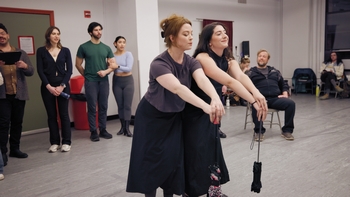
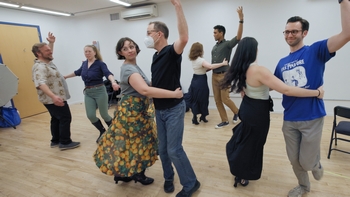
Wages, who studied ballet in years past, is called on at one point to dance a tarantella, which Paramount performs with Sophy:
He believes that Utopia, Limited would be a good show for people to experience if they're exploring whether or not they want to learn more about opera and operetta. "It moves quickly. It has a lot of beautiful music, but it also has interesting transitions. ... I think the storyline really moves well with the music. And of course, it's in English, so it's clear to follow." He's aware of critical reservations about the show's construction, but he feels that Gilbert definitely wrote a strong character arc for King Paramount. And while he is cautious not to introduce any spoilers about the storyline, Wages does share one facet of the Utopia plot that is unlikely to surprise anyone who knows a smidgen about Gilbert & Sullivan. "It ends on a feel-good moment," he says. New York Gilbert & Sullivan Players's production of Utopia, Limited runs April 18-19, 2026, at Kaye Playhouse at Hunter College. For tickets and information, please visit nygasp.org
|