|
Regional Reviews: Chicago A Strange Loop Also see Savannah's review of Vladimir and Joe's review of Dial M for Murder
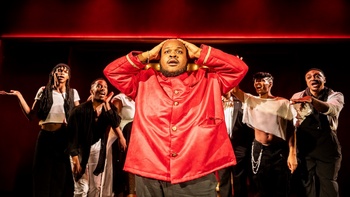
The Pulitzer Prize-winning A Strange Loop, now playing its Chicago premiere in a co-production between Raven Theatre and About Face Theatre, is a surrealistic, multifaceted portrayal of struggles with identity by playwright Michael R. Jackson. As he and his main character put it, it is a musical about a fat gay Black man writing a musical about a fat gay Black man writing a musical. (Jackson himself starred in it on Broadway, though it is not truly autobiographical.) The Mikael Burke-directed musical, played out on a deceptive Sydney Lynne set beautifully lit by Brendan Marble, centers on a Disney usher (referred to throughout as Usher) who is deep in the middle of, well, writing a musical. Along with him are his Inner Thoughts, portrayed by an ensemble of six who play, among other things, the audience of the Disney musical (The Lion King) where he is working, his self-loathing, his "inner white girl," his parents (who have never accepted his "lifestyle" because they are, or anyway his mother is, very religious), white men he has sought out for degrading sex because of the aforementioned self-loathing (shown in a powerful and extremely uncomfortable scene–this play is not for young or squeamish audiences), his agent, and many others along the way. Though the play begins in a quiet, almost sweet, and decidedly humorous mood, introducing Usher (played here by Eddie Weaver, and there is simply not enough praise I can heap upon his performance) and his invisible entourage of untamable Thoughts. (The first of them, Self-Loathing, is recurrent and would be debilitating all by itself if he listened to it, but he fights against it.) These intrusive Thoughts are played by a talented group consisting of Micah Mixon, Matheus Barbee, Christopher Wayland, Michael Turrentine, John-Payne, and Naphtali Curry, who are Usher's constant companions, for better or (mostly) for worse. Many times, the ensemble takes Usher to memories or phone calls with his parents and other toxic members of his birth clan. It does not take long for his mother to profess that she loves him deeply but needs him to relinquish the abomination of his sexuality so that he does not get AIDS like his cousin. As portrayed by Turrentine, she is a toxic presence who does not understand her own toxicity, much the same as John-Payne's portrayal of his father, a constantly drinking man who repeatedly asks him if, since he is attracted to men, he is attracted to him. (I mean there is no right answer to that.) Usher's self-loathing does not end with his sexuality. He also detests his size and cannot find comfort with men of his own race because he does not feel worthy of them. Curry plays another recurrent character, a white man to whom Usher goes to demean himself in a submissive sex scene that plays on slave/master stereotypes, a scene in which violence and intimacy designer Chels Morgan certainly earned their pay. All of this means that he keeps delaying completion of his script, editing it to death and making the perfect the enemy of the good. We know he finishes it–we're watching it, after all–but we are also sucked in as he keeps putting it off. One significant part of his struggle comes from his God-fearing mother, who does not approve of the "homosexual" play he is writing and desires him instead to write a "gospel musical" to sell as a movie to Tyler Perry, whom Usher considers demeaning to the very Black people who love him. Everything culminates in one of the most intense scenes of burning self-loathing I've ever seen, as he fantasizes giving in to his mother's oft-stated demand and we see a scene from the resulting musical. The scene, which allows Marble and Lynne to show off a bit while sound designer Hannah Kwak's work amazes, takes place at the funeral of his cousin, who has died of his AIDS because of his "lifestyle choice," and becomes horrendously, outrageously anti-gay (the chorus sings "AIDS is God's Punishment" over and over), building to a nightmarish crescendo. Breon Arzell's choreography is in turns vibrant and a bit frightening as she uses the ensemble to imitate Usher's frame of mind, echoing Burke's overall directorial style. Backstage, Kyu Park's six-piece orchestra fills the Raven's space with sharply created music. It's an intense show, as I said. But it is also funny and honest and even very sweet at times. It can definitely be cringe, but even those scenes are there for a clear and immutable reason. A Strange Loop is the perfect show for those who enjoy thinking about and discussing what they have just seen. Indeed, my son and I talked about it all the way home and I can't imagine that I will get it out of my mind any time soon. It is, in short, theatre at its finest. A Strange Loop, a joint production between Raven Theatre and About Face Theatre, runs through November 22, 2026, at the Raven Theatre, 6157 N. Clark, Chicago IL. The initial run is already sold out. For tickets and information, please visit https://www.raventheatre.com
|