|
Regional Reviews: Chicago Much Ado About Nothing Also see Richard's review of The Real Housewives of the North Pole, Kelly's review of White Christmas, and Karen's review of A Christmas Carol
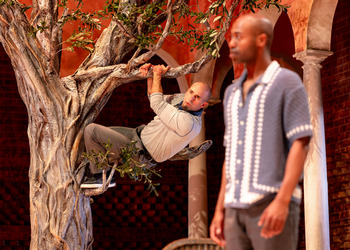
Tom Piper's scenic design and costumes lean into the truth, universally acknowledged, that ridiculously attractive men just home from war are in want of equally attractive wives. And to find them, these men naturally journey to the idyllic homes of their wealthy friends. Piper's set occupies not just the thrust of CST's Courtyard Theater, but bypasses what productions often employ as the proscenium all the way to the upstage wall of the theater itself. Furthermore, Cadell's direction spills over into the audience, filling the space to the rafters. On the main level, guests enter into Leonato's estate via doors that are two stories high and accommodate dramatic entrances, complete with smoke effects. Surrounding these necessary instruments of high drama, Piper has constructed a double-decker series of arches. Those on the main level are tall and spread out. On the upper level, where the play's intrigue happens (or at least is observed), the arches are shorter and more regimented. The highly realistic tree that sits upstage left, in conjunction with the terra cotta tones of the set overall, establishes that the action, so far as the play's most privileged characters are concerned, takes place in a liminal "vacation" space. And yet, the deception and listening in that occurs in the visually more frantic upper level of the set remains in tension with this vacation vibe. Piper's costuming choices, particularly for the women of Messina, are also effectively liminal. Their high-waisted skirts, wide-legged pants, and the angular lines of their dresses suggest the roughly 1940s aesthetic of a society just emerging from war. Moreover, Piper employs metallic fabrics and cuts that range from demure to daring in the moments when the women of Leonato's circle are serious about the business of marriage. He then juxtaposes these with bold, flowing garments, often featuring naturalistic elements when the women are off the clock, as it were, and free to associate amongst themselves. In contrast to this intelligent richness for the women, the men's costumes are cheekily standardized. When Don Pedro and his retinue arrive, their grey uniforms are pointedly drab and nondescript. Don John and his co-conspirators are distinguished primarily by the dominance of black in their costumes and a tendency toward generically Asian lines. This opens up space to emphasize, for example, Claudio through his "resort wear" when he is confidently at rest, as well as Benedick's outlandishly snazzy costume after he has been ensnared by Don Pedro's scheme and has set his sights on Beatrice. Given Piper's splashy, entertaining successes, it would be easy to overlook other elements of the production design. Yet the sound design (Nicholas Pope), musical compositions (Eliza Thompson), and lighting (Jason Lynch) are important parts of the production's sparkling vibe and flawless pacing. Given the satisfying emphasis on play in Cadell's direction, Lynch's lighting is integral to the rapid shifts between the pranksters and the pranked, as well as between the frothy comedy and the darkness Shakespeare offers. Likewise, Pope's sound design playfully weaves Thompson's music throughout the dialogue and fills the space with it, conveying the message that mischief may be afoot at any given moment. It's a genuine pleasure to settle back and watch Cadell and her cast play with some of Shakespeare's very best material. That pleasure obviously starts with Deborah Hay's Beatrice and Mark Bedard's Benedick. The two are masterful in capturing the reality that both characters are a bit more road weary and cynical than the young lovers who "should" be the focus of the romantic plot, and yet beneath the armor of their wit, each has a tender, loyal heart that gravitates toward love. In particular, Hay's comedy hearkens back to the broad, physical style of geniuses like Lucille Ball and Carol Burnett (kudos to movement director Amber Mak), and she is equally impressive and believable when she dials her personality down when Beatrice's ferocity and frustration turn dramatic. Bedard is similarly skilled in playing Benedick's swagger for all it is worth, even as his inner dork peeks through. And yet, in the scene where he confronts Claudio at Beatrice's behest, there is genuine steel in a performance that is believably connected to both the man who so capably spars with Beatrice and who falls so readily into the trap Don Pedro and his confederates set for him. With Hay and Bedard setting the comedic bar so high, Cadell affords the rest of the cast ample room to play as well. The "straight" characters like Don Pedro (Debo Balogun), Claudio (Samuel B. Jackson), and even Don John (Erik Hellman) seize every opportunity to wink and nod at the audience, as well as to actively involve them in their various schemes. Yet none of this embrace of the comedy compromises the darkness that infuses the story. Balogun seems to be all charisma until the chillingly effective moment when the force of his personality turns against Hero. This plays in an especially interesting way against Kevin Gudahl's performance as Leonato, ever the jovial father and host until he, too, immediately believes the worst of his own daughter. Also important in this mix is Jackson's undeniably attractive yet deliberately bland Claudio. In a role that can easily become a broad strokes plot device in the wrong hands, Jackson does excellent work using his physicality to convey why Hero, and the people of Messina more generally, would be smitten with him, but he also plays with the subtleties of Claudio's whipsawing moods, not only when Hero's virtue is impugned, but also when he believes, with little prompting, that Don Pedro has betrayed him. Counterbalancing the shades of darkness in these performances, Hellman plays the villainous Don John as really rather stupid and unconvincing (in the best possible way). The choreography of the scene in which he formulates the plot with Borachio (Yona Moises Olivares) and Conrade (Colin Huerta) is ludicrous, underscoring exactly how unsophisticated the plan is. This, in turn, emphasizes how quick the play's supposedly honorable and upstanding men are to believe this transparent villain over any given woman. This take is supported by great performances by Olivares, who has a wonderfully subtle and suave approach to a role that so many approach as pure thug, and Huerta, who plays the somewhat straighter henchman, yet still draws laughs with sure comedic timing. Given how big Cadell goes with the comedy overall, danger might seem to loom in terms of the approach to Dogberry, Verges, and the Watch. Any such fears are misplaced, though. Having opened the door to earlier eras of comedy with Hay's performance, Cadell gives these characters license to flat out clown. As Dogberry, Sean Fortunato evokes the working man delivery of Art Carney and the physicality of Danny Kaye or Dick Van Dyke. Again, Amber Mak's work in crafting a complicated group "salute" any time the Prince is mentioned deserves high praise. Complementing Fortunato's performance, Jaylon Muchison plays Verges to great effect as a Dogberry fanboy with OCD. Furthermore, Muchison's performance as the Friar both demonstrates the actor's range and affords Cadell yet another opportunity for play as the other members of the Watch (Joey Chelius and Suzanne Hannau) double as musicians and auxiliary stage hands (often mingling with actual crew), dressing Muchison onstage and reminding him of which character he is supposed to be playing. As both Leonato's brother Antonio and the Sexton, Jeff Parker adds deft comedy and drama to both groups. If there is even the slightest weakness in the production, it may be in that Cadell did not find the same opportunities to shine for the women of the play other than Beatrice. Mi Kang is a charming Hero, and her work during the disrupted wedding is strong, but she is certainly a background character. Similarly, Felicia Oduh (Ursula) and Tiffany Scott (Margaret) sparkle when they are plotting with Hero to trap Beatrice, but this trio of characters seems a bit neglected in comparison to the care and development that other groupings receive in the production. Much Ado About Nothing runs through December 21, 2025, at Chicago Shakespeare Theater, Courtyard Theater, 800 East Grand Avenue on Navy Pier, Chicago IL. For tickets and information, please visit chicagoshakes.com or call 312-595-5600.
|