|
Regional Reviews: Chicago Salome Also see Karen's review of Eureka Day
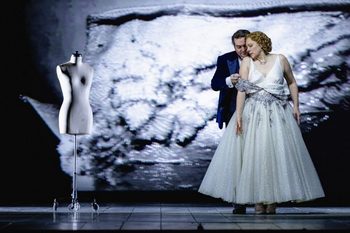
No shortage of artistic energy has been expended on that question, and it's one of the driving forces behind Salome, given an incredible new staging now at the Lyric Opera. One of Richard Strauss's most famous operas, the piece takes biblical characters to ask modern questions about the way our psychology works. In Sir David McVicar's production, restaged here by revival director Julia Burbach, questions of private psychology intersect with political ideology to produce a stunning and unsettling effect. Strauss adapted the opera from a play by Oscar Wilde, which he encountered in a German translation by Hedwig Lachmann. Strauss cut the piece down, sharpening it to a taut one-act that keenly observes the Aristotelian unities as Strauss's score offers the thrills of sublime, Romantic power to the audience, while the libretto, with its deep interest in the psychology of obsession, marks the opera as a work of high modernism. McVicar originally staged this production in February 2008 at the Royal Opera House, London, drawing inspiration from Pier Paolo Pasolini's infamous film Salo to set the action in the world of Mussolini's fascist Italy. He couldn't possibly have known how prescient a choice that setting would be. In the nearly two decades since, multiple financial crashes, the COVID pandemic, and growing nationalism have led to a resurgent authoritarian right wing emboldened and with more access to the levers of political power than at any time since the end of World War II. I imagined this Salome finding extensive parallels between Herod's court and our own increasingly unhinged reality. After all, Strauss's tragic heroine is often depicted as a petulant child who demands the prophet's head in a fit of pique, furious at hearing the word "no." There is plenty of potential for timely hay to be made there, even in a revival production. I was surprised, then, to discover that McVicar's vision, as reconstructed here by revival director Julia Burbach, isn't overtly interested in the motivations of the fascist, nor in the social necrosis it engenders. Further, Italian blackshirt fascism, far less familiar to American audiences than its more chronicled Germanic counterpart, doesn't immediately evoke the specter of totalitarianism in the audience. But these less loaded signifiers work in the production's favor since what emerges is a nuanced, intricate look at the punishing effects of psychological and sexual abuse. From that specific vantage point, it ultimately invites a meditation on the broader implications of a society of domination and surveillance. As the show opens, a border at the top slowly rises to show a sliver of action indicating a festive banquet. Most of the scene, however, is taken up by a dungeon-like basement filled with soldiers. They're guarding John the Baptist, called Jochanaan here, and discussing how unsettled the Princess Salome seemed at the banquet. Played by Jennifer Holloway, dressed in a silver evening gown, Salome descends into the basement, complaining about the leering of her stepfather Herod. Hearing the prisoner's ravings, she demands to see him. The soldiers reluctantly haul Jochanaan out of the hole in the stage where he's stowed, costumed like a political prisoner, unshaven and unkempt, wild-eyed and dirty. Despite his filth, Salome is captivated and demands to touch him, to stroke his hair, to kiss him, all of which he refuses. Instead, he excoriates her with a torrent of misogynistic abuse. The insults don't dim her ardor, and though she has him thrown back into the pit, the prophet has clearly captured her imagination. McVicar/Burbach dramatize her obsession as Herod and his wife Herodias enter the basement and order the court to set up tables for dessert and drinks. As the stage fills with activity, Salome withdraws stage left, traditionally the weakest position, to sit silently atop the prison cell. As Herod tries to banter inappropriately with his stepdaughter, Holloway's Salome approaches a level of anhedonic near catatonia, moving us toward the climax. Holloway makes clear that something about her interaction with Jochanaan has permanently changed the princess. Any production of Salome builds toward one of the most famous moments in opera, the Dance of the Seven Veils. Sometimes staged as a striptease and sometimes as a seduction scene, it's the dance Salome agrees to do for Herod in exchange for a promise to give her anything she asks in return. The dance has the potential to be scandalous or lurid; the original Salome, Marie Wittich, refused to perform it. Here, McVicar and Burbach's version distinguishes itself and fully establishes its own clear interpretation of the piece. As the dance begins, the set breaks apart and moves off as another, box-like set piece slides onstage. A projection fills the upstage cyclorama showing a child's chair with a stuffed bunny. Rather than Salome dancing for Herod, the two dance together, awkwardly, like an adult and child. The projection changes and a second box-like frame slides into place around the pair. The projection shows a woman's bare back from neck to hips as the dance awkwardly continues. The scene changes again and a dress form glides in with the next box. Herod roughly forces the princess to put on the dress it contains. We move through seven of these boxes, the king and princess tussling and jostling with each other through each of these "veils." The final one contains a wash basin and a projection of a lightbulb. The imagery evokes torture, and Salome dunks her head into it, throwing a spray of water into the air. As the last box slides off and the room returns, she's bedraggled, barefoot, clad now in just a shift, her finery gone. She is vulnerable. The moment is extremely theatrical. Far, far too much theatre is either too talky or too cinematic in its aesthetics. The effect of this moment could only have been achieved on a stage, and it illustrates why opera (and theatre more generally) still has a singular power to move audiences when it fully embraces the aspects that distinguish it from other forms of art. More directors and writers should ask themselves what the stage can do that other mediums cannot. Moreover, it recalibrates the dance for a 21st century audience. Staging the dance as a striptease renders the performer physically vulnerable in a literal sense, of course, but it figures female sexuality as a form of power. Too often it makes the princess into a spoiled girl who wants what she can't have. The effect here is totally different, working on two levels. Narratively, this dance doesn't construct Salome as a princess. Instead, it shows her as the object of the unwelcome, predatory lust of a powerful man. The opera opens with her fleeing the banquet, uncomfortable about the leering of Herod. The libretto has a pervasive motif of images of looking and seeing. The Dance of the Seven Veils invites us to see Salome for what she is in this court, which is the least powerful member of the family. Beyond that, the dance invites a simple metatheatrical question: What does it mean that we believe a woman's body can be a metaphor? That isn't a problem we can fully resolve within the scope of a single opera, but it does make the princess's tragedy complete, and it clarifies the opera's ending. At the point of her greatest vulnerability, Salome then turns the tables on Herod by demanding the head of John the Baptist. He furiously tries to bargain with her by offering wealth and power, saying he'll give her half the kingdom and his most precious jewels instead of the prisoner's head, but she can't be appeased. In this staging, it's clear that she doesn't want revenge on Jochanaan. She wants the head because it's the only thing that will hurt Herod. The royal executioner disrobes–the only nudity in this otherwise chaste rendering–and descends into the prison, returning with Jochanaan's head. Holloway then delivers Salome's legendary final aria, a wrenching mad scene, in which she sings to the severed head. She's a fine musician with a powerful, evocative soprano, and she finds incredible levels of pathos in the music. Dramatically, she sweeps about the stage, moving up and down the curved staircase, cradling the head like a lover and covering her clean, white shift with crimson blood. By the time Herod orders the soldiers to kill her, it feels almost like a perverse triumph. Salome tells the dead Jochanaan, "If you had truly looked at me, you would have loved me." This is the final instance of a character struggling with what it means to look at something. Ultimately, in this staging, Salome's love for Jochanaan isn't about wanting something she can't have. It's about seeing someone outside this society and wanting him to see that she too isn't corrupted by it. She wants someone to see her rather than to just look at her. She wants to be something other than an object, unfortunately an impossibility for a character in an opera. Fascism thrives by turning individuals against one another, by making them look at each other with suspicion. Herod's court becomes a surveillance state. This show asks us to think carefully about what it means to look and to see. Salome runs through February 14, 2026, at Lyric Opera of Chicago, Lyric Opera House, 20 N. Wacker Drive, Chicago IL. For tickets and information, please visit lyricopera.org/salome or call the box office at 312-827-5600.
|