|
Regional Reviews: Chicago Stereophonic Also see Joe's review of Little Shop of Horrors and Seth's review of Salome
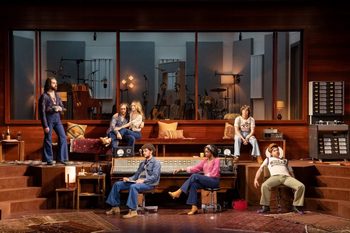
Stereophonic is loosely but clearly based on the fabled story of Fleetwood Mac's recording sessions for their album, Rumours. An unnamed band has holed up in a recording studio to record their next album as their previous one continues rising up the charts, a surprise hit. The band consists of three British members, married couple Holly (keyboards and vocals, played by Emilie Kouatchou) and Reg (bass, Christopher Mowod) and Simon (drums, Cornelius McMoyler), as well as two Americans, the long-term couple Diana (vocals, Claire DeJean) and new bandleader Peter (guitar and vocals, Denver Milord). Joining the group is recording engineer Grover (Jack Barrett) and his assistant Charlie (Steven Lee Johnson). When we meet them, they've already been working for some time and have a long way to go. The fault lines in the group are immediately clear as the group arrives for another day in the studio. Diana suffers from a crushing lack of confidence in her abilities as a musician because she can't play an instrument. Peter sees it as his responsibility to push her, both as her partner and as the bandleader, but he's abrasive and brash, alienating everyone in the group. Reg is late, the product of a worsening alcohol problem, and eventually hungover when he finally shows up. His drinking is threatening both his job with the band and his marriage, though he seems oblivious to both. Simon sees it as his job to hold the band together and keep the peace, while Grover got the engineering job by lying that he'd worked with the Eagles. The giant bag of cocaine the group liberally enjoys doesn't make things any easier, and all these pressures will rub up against each other like tectonic plates throughout the show. Stereophonic is a big play, in more than one sense. Even in the cut down touring version–Adjmi's note in the playbill calls it "the Radio Edit"–it runs nearly three hours across four acts. At a time when new American plays increasingly cram their conflicts into a taut, intermissionless 90 minutes, this length feels luxurious. Adjmi uses this scale to allow conflicts to fully develop, to simmer until they boil over and finally explode. Nothing feels rushed because the play has time to unfold naturally. The other aspect of Stereophonic's grand scope is Will Butler's original music. His songs are dynamic and powerful (and they made me think that maybe he should've been the primary songwriter in Arcade Fire, but that's a conversation for another time) and they evoke the sound of imperial era Fleetwood Mac without devolving into pastiche. The show isn't a musical, but one of the more impressive aspects is that the cast plays the songs live. Seeing the group work through a song in real time, even if it's rehearsed, is a thrilling window into the creative process. But the songs also serve a vital dramaturgical function in the play. We only hear the group play a few songs in total. For the most part, we're hearing snippets, single parts, incomplete takes, and rehearsals. This fits-and-starts engagement with the music, especially for an audience familiar with musicals, might feel frustrating, but that's the point. There is an incredible song just over the horizon if we can just push a little bit farther, just wait a little bit longer. This structural conceit aligns us with the band's perspective, and most specifically Peter's, as they work to make the album they hear in their heads. It also explains why they keep going, even as their nerves fray and their relationships unravel and the personal costs become too high. The threads are all there if we can find a way to weave them together. When they do manage to finish a song, it's a thrilling experience that signals a major moment in the play. For instance, the second act ends with the band cutting a song called "Masquerade." It's three in the morning and the entire group is exhausted. Simon is too tired and strung out to accurately keep a beat, but his pride makes him refuse to use a click track. Several false starts fill the audience and the band with incredible frustration. After Grover snaps and yells at him, leading to a tense, interminable showdown between the two, Simon caves and slips on headphones. The band then tears gloriously through the song and explodes joyfully out of the recording booth, hugging and shouting with glee. The act closes with Simon screaming "We are such a good band!" The repeated failures make the ultimate triumph greater. Earlier, in one of the show's most wrenching moments, Peter tries to help Diana with her song "Bright." As she's written it, the piece is a meandering piano ballad that he insists needs to be cut down. He rearranges it, adding a four-on-the-floor drum pattern and driving bass to speed the song up. He tells Diana to play the piano part to help free her voice, and the entire band achieves a soaring, chugging rendition of the song that absolutely explodes out of the recording booth. Then, the second they're finished, he immediately criticizes her in front of the group again, calling her a "mediocre" songwriter for not cutting it down. There are other examples, like a tense three-part vocal harmony recording session mined for comedy or the end of Peter and Diana's relationship that comes when his incessant criticism of her singing becomes too much, but this is one of the show's signal glories. Throughout, Adjmi and Butler use the dialogue and music synergistically to comment on and feed into one another in a way that few musicals ever achieve. It's a masterclass in dramatic storytelling for the stage. Perhaps a natural question is how did this play become the most successful non-musical in the history of the Tony Awards? Did it tap into something particularly timely? Stereophonic isn't exactly a play about How We Live Now, and it's not four characters arguing in an upscale living room about Important Issues. It's not overtly political, perhaps an oddity in such a polarized era. But enough about what it isn't. Stereophonic takes us within a diminished and exhausted culture that's been hollowed out by rapacious capitalism reflecting on its former decadence, all through the lens of a legendary album's origin story. Impossible as it may be to contemplate today as private equity strips every industry for parts and every artist is glibly told to do more with less, there was a time when a record company would give a group of still largely unproven 20-somethings millions of dollars and months of time to spend making a record. It's not, however, a simple boomer cultural hagiography, nor a paean to some lost Golden Age. The members of this band are difficult, flawed, arrogant, and pretentious. They pour the record company's money into drugs and booze just as much as their art. They hurt each other, both accidentally and on purpose, and abuse their engineers because they can. The play's scale and ambition allow us to see all these characters as three-dimensional, and drawing on well-known source material allows Adjmi to dig deeper into their humanity. What Stereophonic chronicles is that creativity is often messy and fractious. The process of making great art requires time and resources. That's not to lionize the personal strife–plenty of great art has been made without anyone getting divorced–but to say that art requires giving artists the scale necessary to pursue their vision, to try and fail, to challenge one another and themselves, and to eventually create something all their own. We live in an era in which some people want to make art instantaneous, to reduce it to the computer-generated output of a probabilistic system. If the play has a message, it's that art takes time. The touring production of Stereophonic is a tremendous evening in the theatre. It's a powerful script performed by a stellar cast of extraordinary talent. I do feel that the CIBC Theatre space is a bit overwhelming for the play; I actually think it would be better in the round or a thrust space, though I realize there are economic forces at work here. Still, I found myself wondering what kind of afterlife this play might have, given the technical difficulties of producing a live band onstage every night. (It really would be flat without the band playing live.) A play of this scale is as much a relic of the past as the album it chronicles. So, if you have the chance, see it now. Stereophonic runs through February 8, 2026, at at the CIBC Theatre at the Lyric Opera House 18 W. Monroe Street, Chicago IL. For tickets and information, please visit broadwayinchicago.com/shows. For information on the tour, visit stereophonicplay.com. |