|
Regional Reviews: Chicago Holiday Also see Christine's review of The Dance of Death, Karen's review of The Irish... and How They Got That Way, and Richard's review of Birds of North America
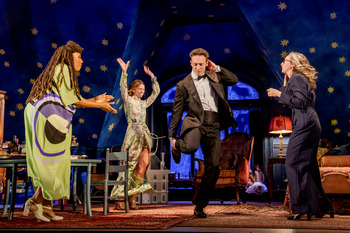
The plot is, of course, pure romcom: Julia Seton, the favorite child of the richer-than-rich Edward Seton has uncharacteristically gone to a spa where visitors surrender their phones as part of the vaguely "new agey" experience. There she has met Johnny Case, a driven, rags-to-riches lawyer whose well-meaning friends have strong-armed him into taking a break. The two fall for each other and get engaged all in the course of three weeks, courtesy of the artificial vacuum of the retreat. The play opens with Julia staging the introduction of Johnny to her family, most importantly her father, on whose good will her "thriving" textile business depends. Also, she is set not just to break the news of their engagement, but also their intention to marry and set sail on a honeymoon cruise in short order. Through interactions with Julia's adamantly progressive, bohemian sister, Linda, her addiction-plagued brother, Ned, as well as a handful of ancillary characters, Johnny quickly comes to realize that his own worldview and relationship with money differ sharply from Julia's. The plot points are predictable, though satisfying and well-executed, and in the early going, Greenberg adds some welcome complications to the frothy comedy. The three Seton siblings seem to enjoy genuinely loving, albeit dysfunctional relationships with one another. Their father, though certainly stereotypically cold and controlling, demonstrates glimmers of humanity. Moreover, it turns out that Susan and Nikka, the couple who sent Johnny on his enforced wellness trip, are also friends of Linda who dwell in the progressive, artistic end of the ultra-rich pool. Unfortunately, the play's second half doesn't meaningfully explore these intriguing elements, and the slightly rushed wrap-up lapses into tropes and one-dimensionality. Julia "recovers" from her temporary belief in romantic love and investment in meaningful connections with others. She and Edward immediately try to run roughshod over Johnny. This "cures" him, in turn, of the temptation to devote a year to their ambitions. Linda is likewise abruptly relieved of her duties as the family fixer and free to run after Johnny. None of this is unexpected, and in isolation it's entertainingly rendered, but the unrealized potential of the first act means that the successes don't land quite as well as they might have. If the adaptation has minor shortcomings, there's little fault to find with the production. Walt Spangler's set design and Amith Chandrashaker's lighting create two visually stunning spaces that are both emotionally and thematically resonant. The drawing room in the Seton mansion bookends the play. Spangler renders this objectively enormous room claustrophobic through the use of heavy draperies and dusty, oppressive tints of purple and pink in the color scheme to accent the pointed neutrals of the walls. Chandrashaker only grudgingly lets "natural" light into the space through the tall, looming windows when Linda desperately throws the curtains wide. In the final scene, the absence of this natural light signals the seeming triumph of the status quo. The contrast of this set with the eclectic warmth of the attic playroom in the play's second scene is remarkably effective. The slanting, dark blue "sky," painted with with a sprinkling of gold stars looms over the cluttered, irregular space, lending it a dreamy, expansive feel. The lighting here subtly calls attention to the fact that the room's contents are a jumble of standard childhood items and the remnants of the siblings' mother, whose presence has otherwise been swept from the house. In this scene, Richard Woodbury's sound design makes its greatest contribution as the enormous New Year's-cum-engagement party in the main part of the house competes with the intimate moments and interpersonal friction transpiring in a space overflowing with memory and chaotic possible futures. Kaye Voyce's costumes effectively tie up the other elements of the staging in an effective, visually communicative package. Linda's high-waisted, wide-legged pants evoke images of both Katharine Hepburn's signature look as well as the earnest social progressives from the 1960s onward. Julia's carefully considered ensembles convey both her professional and personal identity (and how carefully she controls both), and Ned's character, which is a bit underdeveloped in the play itself, is conveyed by the juxtaposition of the track suit and pajamas he clearly prefers and the disheveled tuxedo he uncomfortably occupies during the party. The cast is uniformly strong, but Luigi Sottile is the standout as Johnny. Pulling off the combination of ambition and earnestness in the confines of the genre is no mean feat, but Sottile has charisma to spare and a real gift for the rapid-fire dialogue. Johnny's plan for his "holiday" once he has accumulated what he considers to be "enough" money for the time being doesn't really bear scrutiny, but Sottile's performance earns the audience's buy-in, and it's believable that each of the Seton sisters would fall for him. Bryce Gangel, likewise, handles the dialogue and inhabits the character of Linda adeptly enough to lend a productive depth to the play overall and to each of the relationships she finds herself in. This is particularly to Gangel's credit as Greenberg's adaptation hands the actor slightly uneven material. On paper, Linda might read as one-dimensional early on, then a bit too much during her breakdown in the middle of the play, but Gangel's physicality and easy movement between a light touch with dialogue and emotional investment in the big moments adds up to a character that feels well-rounded. Wesley Taylor embraces the assignment of bitchy comic relief and executes it well as the multiply addicted Ned. The laughs that Taylor draws are big and effectively propel things from scene to scene, thus eliminating what could be clunky transitions between emotional beats. It is, of course, a somewhat troubling inheritance from the original play (and the romcom genre itself) that there's little investment in the very real issue of addiction. This has the potential to undermine the stakes for Linda, as the play tells us (rather than really showing) that she remains embroiled in the world she finds so distasteful because she does not want to abandon Ned to it. The work that Taylor and Gangel do together in the scene in which Linda asks Ned to describe what it's like to be well and truly drunk goes a long way toward remedying that issue. Molly Griggs (Julia) and Jordan Lage (Edward) both have the somewhat more thankless task of portraying characters that the play ultimately reacts against. Although there's certainly no call for a defense of the hyper-acquisitive class, or even a need to give this point of view "equal time," neither Julia nor Edward seems to be quite the same character at the play's end that the audience was initially introduced to. Though Griggs and Lage both do good work with the comedy and find their moments to provide a reality check to the less grounded characters, there are just not as many opportunities for them to transcend tropes and stereotypes. The supporting cast feels somewhat overcrowded, not because of anything lacking in the performances, but because various characterizations don't seem to have moved beyond "must haves" from Barry's original play. Rammel Chan is very good as Walter, the Seton's long-suffering chef who is holding on to hope that Edward will make good on his promise of investing in a restaurant with Walter at the helm. There is interesting potential here. For example, Linda is fleetingly engaged in urging Walter to break free of the family's dysfunction and empty promises, yet she asks him to create a last-minute second dinner for her and five friends while he is overseeing Julia's sprawling engagement party. Although this might have productively complicated the "good sister/bad sister" dynamic, Greenberg's adaptation doesn't spend much time here. Similarly, Alejandra Escalante and Erik Hellman clearly relish their roles as the vulgar, odious cousins, Laura and Seton Cram, (and do very good work in playing them), but the characters offer little more than comic relief that is so broad, it is jarring in comparison with the character of Ned, for example. Moreover, it seems as if the characters are intended to hammer home for Johnny what exactly it is that he's signing up for, but ultimately they seem to be distractions that consume time that might have been more productively devoted to the play's other relationships. The characters of Susan (Jessie Fisher) and Nikki (Christiana Clark) stand in contrast to the Crams. Susan comes from "virtuous" old money and apparently spends it for good; her wife Nikka fundraises professionally, coaxing the Seton class into virtue. Unbeknownst to Johnny and Linda, these two already form a link between them at the play's beginning, and the couple's backstory seems well-positioned to complicate Johnny's seemingly naive attitude toward money as well as to shed light on Linda's. But despite charming, funny performances from both Fisher and Clark, this potential remains primarily confined to exposition that doesn't really go anywhere. Holiday runs through March 1, 2026, the Goodman Theatre, Albert Theatre, 170 N. Dearborn, Chicago IL. For tickets and information, lease visit GoodmanTheatre.org or call 312-443-3800. |