|
Regional Reviews: Chicago Hedda Gabler Also see Christine's review of The Dance of Death, Karen's review of The Irish... and How They Got That Way, and Richard's review of Birds of North America
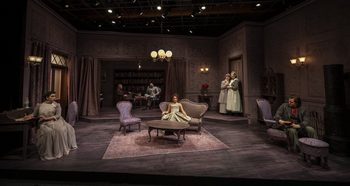
Directed by Remy Bumppo's Artistic Director Marti Lyons, Hedda Gabler is an unapologetic expression of female existence as radical action. And while the play has an extensive production history, thanks to its prominence in the canon of modern drama, reception of Hedda has long centered on her enigmatic characterization. "Why does she do and say the things she does?" But Lyons and the production team at Remy Bumppo present Hedda as a woman who frustrates critical judgment–who is not an avatar for the plight of all women, but a woman who demands your attention because she exists. Her actions, whether delightful or destructive, are a persistent declaration of her presence in the world and the efforts she will pursue to exert herself upon it. And whether we like what we see in Hedda or not doesn't really matter because, ultimately, she does not grace the stage for us. Hedda Gabler is her own ontological imperative: to live, to act, to think, and to speak across her world and into our own. The world of Hedda Gabler is presented in expressionistic framing, capturing the centrality of Hedda (Aurora Real de Asua) as the subjective lens guiding our view of the play's world. Joe Schermoly's scenic design washes the Victorian-era living room in purples and lilacs–a color scheme Hedda detests–ensnaring her not only in a disagreeable palette, but in a house that has become a trap of her own making. Her doting but aloof husband, Professor Jorgen Tesman (Eduardo Curley), bought the house with money borrowed from his beloved aunts because Hedda once mentioned liking it, but only as a way to fill an awkward moment of conversation during their courtship. Tesman and his Aunt Julie Tesman (Annabel Armour) wear loathsomely similar purple in elements in their costumes (design by Kotryna Hilko) to mirror the same effect their family has upon Hedda as the house. Her brash and unapologetic affect–made brilliantly enthralling in Real de Asua's performance–is immediately recognizable in the clothes she wears throughout the play. Contrasted against the stark Victorian morality captured in the fashions of the 1890s, Hedda refuses to diminish her presence by hiding or constricting her body. Even when she wears a black mourning dress for the death of Ejlert Lovborg (Felipe Carrasco), her sheer sleeves reveal a transparency to the woman adorned in the memory of a friend she encouraged to meet his end. And the lighting (designed by Maximo Grano De Oro) works perfectly in concert with Lyons's staging to keep Hedda squarely within our gaze, even when she may not be the primary focus of the moment. Altogether, this is a world of Hedda's making. She is not merely an individual passively impacted by existing in it but an author of its manifestations–a symbol that she struggles with the world because she wrestles with herself. Hedda's own inner turmoil is impressed upon the people around her through her seemingly inextricable actions. Her old classmate, Thea Elvsted (Gloria Imseih Petrelli), even reminds Hedda of her bullying when they were young, giving us a glimpse into the unremitting longevity of Hedda's impact and influence upon those around her. And now, Hedda decides to insert herself between the married Elvsted and her affections for Lovborg, for whom she has worked as his assistant on his soon-to-be published masterwork of scholarship. But Elvsted finds himself on the other side of Hedda's disinterest in their former romance. When the manuscript of his book goes missing, Hedda covertly destroys it and encourages Elvsted to find an honorable release by ending the depths of his despair with one of the pistols she inherited from her late father, General Gabler–a symbol of how driving others toward violence runs in the family. Meanwhile, another longtime friend, Judge Brack (Greg Matthew Anderson), finds cause to visit Hedda under the guise of helping Tesman ingratiate himself into polite society to advance his career. But Brack's motives are far more concerned with becoming more intimate with Hedda, a motivation she initially entertains but later comes to find threatening. Hedda's social milieu is a web of overlapping connections, some stretching back to her youth. But as she conducts every movement across each thread, she struggles to avoid becoming ensnared by her own decisions. The ensemble cast of Hedda Gabler are a resonant symphony conducted by Lyons's masterful hands and following the lead of their exceptional soloist, Real de Asua. Despite the stiff and stingy Victorian setting of the play, the actors move with natural intrigue and palpable connection toward one another. And with expert pacing, the play powerfully extends that connection into its audience, gripping us with the same intrigue that drives us toward its gruesome, but seemingly inevitable, conclusion. We are enraptured with Hedda Gabler and she knows that. She will ensure that her existence remains memorable to us well after she brings the lights down. Hedda Gabler runs through March 8, 2026, at Remy Bumppo, at Theater Wit, 1229 W. Belmont Ave., Chicago IL. For tickets and information, please visit www.RemyBumppo.org. |