|
Regional Reviews: Chicago Fault Also see Karen's review of The Angel Next Door and Christine's review of Windfall
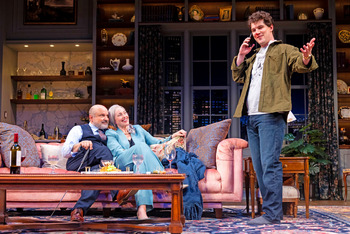
The plot unfolds, more or less, in real time in the living room of the high-end apartment of Jerry and Lucy. Jerry arrives home, intending to celebrate the truly massive merger he has managed to land, only to find Lucy and a much younger man in flagrant delicto. Jerry's reaction to the situation is erratic, to say the least, and ends with the younger man (Shaun, as it turns out, to the disbelief of Lucy, who was sure his name was Dave or "something with a D") shackled to a French Provincial chair and "agreeing" (for increasingly immense sums of promised money) to act as adjudicator as Jerry and Lucy seek a determination regarding who is at fault for the deterioration of their marriage and business partnership over the last decade. What ensues is a series of performances by Jerry and Lucy as they play to their captive judge. In the course of these, however, both characters stumble into truth and vulnerability, though there is always the possibility (or flat out likelihood) that these epiphanies are at least partly strategies as well. Moreover, Shaun's interjections and breathless demands for more and to know what happens next round out the text in a way that is believable enough, and it is only in retrospect that one recognizes how clunky and unbelievably expository the play could have been in less deft hands. The production design is slick and effective. Paul Tate dePoo III uses the entire width of the stage in CST's Yard theater space for the richly appointed living room, then lends a sense of vastness to the whole of the apartment with the cityscape outside the windows and the hallways that shoot off upstage toward the kitchen and at left toward the master bedroom, presumably. The pale, blue-green walls fill up the space, and the rose-colored, unusually long sofa adds an unnerving organic element that contrasts effectively with the pointedly masculine dark blue upholstery of the provincial flanking chairs. Greg Hoffman's lighting works beautifully within this scenic design to move the characters from early evening into the later hours. Mara Blumenfeld's costumes have little room for play within the tight narrative constraints here, yet Blumenfeld finds essential beats. The black, belted dress that Lucy wears at the play's beginning is by no means daring or carefree in isolation, yet when the character exits and suits up (even as the play's men celebrate the C word), the contrast between this barefoot, wide-skirted look and the gravity of her gray-blue pantsuit is striking. Similarly, the crimson back of Jerry's vest and the navy and olive green of Shaun's look place the two men in a space that is visually and conceptually a world away from her. It's easy to imagine how even a well-written three-hander, confined to a single location and a constrained time frame, could wind up leaving the audience able to see the calculations of when one character needed to throw in another line, however pointless or expository, to remind the audience of their existence or, alternatively, impatient with long monologues where the characters themselves seem to forget that anyone else exists. Pietsch has more patience and faith than that, and in this production Alexander's direction and the skill of the cast repay both instincts. Enrico Colantoni (Jerry) and Rebecca Spence (Lucy) are wonderful together. Colantoni comes in strange and hot as Jerry, and as Lucy, Spence's attempts to lower the temperature of the situation and render Jerry and their marriage legible to both Shaun and the audience sets up the play's comedic sensibility beautifully. Pietsch seems to be deeply interested in the eccentricities of the wildly wealthy not just as a phenomenon, but as a process. Colantoni's determined, but decidedly imperfect British accent and enthusiasm for the days of empire capture this, then transform it as he relates the failure that wounded him deeply enough to set him on his current trajectory. For Lucy, this eccentricity takes the form of decades of career success and sustained confidence that lead her to assume will continue indefinitely, until she is, on the day the play takes place, confronted with the intersection of misogyny and ageism. The specifics of each crisis grow shaky under scrutiny, but Colantoni and Spence are adept at listening attentively and they skillfully convey through the subtlest shifts and interjections that Jerry and Lucy do, in their warped way, value and love one another. Nick Marini's performance as Shaun is vital to why the interactions between Spence and Colantoni (and, by extension, the entire play) succeeds. Shackled and deprived of pants for most of the play, Marini obviously must bring the necessary farce to the play, and he delivers. But he also handles the most mundane interjections imaginable in such a way that he subtly disrupts the performances by the other characters and rouses the audience, leading them to remember that, however compelling Jerry or Lucy might be in any given moment, they are performing for the judge. Fault runs through May 24, 2026, at Chicago Shakespeare Theater, The Yard, 800 E. Grand Ave. on Navy Pier, Chicago IL. For tickets and information, please visit www.chicagoshakes.com. |