|
Regional Reviews: Chicago Scaramouche Also see Kelly's review of The Wedding Singer and Christine's review of Loki: The End of the World Tour
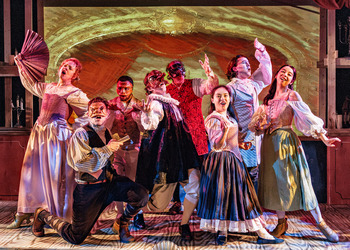
In terms of the book, Day and Glossman hew closely to the novel. The story follows André-Louis Moreau, a young lawyer who, on the eve of the French Revolution, clings to the law as a means of navigating turbulent political times. But when his closest friend, a priest in training and a man on the side of the people, is murdered in a duel with the Marquis de la Tour, Moreau is swept up in the politics of the time and finds his voice as an orator; this leads to charges of sedition that require him to flee his provincial hometown. Destitute and on the run, Moreau eventually becomes the Scaramouche of a traveling commedia dell'arte troupe. Through both his acting and writing skills, Moreau lifts the troupe out of poverty, leveraging his contributions to the point where he convinces the wary and resentful Pierre Binet, leader of the troupe, to make him a full partner in the company and bestow his blessing on Moreau's marriage to Binet's daughter, Climène. But politics and personal history catch up with Moreau when he crosses paths not only with de la Tour but also with Aline, the young woman alongside whom he was more or less raised by Quintin de Gavrillac, Moreau's godfather and Aline's uncle. Although Aline is eager to elevate her own social status and thus welcomes the romantic overtures of de la Tour, her fondness for and loyalty to Moreau lead her to distract her would-be fiancé when Moreau unmasks during a curtain call. Aline's subsequent visit to Moreau at the troupe's encampment stokes Climène's jealousy when Moreau haltingly tries to explain his own identity and his relationship to Aline. Climène, in turn, decides there's little point in resisting the overtures of de la Tour. Ultimately, Moreau co-opts the troupe's performance to call out de la Tour, leading to a riot and spurring him on to his next series of adventures as a fencing master and, once again, an accidental and not entirely enthusiastic Revolutionary politician. When aristocratic heads begin to roll, Moreau's learns that his parents are Madame de Sautron, who is also Aline's aunt, and the villainous de la Tour. Moreau reconciles with his long-lost mother and grudgingly hands a permit over to de la Tour, who flees the country. Aline and Moreau realize their feelings for one another, and they all live somewhat indifferently ever after, as Moreau decides to leave the Revolutionary government, which he finds, as he predicted at the play's beginning, to be as bad as what preceded it. The book, on the whole, does a very good job of pulling off the picaresque rhythms of the story, which is framed by the idea that the troupe of actors is recounting the story of this incarnation of Scaramouche. The songs, however, tend to bog things down rather than propelling the action and maintaining the pace. There are thirty-two listed numbers. Some, like the expository ensemble numbers that simply convey that Moreau is moving from one adventure to the next, seem unnecessary, given that the show is not sung-through and the framing device could easily lend itself to a ember of the troupe simply conveying the information in a line of dialogue or two. Others call attention to the story's rather shaky foundation in terms of its social worldview. The Marquis de la Tour, despite being truly despicable, gets two love songs, one to Climène and one to Aline, whom he is simultaneously pursuing as his mistress and would-be wife, respectively. The songs for the women also call attention to the show's questionable outlook. In "Entitled to Be Happy," Aline reveals that her sole ambition is to elevate herself through marriage, and there's little in the play that sells the idea that she has grown or changed. As a result, it is hard to be invested in their obviously inevitable pairing by the play's end. Similarly, although Climène's duet with Moreau, "By Candlelight," seems rooted in romance and individual connection, her second primary number, "Explain!," seems to indicate that she, too, is purely mercenary and was never particularly attached to Moreau. Certainly constraints on women's choices in this historical period are relevant to this, but between the two love songs for the play's primary villain and these superficial songs, the show's romantic plots are unsatisfying, if not outright troubling. Some of the songs do indicate that a musical approach could be successful with further development. "The Time Has Come," delivered by Moreau's fiery friend Philippe, nods to Les Misérables, but is rousing and original in its own right. "A Brand New Play," in which Moreau convinces the troupe to lean into its source material, rather than toiling to be entirely original, is a great number, both musically and in terms of its point of view, and in the second act, "Fencing" offers a great, energetic lift, after a few too many reprises of earlier songs. The staging, as is usual for City Lit, is great. Trevor Dotson uses a rickety "stage" as the centerpiece of the scenic design. The audience can see the unsteady wooden frame surrounding a screen that houses projections of the troupe's various theaters, the French countryside, the lavish ballroom of Madame de Sautron, and so on. Projection designer DJ Douglass chooses an impressionism-influenced style that communicates the reality that the play is casting its eye backward and thus viewing the society and politics of Revolutionary Era France through a historical lens. Jackson Mikkelsen's lighting design is good on the whole, particularly in terms of underscoring rapid shifts in setting. There are times when the lighting might benefit from a bit more restraint, though. In particular, the use of intense red to denote the revolutionary cause begins early, and the visual cue gets somewhat confused in the violence of the second act, which is not the sole purview of the revolutionaries themselves. Jennifer Mohr's costumes are well done and, for the most part, versatile. Mohr sells the opulence of the world of Aline, the Marquis, and Madame de Sautron as well as the hardscrabble existence that the members of the troupe lead. There are times when the costume design would have benefitted from a bit more visual distinction when an actor plays multiple roles. This is most notably true of the actor who plays Moreau's revolutionary friend as well as a member or the troupe and, later, a nobleman. The cast is very good across the board. Ethan Smith has all the charisma necessary to keep the audience invested in Moreau's journey. Smith is a strong singer and a compelling enough actor that his performance goes a long way toward selling the questionable romantic storylines. As Pierre Binet, leader of the troupe, as well as Moreau's godfather and Bertrand des Amis, the fencing master who mentors Moreau late int he play, Henry Michael Odum is really a standout. Most notably, he has the best feel of all the cast for both the comedic and dramatic beats. Laura Michele Erle has a lovely voice and gives the role of Aline more depth than the text itself seems to afford. Erle finds opportunities for this as Aline advocates for reconciliation between Moreau and his godfather, and even in the moments when the character draws on the social graces of her class to navigate her own life and urge Moreau to reflect on his own beliefs, rather than simply reacting. "By Candlelight" offers India Huy (Climène, as well as Madame de Sautron's servant Jacqueline) an opportunity to show off her voice, which unfortunately gets overpowered in other numbers. Climène is a bit of a thankless role, and although Huy certainly stakes out a character, the performance would likely have benefitted from direction that imparted a bit more force, which might in turn have helped to shore up the romantic triangle. As the Marquis, Kent Joseph does what he can with a perplexing character. Joseph has a good voice, but one that is perhaps not as well suited to the two head-scratching ballads the character is charged with singing. Likewise, he shows himself to be a capable actor, but the role seems to require more thoughtful direction if the audience is meant to see it as anything more than a villain of the mustache-twirling variety. Alicia Berneche fairs somewhat better as both "Madame," a member of the troupe, and Madame de Sautron. Berneche's strong, operatic voice is well-suited to the fan-snapping, sharp-witted actress, and she leans into the absurd melodrama of the revelation that she is Moreau's mother. In the ensemble, Connor Ripperger stands out as Philippe, the friend whose murder by the Marquis spurs Moreau's journey, and as Léandre, the hopelessly inept romantic lead in the troupe, among other roles. Shea Lee also demonstrates great comedic timing and physicality. Rushil Byatnal and Ed Rutherford have a variety of minor roles, but both inject distinct character into each and lend their excellent voices to fill out the ensemble numbers. Scaramouche runs through June 14, 2026, at City Lit Theater Company, 1020 W. Bryn Mawr, Chicago IL. For tickets and information, please visit www.citylit.org or call 773-293-3682. |