|
Regional Reviews: Chicago Spamalot Also see Kelly's review of South Pacific, Karen's review of An Enemy of the People, and Christine's review of Tartuffe, or, The Charlatan
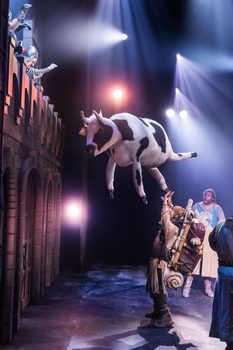
Idle is a gifted comedian, but his skills as a dramatist are not quite as sharp. Almost all of the songs in Spamalot overstay their welcome for at least a verse, milking the joke past the point of diminishing returns. For instance, "The Song That Goes Like This" is a funny sendup of the musical theatre convention of an overwrought, emotional ballad. The joke is clever, particularly when Galahad croons "Now we can go straight/into the middle eight/a bridge that is too far for me" before singing about how the modulation up to E is too high for him. But then the song just sort of keeps going. Even when Idle has the actors call attention to how long the number is, the joke has lost its power. In theatre and in comedy, less is more. The clearest example of Idle's lack of dramatic sensibility is his choice to interpolate "Always Look on the Bright Side of Life" into the show's score. Of course, it's probably the most famous song in the Monty Python catalog, but it's beloved because of the ridiculous circumstances in which it appears in Life of Brian. Here, King Arthur's loyal servant Patsy sings the number at the top of the second act to lift the king's spirits after the Knights of the Round Table are scattered by the French taunting. It's just not as funny when it's not coming from a group of crucified convicts. Any adaptation exists in a tense relationship with its source material, but the generally tepid reaction to the show from the other Pythons (who mostly said they appreciated the residuals) is telling. On a basic level, the ultra-dry, surrealistic-inflected Python style is at loggerheads with the bombast and broadness of musical comedy. Much of the show's book is drawn directly from the source film, and it often sits uncomfortably next to the musical elements. A huge part of the charm of Holy Grail is the fact that it looks like it cost about £1000 to produce. I'm not the world's biggest Python-head, but anyone who likes comedy has to appreciate their influence and their ability to create incredibly memorable and vivid material on a shoestring budget. I fundamentally believe that constraints make great art, and Monty Python is one of the best examples of that principle. Absent those circumstances, much of the show can feel like a dorm room recitation of the movie's script rather than a real reimagining. That said, only the most committed of grouches could have a truly bad time at Spamalot, and it does succeed when it finds ways to make the form serve the content. For instance, the show opens with a much more successful interpolation of the "Fisch Schlapping Song," a deeper musical cut that's a lively, bright production number and a nod to the film's bizarre credit sequence. Likewise, the climactic sequence with Tim the Enchanter and the Rabbit of Caerbannog is delightfully theatrical thanks to some simple puppetry. And the second act veers further from the film's plot after the Knights of Ni demand Arthur write a Broadway musical, descending into some wild metatheatre before reimagining the film's ending in a way that's much more consistent with musical theatre conventions, breaking the fourth wall to find the grail ahead of a wedding. The more Spamalot departs from the source material to find its own voice, the better it gets. This touring version, like the 2023 Broadway revival, is directed by Josh Rhodes and updates the material with a smattering of contemporary pop culture references. Some of these work quite well (a George Santos gag in "You Won't Succeed on Broadway" and a surprisingly funny Trump joke sold perfectly by Sean Bell as Sir Robin) while others fall flat (can we stop doing "hawk tuah" jokes now, please?). And the play does show its age a bit, although I think you'd have to try to be offended by a show this zany. The cast is fortunately delightful, which is essential to making the show work. The ensemble clearly understand the source material well. Whatever else you can say about this show, it's an actor's paradise because most of the performers play more than one part. In one of the few undoubled roles, Major Attaway's rich, powerful baritone voice contrasts with the almost childlike energy he brings to King Arthur. Sean Bell's Sir Robin is a highlight, particularly his star turn in "You Won't Succeed on Broadway" and his showstopping gag with his minstrels. Steven Telsey's Prince Herbert is an almost uncanny likeness of Terry Jones (my favorite Python), and Amanda Robles makes a meal out of the Lady of the Lake's songs. But the MVP is probably Chris Collins-Pisano, who plays Lancelot as a feral little monster while taking scene-stealing turns through the head Knight of Ni, Tim the Enchanter, and the French Taunter. If you've never seen Monty Python and the Holy Grail, you'd be better served to watch the film first. But for Python fans, there's plenty of fun to be had in revisiting this eminently quotable classic. Spamalot runs through May 31, 2026, at the CIBC Theatre, 18 W. Monroe St., Chicago IL. For tickets and information, please visit https://www.broadwayinchicago.com. For information on the tour, visit https://spamalotthemusical.com |