|
Regional Reviews: Chicago Tartuffe, or, The Charlatan Also see Christine's reviews of Covenant and Scaramouche and Seth's review of Going Bacharach: The Songs of an Icon
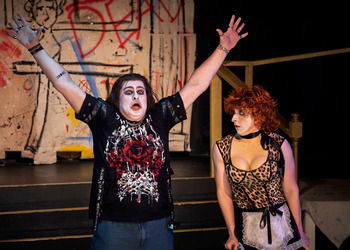
The collective offers no credit to a translator or adapter (Stef Brundage is credited as dramaturg), but whatever English version the production proceeds from is excellent and exactingly executed by the cast. The story unfolds in the household of Orgon who, under the influence of his mother, Mme. Pernelle, comes to admire the decidedly shady Tartuffe, a man Orgon has saved from poverty. This devotion devolves into madness as Orgon vows to wed his daughter, Mariane, to Tartuffe, thus breaking the existing promise to marry her to Valère. As relatives, servants, and Mariane herself object to this arrangement, Orgon digs his heels in, banishing his son Damis, and making Tartuffe his heir. Wackiness ensues in the form of a lovers' quarrel between Mariane and Valère, as well as the absurd efforts of Orgon's wife, Elmire, to prove to him that Tartuffe is a lecherous fraud. Ultimately, though, the "king in the machine" saves Orgon (and those who depend on his privilege) from himself and the insidious forces of the older generation. Morgan Laszlo's scenic design relies largely on dividing up the black box theater with heavy black draping that allows for characters to pop in and out of the action from multiple "entrances." This is augmented by off-white canvas "walls" covered in the suggestion of buildings and extensive punk-infused graffiti. Otherwise, the only set elements are a wide set of upstage center stairs that lead to a balcony, a pair of chairs that are also draped with graffiti-filled cloths, and the covered table that facilitates Tartuffe's unmasking near the end of the play. It's a smart, lean design that's well-suited to supporting the precise, percussion-punctuated movements of the actors. Ollie Voirin's costumes mirror the vibe of the set, as well as adding important layers of visual information. Mme. Pernelle's funereal plum suit and head scarf, together with a distinctive Kabuki-influenced style of clown paint signal both class and generation. Orgon and his wife Elmire are outfitted in formal wear that manages to come across as gaudy, stuffy, ostentatious, and shabby all at once. Their starker clown white contrasts with the subtler makeup for Mariane, Valère, and Damis, whose costumes are rooted in a punk/metal aesthetic that seems to emphasize individuality, even as they constitute a kind of uniform for this younger generation. Tartuffe's look draws on the visuals of all three generations: his makeup most closely resembles that of Mme. Pernelle, whereas his glittering gold jacket and walking stick speak to the crass, new-money aesthetic of Orgon and Elmire. Finally, his tunic seems to be a nod to famous fellow charlatans like the Maharishi, but the Black Flag logo gives him a kind of demented Youth Pastor vibe. Abbie Gillette's lighting design and Sebby Woldt's sound also work well with Laszlo's set. Both contribute to the chaotic energy and high drama of the play's action, despite the fact that both elements are clearly minutely planned and precisely executed. The percussion by Tom Jasek is the highlight of this. Whereas the lighting and sound move the overarching story along, it's Jacek's work that makes the production fascinating from beginning to end. Jacek provides cues for every line of dialogue, as the actor delivering it stares directly into the audience, and all others on stage snap their attention to the speaker. It's easy to see how the device could become wearing if it weren't so deftly directed and executed. The performances are excellent across the board. As Mmm. Pernelle, Vi Burnette is infuriatingly condescending and unflappable, combining weaponized civility with true nastiness. In relatively little stage time, Burnette perfectly captures the impenetrability of the true believer. Henry DelBello's performance as Orgon draws beautifully on Burnette's. Orgon is more human than his mother, but this is hardly a recommendation. DelBello whipsaws between unhinged hyper-emotionality and the coldness and rigidity reminiscent of Mme. Pernelle. Meanwhile, as Orgon's brother-in-law, Cléante, Talia Neidorf, with pipe always on hand, offers an equally absurd, quasi-intellectual character who pops in to lend "both sides" weight to the proceedings. These paired performances, in turn, set up Oline Hale for success as Orgon's wife, Elmire. Hale's performance is much lower key, but no less important to why the production is so interesting. Although "stabilizing" would be an inapt descriptor for any character in the play, Elmire is canny and intelligent, even as she greases the wheels of the farce. Hale blends class-conscious stiffness with strategically deployed (and comically heightened) sexuality, lending and weaving an interesting, gendered thread into the fabric of the plot. As Mariane's maid, Dorine, Tucker Privette takes up that thread and runs with it. In her plunging, leopard-print top (complete with gaffer-tape x's over nipples) and Frederick's of Hollywood French Maid skirt, Dorine evokes every shrewd servant in literature and theatre who pulls the strings of their "betters," and in so doing keeps their from crumbling, at least for the moment. Privette's comic timing is impeccable, as is his combination of sweetness-and-light deference with simmering frustration and rage provoked by how profoundly stupid and oblivious even the young lovers are. With such a large cast of characters, and such a demanding approach to the material, one might expect some roles or performances to slip through the cracks. That's not the case here. Riley Marie Fortin (Mariane), Anthony Soto (Damis), and Jacob Dorris (Valère), to some extent, have less dialogue and more broadly drawn characters, yet Bullion's direction gives each their due, and all three repay that investment. In fact, it seems strategic that each of the three characters seems, initially, as if they might be a bit of a throwaway, but the actors gradually build their performances so that each is ultimately as "real" as these highly stylized individuals can be. Deacon Leer's performance as Tartuffe is quite fascinating. One might expect a nonstop charisma blitz from the title character, thus "justifying" the fact that Orgon and Mme. Pernelle have fallen under his spell, but that's not where Leer takes the role. He also doesn't lean into the other extreme by playing Tartuffe as an entirely despicable, slimy figure. Rather, we see Tartuffe leaning on snappy interactions with his flunky, Laurent, and there's excellent rapport between Leer and Phillip Smith in this regard. Leer lets Tartuffe's attempts at seduction fall entirely flat and trusts the brilliance of the verse to sell his virtue and piety to those who want to be convinced of it. As Mme. Pernelle's servant, Flipote, who also turns out to be the Officer of the Court who ultimately serves Tartuffe his comeuppance, Grace Reynolds is mostly in the background. But true to the tight, collaborative spirit of the production, her physicality and facial reactions are an important part of the success here. Tartuffe, or, The Charlatan runs through June 7, 2026, at Stars & Garters, 3914 N. Clark, Chicago IL. For tickets and information, ConspireWithUs.org. |