|
Regional Reviews: Chicago Two Out of Three Falls Also see Kyle's review of Southern Rapture, Christine's reviews of Deserted, Catch as Catch Can and Untitled Vampire Play and Seth's review of Leopoldstadt
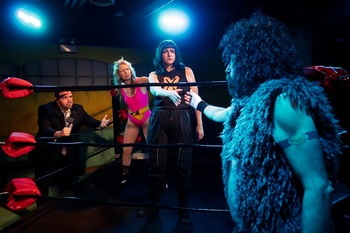
The story centers on Johanna Goodish, a woman barely clinging to a career in low-tier wrestling. Her tenuous hold is further threatened when she begins seeing her father, a wrestler who had been murdered thirty years earlier, causing her to freeze during matches. Troubled by the sightings and out of options after she injures an aging "star" in the ring, Johanna reaches out to her ex, Meg. At Meg's encouragement, Johanna eats crow with the promoter and agrees to let Gilda, the wrestler she had injured, humiliate her in the ring. But when her father appears again, Johanna is startled into punching Gilda and knocking her flat. In a panic, Johanna seizes the moment to announce her intention to avenge her father's murder by killing Eduardo Quiñones, "El Moreton," the man who stabbed him in the showers after a match and walked away without consequences. The stunt catches the eye of Jackie Cartwright, Jr., who runs a pay-per-view-worthy wresting organization. He offers Johanna $500,000 to meet Quiñones in the ring in just three weeks' time. With Meg stepping in as her manager, Johanna agrees, and Cartwright sets her up to train with Olympus Montez, a wrestler who knew her father. The central story, which Daniel acknowledges to be a fictionalization of real events, has a lot of promise, and the play itself realizes some of the potential. For example, with Meg's support, we see Johanna begin to process her relationship to her father's memory and murder, as well as her relationship to wrestling. But there are some threads that Daniel does not seem interested in pulling, such as what led Quiñones to kill her father in the first place or why Cartwright, in a very abrupt turn, would ask Johanna to actually kill Quiñones (rather than simply abiding by the agreement to "stage" his death in the third fall of the match). Other plot threads, like Meg and Johanna being exes with unresolved feelings, are set up early on, then neglected for most of the play until the relationship suddenly advances again, apparently for the sole purpose of giving Johanna something to lose if she actually goes through with the plan to kill Quiñones. More seriously, the text pays very fleeting attention to the issue of race in wrestling, then quickly moves on. Complicating these bumps in the text is the fact that Yates hasn't quite achieved a balanced tone in directing the show. The characters of Gilda and Cartwright, for example, play everything big. This is not only rather one note, it tugs at the very idea of wrestling as theatre by not providing these characters with distinct personae in and out of the ring. Quiñones also seems to be "always on," down to addressing all his lines to the audience, rather than other characters, but the performance is rather inexplicably subdued. And on a simple practical note, there are often gaps when one character finishes a line delivery before another character responds. This drags the pace of the show down, making it feel longer than it is and making some exchanges between characters seem superfluous. There are also some blocking difficulties. The space, which has several support pillars, is certainly challenging to work within, but some of these seem to be unforced errors; for example the audience is seated in a "L" on two sides of the set ("downstage" from the office entrance and "stage left" from the ring). An early fight between Gilda and Johanna takes place up against the downstage left pillar, meaning that it is all but invisible to the audience seated downstage. Other aspects of the production, though, are strong. The set by Manuel Ortiz comprises a ring surrounded by elements suggesting a gym and a small, cramped alcove that serves as the seedy offices of promoters and bigwigs within the organizations. Ortiz conveys the warmer, safer space of the house that Meg has inherited from her mother with just a pair of chairs and an end table that cast members move on and off as needed. Emmitt Socey's lighting design does a great job of pumping up the energy during promos and matches, as well as bringing the harsh, gritty light to the offices of sketchy characters and to the ring during training. Gina Montalvo's sound design also supports these shifts in physical and psychological space. Anna Rogers' costumes paint with broad strokes, for the most part, and those broad strokes work very well. In particular, all of the choices for the play's climax are very well done individually and they work together beautifully. Most importantly, though, is the fact that the wrestling (Kate Lass is the wrestling/fight director, and Axel Rico is wrestling consultant) look great, whether it's Johanna and Olympus messing around, or Johanna and Quiñones in a bout with the highest possible stakes. Brittany Ellis is very good as Johanna. She convincingly plays the weariness of a person in Johanna's position, and even if the play doesn't necessarily give us the clearest sense of who Johanna is or how damaged she might be, both physically and psychologically, Ellis's choices and body language really flesh out the character. SaniaFaith is similarly good as Meg. She and Ellis convey the solidity of the relationship between the two characters that persists even though Johanna has not done right by Meg. The rapport the two actors create makes one wish that the play had invested more consistent attention in this relationship. SaniaFaith is particularly adept at communicating the slightly naughty thrill Meg gets from seizing the mic and taking the stage every time Johanna freezes at an important public moment. Jamaque Newberry offers the strongest performance in the supporting cast and, like Ellis, the work he does goes a long way toward remedying some of the gaps and rough patches in the play itself. Newberry's performance is particularly notable for the way it succeeds in selling the character's guilt and shame for never speaking out in the wake of the murder, but also capturing the fact that Olympus is a would-be performer who can't resist an opportunity to return to the spotlight, even if it means shining a light on his deepest pain. Eric Frederickson is entertaining as Amos Goodish, aka King Kong Bruiser. The character is not only the ghost of Johanna's father, but also a semi-mythical representation of how things used to be in the wrestling world. Frederickson is good in the brief scene where he and Johanna actually talk, after a fashion, and it's a disappointment that the character essentially disappears well before the play is over. Ron Quade is effectively sleazy and over-the-top as Jackie Cartwright, Jr., just as William Hardin is the flashy number two as Tony Voss. As Gilda Saxton, Holly Cerney struggles to find her feet as an admittedly underwritten character. There are moments that certainly work and clearly showcase Cerney's talent, but Gilda is too broadly drawn to really be an effective or interesting character. Two Out of Three Falls runs through July 18, 2026, at The Factory Theater, 1623 W. Howard Street, Chicago IL. For tickets, visit TheFactoryTheater.com or call 312-275-5757. |