|
Regional Reviews: Chicago St. Nicholas Also see Christine's review of Two Out of Three Falls and Kyle's review of Southern Rapture
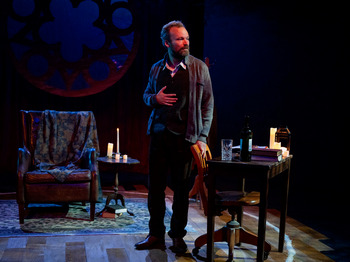
The play calls on the lone actor to hold the audience's attention for close to two hours as the unnamed character relates, at some unspecified point after the events he's recounting, what amounts to his frustrated artistic ambitions colliding with a standard-issue mid-life crisis. He commences the story well into his debauched career as a theatre critic (and, by his own account, a fraud who thrives on tearing "those who can" down) in Dublin. Having grown fat and red in the face on drinks bought by actors, directors, and playwrights desperate to get on his non-existent good side, he finds himself smitten by a young woman, Helen, in an indifferent production of Salome. Drink and the unexpected stirring of long-dormant feelings lead him to tell the production's director and assembled company, including Helen, that he has already filed a glowing review. A kiss on the cheek from Helen after he drives her home, coupled with the knowledge that his actual review has surely contributed to the play's run being cut in half, is sufficient to prompt him to abandon his family. He flies to London on the heels of Helen's company and spends the day and much of the night stalking her and downing liquid courage. He ultimately presents his drunken self to the house where the company is staying and continues to drink as he attempts to sell the story that his editor changed his glowing review and he, of course, resigned from the paper immediately. Although the director, Helen, and another young member of the company are drawn to this version of events, a slightly older woman who has already crossed paths with our critic flatly states that she does not believe him. The night unravels with a whimper as the director and actresses retire upstairs, and the critic drinks himself even more deeply into a stupor. An encounter with a porno magazine awakens darker tendencies in him, but the image of the daughter he has abandoned ultimately pulls him back from the brink of assaulting Helen. He stumbles away from the house and his life and falls into nightmares in a park, miles from anything. It's there that he meets William, a vampire. He needs very little persuading to become the Renfield to what William assures him amounts to a quite benign nest of vampires. For the price of charisma and snappy clothes, the critic becomes the Renfield for Willam and "the women." For the next "while," he uses borrowed thrall to lead young people back to the house where, according to William, the vampires will give them the party of their lives, take from them only what the vampires need to survive, and leave the victims with no memory of the encounter. But as he contemplates William and the power the vampires have not to control others, but to make them want what the vampires want, the critic reemerges and he comes to feel contempt for William's pronouncements on art and the vampire's longing for a conscience. Frustrated, the critic uses a detail that William has provided him against the vampires he smashes a jar of rice, leaving them trapped by their compulsion to count each grain. That night, he decides that the group of victims he will bring to the vampires will be the last. Helen, once again, turns out to be part of it. The vampires forego the party and simply feed on them, the critic included. As he wakes, bloody and dazed, the man does feel obliged to get Helen out of the house, but even as he does so, he realizes that he can now return to Dublin, as he has secured the one thing he has always longed for: a story to tell. The play is odd, to say the least, but laudably watchable, given that its form is one that can easily become tedious if not handled well. McPherson moves deftly between relentless, detailed descriptions of bodies and bodily functions to highly abstract reflections on art and morality to beautifully rendered moments of love and human connection. Rutherford and Webb navigate this varied terrain with ease. Just when the audience is likely to be drawn in to a lovely description of a tender moment, Webb snaps back into cynical, manipulative character to mock us for falling for it. The end result is a meditation on what we allow to move us and how we come to want what we want. If there's a weakness in the play (and/or the production), it is likely that the timeframe is somewhat unclear. The first mention of the character's "track-suited wife" comes as a surprise, for example, and the length of time he spends recruiting for the vampires is a bit vague, as is the time elapsed since his last "mission." Jeremiah Barr's set design suggests dislocation in both time and space, a vibe that costume designer Sypniewski leans into by outfitting Webb in the uniform of an educated man of a certain age. Barr has created a more or less circular hardwood floor, but we see the irregular ends of its boards, as though the timeless, candlelit study is not quite of this world. A perfect circle of rice encloses the space, and using a leather chair, a small desk, and an end table that doubles as a bar, Barr provides the suggestion of spaces for Webb to move through as he tells his story. The set is visually effective, and Liz Cooper's lighting does excellent work to move the story along within the space. Cooper's lighting cues are deliberately legible without ever being obtrusive. Joe Griffin's sound design is largely on par with the set and lighting, although the integration of music into the play's soundscape is not quite as smooth as the more straightforward, world-building cues. Kevin Webb's performance is flat out impressive. He does not shy away from what is contemptible about the character, nor does he let the character's self-awareness become some badge of honor inclined to win the audience's grudging respect. But neither does he descend into gleeful sociopathy. For as much as the character's self-loathing demands that the audience be aware that he is manipulating them when he speaks of his daughter as a child, his wife when they were falling in love, or even Helen as he dwells on his obsession, Webb conveys that there is something real, human, and complicated behind these moments. Black Button Eyes Productions' St. Nicholas runs through July 26, 2026 at City Lit Theater Company, 1020 W. Bryn Mawr, Chicago IL. For tickets and information, please visit www.blackbuttoneyes.com. |