|
Regional Reviews: Chicago Eureka Day Also see Savannah's reviews of Kowalski, A Wrinkle in Time and Blood of the Lamb, Christine's review of Play On! and The Attic, Catey's review of Jekyll & Hyde, Joe's review of Dirty Dancing: The Musical, and Karen's reviews of Witch and Birds of North America.
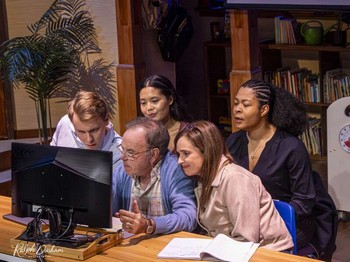
Eureka Day premiered in Berkeley, where the play is set in the 2018-19 school year but took on new meaning after the COVID pandemic raised new questions about vaccines and science and how we decide what to believe. It takes place in a private school, meticulously designed by Bob Knuth for the Citadel, where decisions are made by the consensus of the executive board. The board is made up of a founding member of the school, Suzanne (Jennifer Ruffner); Eli (Ethan Check), a stay at home dad and we later learn a founder of a major tech company; Meiko (Carmen Liao), a single mom; Carina (Alexis Primus), who holds the seat always reserved for a new parent to the school; and Don (Steve McDonagh), the headmaster who serves as the mediator of the board. It is clear from the start that every member has the best of intentions–or at least very liberal-leaning ones. It is also clear that their inclusivity is performative, especially as Suzanne, Eli, and Meiko consistently throw microaggressions at Carina, the only African American on the board. When a mumps outbreak brings to light divergent viewpoints on vaccines, science, and one's obligation to the community, that performance of inclusivity begins to break down in often hilarious ways and the consensus begins to crumble. I have really grown to love the Citadel space, especially when it is used for these intimate and revealing stories. Though cluttered like an elementary school classroom (the retired first grade teacher sitting next to me exclaimed she felt right at home), Westerman uses Knuth's set to perfection. The action centers around two small rectangular tables that are moved for each scene, reflecting how the characters are feeling: pushed together into a square for scenes of consensus and spread apart or lined up when the community begins to pull apart. Westerman's staging, including at times having characters with their backs to us, also deepens our understanding of who is included and who is an outsider, even when they are full-paying members of the community. However, the funniest scene of the show drops this table convention altogether. This scene happens when Don and the executive board host a Zoom community meeting. The audience is treated to a view of the screen, complete with increasingly vitriolic online comments popping up throughout. Peter Boenish's projections are tremendous, with comedic timing all their own. While it was purposely difficult to listen to the actors while also watching the comments scroll across the screen, I could instantly feel the weak bonds of the community beginning to crumble. Westerman's vision is clearly supported by an equally strong cast. Each member of the executive board embodies their character fully, adding to the humor, tension, and conflict unfolding onstage. The standout is Primus, who begins the show as the outsider. Through their reactions and expressions, so clearly visible in the close quarters of the Citadel, the audience is also encouraged to question the authenticity behind the board's discussions of inclusion. Ruffner presents a great foil to Primus, clearly grounded in Suzanne's convictions that everyone–or more importantly, everyone's beliefs–should be valued and included equally... as long as they align with hers. The explosive scene between Primus and Ruffner in Act 2 is incredibly powerful. There are no weak links in the cast, so I will add that Liao, Check, and McDonagh also shine. It is especially pleasing to watch the arcs of both Liao and Check as they experience clear changes of heart and perspective throughout the show. McDonagh brings great comic timing to his role as school headmaster and meeting mediator, adding a special moral wrinkle: how far will someone go to keep the school they love afloat? Eureka Day is the kind of play that makes you laugh and then makes you question why you are laughing. It asks what happens when people who genuinely believe they are doing the right thing discover that their convictions have more limits than they realized. You may recognize yourself in these characters, or the people sitting around you, and you may find yourself continuing the conversation long after you leave the Citadel. That is what makes Eureka Day such a compelling night of theatre. It doesn't tell you what to believe. Instead, it puts a group of people with very different beliefs in one room and lets us watch what happens when consensus becomes harder to maintain than anyone expected. Eureka Day runs through October 11, 2026, at Citadel Theatre, 300 S. Waukegan Rd., Lake Forest IL. For tickets and information, please visit www.citadeltheatre.org
|