|
Regional Reviews: Chicago Play On! Also see Catey's review of Jekyll & Hyde, Joe's review of Dirty Dancing: The Musical, Christine's reviews of The Attic and The Swallow, Karen's reviews of Witch, Birds of North America, The Birth of the Pill and I Killed Andy Breitbart, and Savannah's reviews of A Wrinkle in Time and Blood of the Lamb
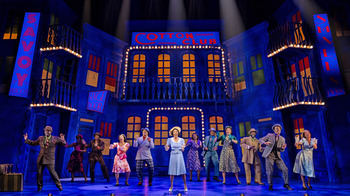
In translating Twelfth Night to Harlem at the height of the Great Migration, the show more or less dispenses with the twin plot. Drawing on the real-life experiences of large families from the American South and elsewhere, the show posits that Vy really is the only surviving twin (rather than just believing she is). She considers Sebastian to be her angel now, and she has moved from Mississippi to Harlem to realize her dream of being a songwriter. She tracks down her Uncle Cootie, who is better known as Jester in New York. As a hanger-on at the Cotton Club, he represents a blend of Shakespeare's Feste and Sir Toby Belch. Olivia in this version is Lady Liv, a Cotton Club diva attended by "Lady Mary," whose love interest, "Sweets," is Liv's bandleader and another facet of Sir Toby. Malvolio is represented by "Rev," the uptight man reviled by others at the Cotton Club for his constant threats to fire anyone and everyone if it will keep Lady Liv (and those who make her career possible) happy. Rounding out the drama (and the romantic comedy) is the Duke, a songwriting genius whose ingenuity has waned since Lady Liv has sworn off men, leaving him without inspiration. There's a lot of inherent potential in streamlining Shakespeare's cast of characters, and so much that appeals in updating the setting to the Harlem Renaissance. However, the show teases much of that potential without realizing much of it. For example, it seems interested in examining the hazing of Malvolio/Rev through the eyes of Mary and Sweets, who have been terrorized by his regular threats to fire them, when they are trying to maintain a toehold in the world of their artistic dreams. There's potential for what reads as a bullying subplot that is played entirely for laughs in Shakespeare to become more complex, as we are (very briefly) invited to consider what forces Rev has been trying to manage and what has motivated his choices. But that potential is undermined by superficial approaches to Mary's character. We learn only that she, too, is a singer, but we learn no more about why she is relegated to serving as Liv's dresser. In the original, of course, there is little engagement with the why of the social order: Olivia is a noblewoman and Maria is not, and the comedy emanates from the lowly being far cleverer than their aristocratic "betters." But in the quasi-meritocracy of Harlem, we are given no insight into why Liv is on top and Mary is not. Furthermore, her "happy ending" is reduced to Sweets begrudgingly agreeing to marry her. Certainly that's no shallower than the endings of all Shakespeare's comedies, but the reimagining of the story has promised the audience more. Similarly, there's no engagement with (or even acknowledgment of) the queerness of the Harlem Renaissance. Instead, the show flattens even theoretical gender play of boys playing girls playing boys, as everyone except Liv and the Duke knows who Vy really is, and the Duke is simply freaked out when his relationship to "Vy-Man" becomes complicated in terms of attraction. In terms of the production, Beowulf Boritt's scenic design is excellent. Other than the opening number (Billy Strayhorn's "Take the 'A' Train"), which takes place on the apron, all the scenes are set against an effectively cartoonish backdrop representing the Cotton Club at center stage, crowded on either side by other spaces important to life and community in the Harlem Renaissance. The set has two levels, allowing for character introductions and songs of isolation to be presented with flair or melancholy, thanks to assists from Adam Honoré's strong lighting design, as the moment demands. Some of the play's best visual moments come from the intersection of Boritt and Honoré's work, as it seamlessly flips the audience's point of view from the house at the Cotton Club to its backstage, and again as the figure of Lady Liv is coaxed out of the shadows, then swallowed up by them again during her first number. Edgar Godineaux's choreography also navigates the space to its advantages. Godineaux's skill is on full display in the numbers in which the entire community comes together in their pursuit of both art and performance, as well as in the simpler, more joyous moments of of movement and song. It's curious and unfortunate that there are few of these sprinkled throughout the show, which underutilizes its talented ensemble. An-Lin Dauber's costumes are also terrific. Lady Liv is every inch the style icon she needs to be, and Dauber both connects characters like Mary and Sweet through color and cut, then reflects divisions between them by adding a clashing shade or a piece that is styled to signal paths that are poised to diverge. And Rev's yellow suit is the climax of the costume design as it needs to be. Where the production does not always hold up, unfortunately, is musically. Epps does not seem to have made a clear decision about how to deal with the conceptual gap between the pit band and the fact that the characters on stage are meant to be making music. When it comes to the Duke or Vy playing the piano, the staging does well. They begin numbers at the piano, then the music takes over without any jarring disconnect. But when ensemble members are on stage with instruments during a scene centered around a derailed band practice, there's no connection between action on the stage, instrumentation, or the song lyrics. Certainly it's a losing proposition to ask actors to mime playing, but in this case, one wonders why the ensemble members are holding the instruments throughout the scene. At the performance I attended, there were shaky moments from the six-piece band as well. Most were confined to the early moments of the show, and there were truly brilliant moments later, so this might be attributable to the swapping in of Nathanael Wilkerson (associate music director) as conductor, a role usually played by music director Theodis Rodgers, Jr. But there is also a more pervasive issue with the song arrangements (Luther Henderson, Jr. is credited with the orchestrations). Understandably, there are constraints when trying to fully realize Ellington's music with a small ensemble, but those constraints are disappointingly evident at times. The cast are all excellent singers, yet there are a number of moments where songs have not been arranged well (or perhaps rehearsed rigorously enough, given that these often occur in the lesser-known songs) to suit the singer's voice. The feeling overall is that the production has underestimated the complexity of the music. All of this said, the production is well worth seeing, thanks to the elements of it that work well, and especially thanks to its excellent cast. Krystal Joy Brown is outstanding both musically and in terms of acting as Lady Liv. Whether by dint of her own familiarity with the music, greater vocal flexibility, or simply more attention smartly paid to nailing this character's numbers, Brown is the cast member whose performance is quite flawless. Her energy is infectious, and as adept as she is at the comedy, when the show gives her emotional material near the end, she sells this as a genuine aspect of Liv's character, without making simplistic choices that imply that there's nothing of the selfish diva at her core. Hailee Kaleem Wright is very good at capturing Vy's guilelessness and innocent determination, as well as the awkward, too-much vibe that makes for an effective contrast to the long-time residents of this particular scene in Harlem. Much of the material later in the show make it clear that Wright is an excellent singer with a technically and emotionally powerful voice, but the show's early numbers don't showcase that voice at its best. Alanna Lovely's performance as Miss Mary makes one wish the show had more for the character to do. Lovely's voice is nearly as strong and remarkable as Brown's, and she elevates the tantalizing material, introduced unfortunately late that hints at the complexity of the character and its great potential. James Earl Jones II's performance as Sweets amplifies this feeling. Jones and Lovely are a familiar duo, both in Shakespeare and in the more contemporary stories. They are the B plot that becomes far more interesting, because the characters are more complicated and more mature. The work these two do together understands that trope, yet breaks its confines. Jones is a wonderful singer and dancer, and as an actor, he seems willing to lean more into the stereotype, confident that this frees Lovely to do more with it and bring him and his character along for the more interesting ride. Like Brown, Alan H. Green as Rev seems to thrive vocally. His performance is also interesting. It ticks all the Malvolio boxes with its stiff, irritating mannerisms, but there's a darker, more frustrated undertone, and in the limited exploration of economic and social realities, Green sells the idea that Rev's actions are not a matter of simple pragmatism or willingness to sell out, but a rational (if not exactly likable) response to the realities around him. Edred Utomi is intriguing as the Duke, though like Wright, the arrangements don't always support his very good voice. Early in the show, he plays the character's melancholy artistic frustrations well, and when the show remembers that Vy's decision to play Vy-Man is entirely motivated by her uncle's insistence that men will never take a woman songwriter seriously, Utomi does as well as any actor can with some weak material. But the character is not particularly well integrated into the show, and it's unfortunate that Utomi's acting talent is relegated to some isolated scenes. James Harkness is great fun as Jester. Harkness is fully up for the swagger the character demands and the moments when the character is knocked down a peg. Kaylah Janssen makes an impression with very little material to go on as his love interest, CC, but these two talented singers and actors are underutilized in what wraps up as an overcrowded ending to what started as a remarkably strong second act. Play On! runs through October 18, 2026, at Chicago Shakespeare Theater Yard Theater 800 E. Grand Ave. on Navy Pier, Chicago IL. For tickets and information, please visit www.chicagoshakes.com.
|