|
Regional Reviews: Chicago Topdog/Underdog Also see Karen's review of Bonnie's Last Flight and Christine's reviews of Detroit '67
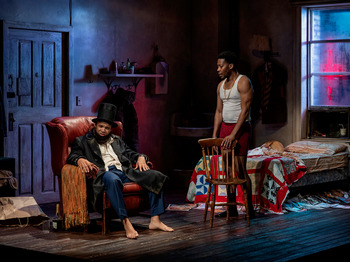
The story follows a handful of days in the lives of Booth and Lincoln, brothers given their names by their father as joke. Since Linc's wife, Cookie, tossed him out, the two men have shared Booth's squalid, claustrophobic room, making ends meet on the salary Linc makes playing Abraham Lincoln in whiteface for tourists, malevolent children, and frustrated housewives who come to an arcade to shoot him in the back. Booth has dreams of establishing himself as "Three Card," the kind of street-corner hustler Linc had been until a member of his crew was shot dead by a mark. In the meantime, though, he makes a living via his talent for shoplifting. Linc worries about being replaced by a wax dummy with a voice box, and Booth weaves tall tales about how he has won back (or maybe will win back) Grace, the woman who kicked him to the curb for cheating on her and for having nothing going on. The brothers air their mutual problems, commiserating with one another and rubbing salt into each other's wounds, by turns. As they do, the dark currents of their childhood and lives since being abandoned, first by their mother, then by their father, emerge. It all ends in violence that is sharp and shocking, despite it having been obvious from minute one that things could end no other way. Arnulfo Maldonado's scenic design is deceptively simple and startlingly effective. The stage in the Downstairs Theater is stripped down to a low, curved thrust with the rectangular floor of the room raised slightly above this surface and set at an odd angle to the audience. Maldonado masks this with a champagne-gold curtain featuring a barely there stars-and-stripes pattern. When this raises to reveal the stage, it remains visible in classic theatrical swags that catch the light. This forms the boundaries of the only space the men have to call even arguably their own. It calls to mind the darkened arcade attraction Linc spends his days in, but also contemporary images of the kind of old-fashioned theater within which the historical Lincoln met his end. But the diorama-like dimensions of the set, juxtaposed to such seeming opulence, also calls on the audience to consider what it means to spend an evening with Black struggle as the evening's entertainment. Counterbalancing such a simplistic read, though, is the fact that the space is neat, on the whole, and scattered with comforts that are too homey and cared for to simply be the fruits of Booth's "labor." There's a quilt on the lone bed and a knitted blanket that Booth covers Linc with when he nods off. The nightstand next to the bed houses a few pairs of neatly rolled-up jeans, as well as the photo album that the brothers have continued to add to in the wake of their abandonment. The lighting design by Lee Fiskness amplifies these competing truths. Relentless red neon light bleeds in from the street, and the main source of lighting for the room is a single bare bulb hanging from the ceiling. But the subtle transitions in the lighting throughout the compressed timeline as the brothers talk nods to a real world outside that window, and when the brothers turn in for the night, Fiskness provides them with a modicum of rest. Justin Ellington's sound design is interesting in its minimalism. Whereas the light of the outside world is a constant, there's no direct intrusion of sound from the outside world. Rather, the music swells in between scenes, ranging from classic Motown to Lupe Fiasco. Superficially, it may seem like a curious choice, but it becomes less so considering how fast and furious the sharp, rich dialogue flows. Dede Ayite's costume design meets the skill and thoughtfulness of the rest of the production. The suits that Booth lifts for himself and Linc are perfectly calculated to depict the brothers' disparate ambitions. The ensemble that Linc dons for his job is appropriately disturbing and makes for an intriguing contrast to the black t-shirt and leather jacket Linc sports once he goes back to throwing the cards. Glenn Davis (Lincoln) and Namir Smallwood (Booth) are wonderfully matched. Davis offers a nuanced rendition of Linc that enters in the first scene not quite having shed his "whiteface" persona. This builds to the darker, more cruel Linc we see near the end of the play, when we come to understand the wisdom of his vow not to touch the cards ever again. Smallwood offers an equally complex and compelling performance that captures the innocence of Booth's delusions and fabrications, even as it does not shy away from the danger and darkness therein. The work the two do together is electric and moving, speaking not just to their own talents, but to the skill of Leon's direction. This is a play that is inherently tense and harrowing. But under Leon's direction, Davis and Smallwood add countless dimensions to that. It's an exhausting and exhilarating show. Topdog/Underdog runs through November 1, 2026, at Steppenwolf Theatre Company, Downstairs Theater, 1650 N. Halsted St., Chicago IL. For tickets and information, please visit steppenwolf.org or call 312-335-1650.
|