|
Regional Reviews: Chicago Detroit '67 Also see Kelly's review of Eureka Day, Savannah's review of Kowalski, Christine's reviews of Play On!, and The Attic, Catey's review of Jekyll & Hyde, Joe's review of Dirty Dancing: The Musical, and Karen's review of Witch
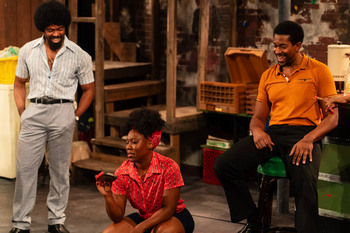
The story centers around Chelle and Lank, adult siblings who are mourning the loss of their parents even as they try to secure the inheritance their parents have worked hard to leave them, as well as their own future and the future of Chelle's son. To do this, with the help (sometimes "help") of their friends Sly and Bunny, the two try to maintain a presence in Detroit's under-the-radar after hours party scene. The balancing act the two are maintaining is threatened not only by Bunny's fickleness as their de facto promoter, or Sly's tendency to draw Lank into his schemes, but by circumstance and Lank's better nature. When he and Sly encounter a seriously injured white woman stumbling along a main thoroughfare, Lank feels compelled to bring her home. Although Chelle is livid at him bringing trouble through the door, even as police violence and community anger threaten to boil over just outside of it, her compassion wins out. She agrees to allow Caroline to stay the night, then the week, working their planned party for tips until the young woman can get on her feet and preferably out of the city. Meanwhile, Sly's numbers have "hit," and he urges Lank to pool his inheritance with Sly's winnings so the two can buy a bar from one of the white owners who is fleeing their part of the city as Black families and entrepreneurs make gains that allow them to buy homes, properties, and businesses. Chelle, who is fixated on honoring and preserving what their parents (and the Black communities before them) have built, is vehemently opposed. Lank not only ultimately ignores her concerns and goes through with the purchase, he and Caroline give in to their mutual attraction, even as the Detroit riots of 1967 erupt and rage outside the comparatively safe confines of Chelle and Lank's basement and home. Tragedy ensues when Lank and Sly attempt to get the papers showing their ownership of the bar and confront the corrupt cops who have invaded the space under the pretense of protecting it from looters. The outlines of the plot are familiar, if not outright predictable. But Morisseau fills the space within those outlines with rich, complex conversations and interactions. On paper, Chelle might read as the killjoy older sister who refuses to imagine more for herself or future generations, but she is far more than that, just as Lank is no stereotype of the rash, angry young man. Gender, generation, birth order, and unique experiences all converge so that the characters' positions and tendencies are specific and individual in addition to being frustrating and relatable by turns. If there is a character that feels somewhat two-dimensional or geared to move the plot along from time to time, it's Caroline. And given how stereotyped and short-changed Black characters have been in every medium, the reversal often (but not always) seems deliberate and purposeful. But in a play with four terrific main characters that's full of interesting intersections and departures, particularly one that does feel a bit overlong, one wonders if the compelling themes related too Black womanhood and relationships across race lines could have been just as effectively explored, if not more so, by trimming the character. Scenic designer Kevin M. Rolfs does an excellent job in rendering the basement of the family home. Exposed brick and wood framework, dressed up with Christmas lights and a record player (and eventually a sound system featuring an eight-track player), hit exactly the right note of a comfortable domestic space crossed with a slightly rougher party room. The washer, dryer, and refrigerator at stage right center evoke Chelle's focus on domesticity and stability, while the wet bar, Black power fist, and Joe Louis poster represent the seed of Lank's dreams. The rubble accumulated at the margins of the stage, as well as the irregular rafters jutting toward the audience from upstage, enclose the characters and the audience in a potent space. The lighting design by Levi J. Wilkins and especially the sound design by Warren Levon are perfectly crafted to emphasize the place-making that the set achieves. The needle drops are precisely executed, and the lights in the basement windows conjure up the natural and human-made forces that both drive and constrain the characters' actions. Finally, Terri Devine's costumes complemented by hair and makeup by Rueben Echols do far more than simply transport us to a particular time and place. The design for Chelle is primarily practical, but wonderfully accented by her gorgeous yellow party dress and hair released from its scarf. Conversely, Bunny's carefully sexy look is balanced by something more comfortable and grounded as she and Chelle wait for Lank and Sly to return. The looks for the men are no less thoughtful and expressive. Shenise Danyèl is wonderful as Chelle. Her performance is infused with confidence, as she leans into lines designed to draw laughs without any hint of worry that she will take Chelle into the realm of stereotype. She and Tamarus Harvell, as Lank, craft a wonderful, lived-in relationship and take risks with one another that pay off without fail. Both siblings are maddening and endearing, and although Chelle is arguably the show's center, neither her position at the beginning nor at the end comes across as simplistically right. Jimiece Gilbert's performance as Bunny is just as strong as that of her castmates. As with all the characters, superficially we seem to know this woman, and Gilbert is not afraid to draw on that surface familiarity. She has an easy charm and smooth comic timing, but well before the dialogue gives us more insight into the warmth and realness beneath the glamor, Gilbert has been earning the moments between Bunny and Chelle that are achingly beautiful. Dairyon Bolden, too, elevates what is superficially "just" a supporting character. The role is written (and written well) to be more overtly comic relief, but like Gilbert, Bolden has his eye on late moments that deepen the character, and there's no doubt that this is who Sly has been all along. Emma Jean Eastlund is not quite as successful as the rest of the cast in reaching three-dimensionality. She does have good chemistry with Harvell, and the two achieve nice moments together. However, the role does not seem as strongly written as the the others. Pulse Theatre Company Chicago's Detroit '67 runs through November 1, 20216, at eta Creative Arts Foundation, 7558 S. South Chicago Avenue, Chicago IL. For tickets and information, please visit www.pulsetheatrechicago.org.
|