|
Regional Reviews: Cincinnati The Piano Lesson Also see Scott's reviews of Sweeney Todd and Jesus Christ Superstar and Rick's review of Pericles
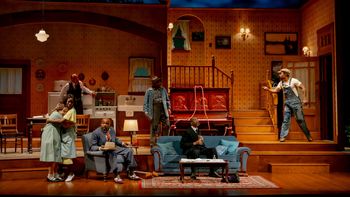
Set in 1936 Depression-era Pittsburgh, it details the Charles family's familial struggle with past traditions and present circumstances. In its powerful staging at Cincinnati Playhouse in the Park (a co-production with the Milwaukee Repertory Theatre), The Piano Lesson offers Wilson's detailed account of siblings Berniece (Nubia Monks) and Boy Willie (James T. Alfred) and their tug-of-war over a 137-year old upright piano now firmly placed in a comfortable but plain parlor (scenic design by Vicki Smith). A ton of history is represented by this musical instrument that bears three panels depicting the faces of their enslaved great-grandparents. In fact, beyond the play's eight present-day roles, the piano might be considered the dominant character. According to Doaker Charles (James Craven), uncle to Berniece and Boy Willie, the piano was acquired by Sutter, their ancestors' slave-owner in Mississippi, traded for a mother and child. Sutter's wife wanted the piano, but she missed her slaves, so the slave/father who had carpentry skills was charged with carving their likenesses and mounting them on the piano. Boy Willie's father stole the piano from the Sutters, a crime that led to his death. It's intimated that Boy Willie might have played a part in Sutter's death. In 1936 the Sutter farm is up for sale, and Boy Willie wants to sell the piano so he can buy the property. Berniece is adamantly opposed to her brother's desire, complicated by the fact that he was implicated in her husband Crawley's death. In typical Wilson style, the ghosts of both Sutter and Crawley mysteriously figure into the complex emotions around the siblings' battle. Alfred's Boy Willie is loquacious and impudent. His mind is set, and he refuses to consider other options. He is fixated on pushing back against the racism that has affected his family for generations. Alfred delivers Wilson's numerous monologues by Boy Willie with impatient vernacular skill and nervous energy: He's often peering out the front door, perhaps expecting someone pursuing him. As Berniece, Monks is upright, steadfast and tightly wound, seeing herself as the protector of family history, represented by the piano. Nevertheless, she refuses to play, hoping unsuccessfully to avoid conjuring ghosts. Uncle Doaker's role is the storyteller, and Craven, a seasoned Milwaukee actor, portrays him with dignity and precision. Doaker is the only character who grasps Berniece's unwillingness to part with the piano, although he tends toward a careful balance in the argument with her brother. Adding texture to the tale are more lively characters. Lymon (La' Tevin Alexander), Boy Willie's friend from prison, has driven them to Pittsburgh in his unreliable truck with a load of watermelons to sell–and to take the piano back to Mississippi. Another uncle, Wining Boy (Lester Purry), a one-time saloon piano player and gambler, staggers in and out of the action seeking funds and trying to convey a faded sense of style and success. Avery Brown (Anthony Irons), an ambitious and upright minister, yearns to win over Berniece, but she regularly puts him off. Berniece's young daughter Maretha (played by Tuula Hicks or Mackenzie Garry at various performances) is learning to play the piano, a skill Berniece has abandoned. Director Lou Bellamy has precisely etched each of Wilson's scenes and encounters between characters. The men sitting around a kitchen table recall a rhythmic railroad work song from Doaker's past employment. Shy Lymon is humorously convinced by Wining Boy to buy an outdated lime-green suit and too-tight shoes as a means to attract women. He also has a charming scene with Berniece, whose protective emotional shell weakens momentarily. While the ghosts never appear literally, thanks to Don Darnutzer's effective lighting design and the soundscape designed by Scott W. Edwards, their presence is a constant reminder of how the past affects the present. Whenever Boy Willie's efforts to move the piano happen, a red glow washes the set, the sounds of thunder and lightning are heard, and the characters react with terror. This all culminates in a raucous scene at the conclusion of the three-hour play when Berniece can only still the pandemonium by turning to the piano bench, playing and asking for help from the ancestors. It's a stirring finish to The Piano Lesson's impactful storytelling. Wilson's plays never hurry and seldom offer full, simple resolutions. That's part of their beauty, because they take the time to thoroughly portray each character. The uneven textures of human experience are revealed through the joys and sorrows of African American life. Every occasion of a production of the monumental plays by this great American playwright is an opportunity to be reminded of the struggle involved in lived humanity. The Piano Lesson runs through May 3, 2026, produced by the Cincinnati Playhouse in the Park, 962 Mt. Adams Circle in Eden Park, adjacent to Mt. Adams, Cincinnati, OH. For tickets and information, please visit cincyplay.com or call 513-421-3888. |