|
Regional Reviews: Connecticut and the Berkshires Ma Rainey's Black Bottom Also see Fred's review of The Urmetazoan
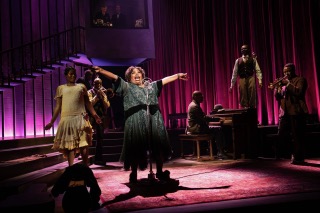
Wilson composed a play for each decade of the twentieth century and this one occurs during a single day in 1927 at a recording studio in Chicago. Scenic designer RIchard Lee's control booth for the session hovers high above and behind the band room, which is on a lower level. Lee includes a small sitting area and a piano as well. Wilson immersed himself in the blues, and the blues performer Ma Rainey lived in Chicago during the 1920s. Now, according the fictional play Wilson creates, she is late for the 1:00 pm recording occasion. Sturdyvant (Neal Lerner) owns the studio while Irvin (Jeff Parker) is Rainey's manger. Both of these white men are vexed that Rainey has not appeared even as members of her band, four Black men, arrive. The four musicians realize that to make a living, they need to wait for Ma to show up. Cutler (Terrence Archie), a trombonist, is a grounded, wise soul. Call him the leader of this group. Slow Drag (Ray Anthony Thomas), on double bass, is quiet at first but has a droll sense of humor, brings out his bottle of whiskey from time to time, and even sashays a bit. Toledo (Dion Graham), a piano player, is studious, has thoughtful opinions about race relations and social justice, and he's patient. Levee Green (Jimmie J.J. Jeter), the trumpeter, is brash, arrogant, and irreverent. Full of himself, he intends to form his own band and he is hot-tempered. For now, he has his own rendering of Ma Rainey's primary song, which he obviously feels is better than the original. Later, he has more than eyes for Dussie Mae (Brittany Antoinette Davis), a younger, sultry woman who is on stage a bit later. During the initial component of the play, the men pass the time of day ruminating about life as they exchange views regarding religion, race, lack of hope, but also dreams. Ma Rainey (Maiesha McQueen) finally appears well into Act 1 accompanied by a Policeman (Peter Bisgaier), youthful Sylvester (Mark Yarde), and Ma's friend Dussie Mae. Near the conclusion of the first 90 minutes, August Wilson has written a long, stirring, informational monologue for the complicated, egotistical, sometimes exasperating Levee. After intermission, everyone readies for the recording event. Ma recommends that Sylvester, a stutterer, has the chops to introduce her song. Next, she insists that she needs a Coke before singing, and that request puts everything on hold for 15 minutes until someone fetches it. McQueen skillfully belts out the title song with vigor, gusto, and heart in a fiery, on pitch performance. It is Sturdyvant, however, who has to report the disastrous news that they did not get the song recorded. This does not sit well. Wilson then accelerates the play to a climactic scene and eventually rivets attention on combustible Levee. August Wilson (whose favorite visual artist was Romare Bearden) explicates and paints his pictures through words. Some of early going in Ma Rainey's is actually quite comedic. We eavesdrop on a subculture of instrumentalists nearly one hundred years back. Each has a specific identity, some more settled and accepting than others. Wilson was also a keen listener, a man who, when many of his plays premiered in New Haven, would spend time in local restaurants taking in what he heard and saw, making mental notes. Wilson's plays are commanding and oftentimes gripping, persuasive works of art. Expect just that with this Ma Rainey's. Director Timothy Douglas was a first-year acting student at Yale School of Drama (now called the David Geffen School of Drama) when Ma Rainey's was first presented at Yale Rep. He was an understudy for Sylvester and he further connected with other August Wilson plays. The production of Ma Rainey's Black Bottom features gifted actors and imaginative designers. It is difficult not to pay rapt attention to a play that moves from the colloquial to the forcefully intense as the cogent, pertinent performance evolves. Ma Rainey's Black Bottom runs through October 24, 2026, at Yale Repertory, University Theatre, 222 York St., New Haven CT. For tickets and information, please call 203-432-1234 or visit Yalerep.org. |