|
Regional Reviews: Minneapolis/St. Paul A Christmas Carol Also see Arty's reviews of Jesus Christ Superstar, A Christmas in Ochopee and The Great Armistice Day Blizzard
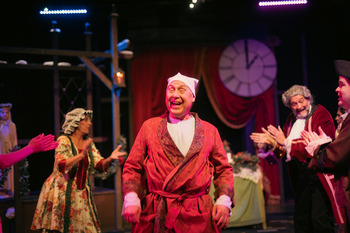
With my schedule this year allowing for just one production of A Christmas Carol, I opted to make a return to Open Window. Once again I was touched by its insightful representation of Ebenezer Scrooge as a whole man on an arc of self-discovery, the deceptively simplicity of its staging, and the open-hearted inclusion of so many traditional Christmas song in the production. Open Window uses Emily C.A. Snyder's stage adaptation of the classic Charles Dickens novella, which omits a couple of things and adds a bit to the story as is usually told. It is still the story of a wretched skinflint, Scrooge, who lives only to make money and to avoid spending any of it–so much so that the character's surname has become synonymous with "tightwad." He particularly scorns Christmas for its goodwill, cheer, inclusion, and especially, its lavish generosity. Scrooge is forever changed one Christmas Eve when the ghost of his deceased partner, Jacob Marley, visits to warn Scrooge that he is on the wrong path in life and will pay for his failings in eternity. Three more ghosts visit and each takes Scrooge on a spirit journey to Christmas past, Christmas present, and Christmas future. Scrooge is thus shaken out of his heartlessness and embraces the qualities of kindness and generosity embodied by Christmas on that day and all through the year. Snyder adds brief but significant bits of dialogue. Some pertain to Scrooge's past, enlarging his backstory and enabling us to understand, if not excuse, his misanthropy. The separate episodes that form Scrooge's visit to his past are more tangibly connected to his present, forming a coherent view of the man. We see him tormented as a child at school for his poverty and neglect; later, that tormentor is seen as a man afflicted by the same strand of greed, as a changed Scrooge laughs him off. We see Scrooge as a young clerk fretting over the lack of business acumen of his congenial employer, Fezziwig, leading him to change employment from Fezziwig to the far more scrupulous, albeit heartless, Marley. We see him meet and court Belle, giving credence to a romance that blossomed before his growing pursuit of wealth turns her away; and we see responsibility for his orphaned nephew Fred fall upon him. Same plot, but the sense of the story being a whole cloth lets us know and understand Scrooge better. This effect is deeply enhanced by Craig Johnson's haunting performance as Scrooge, which is a shade more subversive than Peter Colburn's stirring performance last season. Even at his nastiest, Johnson conveys a vulnerability within the miser, as if his thick crust is formed by pain rather than malice. Johnson expresses the gamut of Scrooge's emotions from ferocity to cynicism to despair to elation. Our understanding of Scrooge is further deepened by Mitchell Geiken's sharp performance as the young man Scrooge. Geiken conveys the effect on Scrooge of a childhood in which he had to look after his own interests, leading to poor choices that compound themselves until he becomes Ebenezer Scrooge as we first meet him, a heartless mercenary. Seeing how he fell into that state doesn't excuse his horrid behavior, but it gives us a better grasp of his humanity buried within, even before he himself does. Thus, Scrooge is not in the end a new man, but a man returned to a core that had been buried alive. Director Kari Steinbach makes the transitions through different settings and points in time easy to follow, and immerses the entire undertaking in a spirit of goodwill. Steinbach makes good use of the simple but effective setting (designed by Robin McIntyre) that includes a raised platform for Scrooge's office, menacingly overlooking his fraught employees, and which cleverly conceals the bed from which the visiting ghosts rouse him. Steinbach adroitly weaves traditional Christmas songs into the staging, including a lovely dance at the Fezziwigs' Christmas party. At times, the music is part of the narrative, and other times used as a bridge between scenes. The songs, under the musical direction of Michael Pearce Donley, are earnestly performed, the voices all pleasing, though when only a couple of actors are involved, a higher volume would have enhanced the presentation. In addition to Johnson's and Geiken's superb work (Geiken is also extremely effecting as Fred, Scrooge's warm-hearted nephew, here given even more cause to yearn for his uncle's company), the play also benefits greatly from Andrew Newman's performance as Bob Cratchit, conveying the humble clerk's modesty and faith. Newman also plays Mr. Fezziwig's son, a character Snyder inserted into the play to a powerful effect. Mandie Siems conveys Mrs. Cratchit's outspoken nature with dash and her heartbroken moments with tenderness. Warren Sampson makes a striking impression as Marley's fearsome ghost, Rick Lamers emits joy as generous-to-a-fault Fezziwig, Julia Ennen expresses the well of sorrow Scrooge's only love, Belle, feels upon realizing that he has turned away from the life she envisioned with him, and Marcie Panian is totally persuasive as the life-affirming ghost of Christmas present. I certainly cannot overlook young Justus Heisler, returning from last season's production and an even more perfect embodiment of Tiny Tim than he was a year ago. Robert L. Graff's colorful and detailed costumes look wholly in place in early Victorian London, yet not so opulent as we sometimes see, which seems proper for the period and the characters. Sue Berger's lighting design captures all of the nuance of the play's vast range of moods, and Nate Farley designed a cornucopia of suitable props. Michael Pearce Donley handles the sound design that allows the cast to be clearly heard throughout the performance, though, as last year, I am not a fan of the greatly amplified voice given to Marley's ghost, which makes it hard to understand some of the text. Other subtle but meaningful alterations in Snyder's narrative include having several employees work at Scrooge's office with Bob Cratchit as their spokesperson, rather than the sole employee; Scrooge's inquiring of the ghost of Christmas past whether his sister Fanny walks the Earth in chains like Marley's, and being perplexed by the ghost's answer; Scrooge offering condolences to Cratchit (who does not recognize him) for the terrible loss his family suffers in Christmas Future, and Cratchit's touching response; and Scrooge's housekeeper appearing early in the play, then showing up (as usual) during Christmas future as part of the degrading of Scrooge's estate, but returning at the end to join Scrooge in an act of love toward an orphaned child beyond even what Dickens had conceived. There are those who have made A Christmas Carol an annual tradition, and those who feel that seeing it once was enough. If you have seen other productions, but not made it to Open Window, I encourage you to experience their version of the tale, which gently deepens the re-awaking of Ebenezer Scrooge's heart. If you have seen Open Window's production, this year's is every bit as rewarding as its predecessor. And if you have somehow never made it to any of the retellings of Charles Dickens' wonderful story, Open Window Theatre offers a wonderful opportunity to get started. For those who really get into the holiday spirit, the theater offers a large display of seasonal decorations throughout its large lobby, along with a shop selling candy, candles, and other gifts suitable for the season. A Christmas Carolruns through January 4, 2026, at Open Window Theatre, 5300 S Robert Trail, Inver Grove Heights MN. For tickets and information, please call 612-615-1515 or go to openwindowtheatre.org. Playwright: Emily C.A. Snyder, based on the book by Charles Dickens; Director: Kari Steinbach; Music Director and Sound Design: Michael Pearce Donley; Scenic Design: Robin McIntyre; Costume Design: Robert Graff; Lighting Design: Sue Berger; Props Design: Nate Farley; Assistant Lighting Designer: Quinn Berger; Stage Manager: Matthew Wilhelm; Assistant Stage Manager: Stephanie Mogren. Cast: Evie Blake (Fanny Scrooge/Belinda Cratchit), Julia Ennen (Belle/Maggie/Clara), Mitchell Geiken (Young Scrooge/Fred/Future), Justus Heisler (Tiny Tim), Kasmira Heisler (Christmas Past/beggar), Craig Johnson (Ebenezer Scrooge), Rick Lamers (Old Fezziwig/Topper/Old Wessex), Andrew Newman (Bob Cratchit/Young Fezziwig), Marcie Panian (Present/Mrs. Fezziwig/Choir Mistress/others), Warren Sampson (Jacob Marley/Old Joe/Musician), Mandie Siems (Emily Cratchit/Young Wessex/others). |