|
Regional Reviews: Minneapolis/St. Paul Macbeth Also see Arty's reviews of Whoosh! and My Name Is Florence and Deanne's review of Go, Dog. Go! Ve Perro ¡Ve!
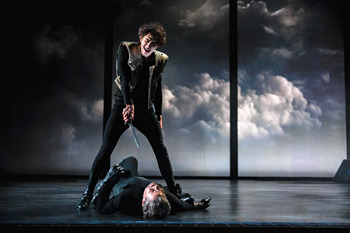
The Guthrie Theater's current staging of Macbeth, the fifth in the esteemed theatre company's 63 years, has all those qualities with a bit of history, a torrent of ambition run amok, supernatural visitations, emotional and moral breakdown, a large quantity of bloody violence (though, thankfully, the bulk of it occurs offstage), and brevity. The play is swiftly performed without an intermission, clocking in at under two hours. The production is especially noteworthy as it marks the return of Joe Dowling, the Guthrie's longest reigning artistic director (1995 - 2015) who is largely credited with securing the funds and seeing through the erection of the company's iconic home on the banks of the Mississippi. Dowling unspools Macbeth at a breathless pace, not stopping for a moment that might have allowed for its personages on stage–nor those in the audience–to collect their thoughts before the next calamity or ill-chosen course of action occurs. The actors, a brilliant ensemble, progress through this tale of "sound and fury" (to borrow a phrase from the play), going headlong into the breach of disastrous endeavors. Macbeth begins with the three weird sisters–sometimes referred to as witches–who agree that they will stir up trouble for Macbeth. Cut quickly to Duncan, King of Scotland, who receives word that the traitorous Thane (or, Lord) of Cawdor, in league with foreign allies, has been vanquished by two of Duncan's generals, Macbeth and Banquo. Since the battle, the Thane of Cawdor has been slain and Duncan declares that, as a reward for his valor, Macbeth shall now be Thane of Cawdor. Unaware of this, Macbeth and Banquo, on their way back from battle, encounter the sisters, who tell Macbeth that he shall be Thane of Cawdor and, after that, shall become King. Banquo is told he will acquire no greater rank, but his progeny shall produce a long line of future kings. The two comrades laugh off what sound like far-fetched tales, until they learn that, indeed, the King has declared Macbeth as Thane of Cawdor. Suddenly, the weird sisters' pronouncements have gravity. After this increase in power, Macbeth begins to anticipate his ascendence to the throne itself, egged on with ferocious ambition (for herself as much as for her husband) by Lady Macbeth. From then on, virtually no one is safe in Scotland as ambition propels both Macbeth and Lady Macbeth into madness. The actors inhabiting these characters completely convey that descent. Daniel José Molina, so impressive two years ago in the Guthrie's marathon history plays, is a youthful Macbeth, who is as woefully ill-prepared to accept the fortune bestowed upon him with grace as he is to stand up to his rapacious wife. Molina's Macbeth lacks the insight to understand his great folly until it is too late, and is too easily lured into complacency rather than recognize the dangers gathering before him. Meghan Kreidler (2017 Emerging Artist Ivy Award) has been far too infrequently seen on theatre stages these past years, devoting herself to her role as lead singer of the rock band Kiss the Tiger. As Lady Macbeth, she combines intelligence, seductiveness, and venom to create a monster in silkily draped gowns. The rest of the cast matches these stellar leads. Peter Christian Hansen is a clear-eyed Banquo, able to see the disastrous turn his comrade has taken, and once betrayed, returning to grimly haunt Macbeth. John Catron as Macduff expresses the virtue and intelligence that Macbeth lacks as he stands against the mad king. Catron, along with the formidable Sun Mee Chomet and equally formidable Regina Marie Williams, are the three weird sisters who gleefully conjure upheavals for the flawed mortals who cross their path. Chomet is also compelling as Lady Macduff, and Williams effective as a doctor whose observations of Lady Macbeth affirm the depth of the queen's madness. Bill MacCallum as the erstwhile King Duncan displays the model of a monarch who wields his crown with grace and composure, in contrast to the wilding Macbeth. James A. Williams as Lennox and Michelle O'Neil as Ross, a pair of Scottish thanes, carry themselves with dignity and authority. Dowling sets the action in a stark and brooding environment, on Riccardo Hernández's set of sheer foreboding walls, chiseled like cliffs at the rear of the thrust stage. These part or close to create varied degrees of emotional compression. These wall are primarily black, though Philip Rosenberg's bold lighting can set them aglow. Images of clouds behind these walls suggest a highland fog that obscures reason. When the scene changes to Great Birnam Wood, stylized trees descend, remaining suspended to counter Macbeth's experience that woods are forever stationary. Aside from the Lady's silkily draped gowns, Judith Dolan's costumes have the players in tightly fitted, black outfits, topped by military berets, that convey the mood of video game street-fighters; all but the sisters whose attire appear to be piles of rags animated by the same dark spirit that inhabits the sisters themselves. Peter Morrow's sound design enables the speakers to be crystalline (albeit, with accents that are occasionally hard to wade through), and composer Keith Thomas provides an underscoring that marries electronica with Scottish highland beats–with the surprising brief insertion of the melody from Ewan MacColl's "The First Time Ever I Saw Your Face." Macbeth is a darkly cautionary tale about the folly of ambition and the venom of distrust, the two headed tragic flaw which brings about the central character's downfall. I have always wondered, though, what Shakespeare saw in human nature that requires Macbeth and Lady Macbeth to nihilistically seize opportunity when the evidence was clear that opportunity lies passively before them. Before the play opens, Macbeth had fought the Thane of Cawdor as a dutiful subject to his king without expectation that he would be anointed to take Cawdor's place. Indeed, he thinks it so unlikely that his first impulse is to scoff at the prophecy. Yet, as the witches foretold, anointed he is. Why, then does he not rest with confidence that, in good time, the remainder of their prophecy would prove to be true, making him the King? Nothing in the witches' words suggests that he has to do anything, only that these things will come to pass. In an alternate response, he would be as good a Thane of Cawdor as he could be and remain loyal to his kin, to continue on the path that led to his good fortune. Shakespeare seems to be telling something in our nature is not content to simply allow good fortune, even when duly earned, to come to us–that our impulse is to act, to create our own destiny. Macbeth is, perhaps, the antithesis of Prince Hamlet. One undone by his unstoppable urge to act, the other by his unnerving hesitation to act. A middle path must lie somewhere, though I have not found it in Shakespeare. In any case, Dowling has brought us a sizzling, muscular Macbeth that demonstrates the flaws in human nature that brought havoc to the Scottish highlands. It is distressing that these continue to plague the seats of power in our time. Macbeth runs through March 22, 2026, at the Guthrie Theater, Wurtele Thrust Stage, 618 South 2nd Street, Minneapolis MN. For tickets and information, please call 612-377-2224 or visit GuthrieTheater.org. Playwright: William Shakespeare; Director: Joe Dowling; Scenic Designer: Riccardo Hernández; Costume Designer: Judith Dolan; Lighting Designer: Philip Rosenberg; Sound Designer: Peter Morrow; Composer: Keith Thomas; Movement Director: Joe Chvala; Fight/Intimacy Director: Annie Enneking Resident Dramaturg: Carla Steen; Resident Vocal Coach: Keely Wolter; Resident Casting Director: Jennifer Liestman; NYC Casting Consultant: McCorkle Casting, Ltd; Stage Manager: Karl Alphonso; Assistant Stage Manager: Kathryn Sam Houkom; Laura Topham. Cast: Leor Benjamin (ensemble), Pierce Brown (Donalbain/Fleance/Apparition), John Catron (Weird Sister/MacDuff/Murderer), Sun Mee Chomet (Weird Sister/Lady MacDuff/Gentlewoman), Charles Foster * (MacDuff's Son), Peter Christian Hanson (Banquo), Kaden Hesser * (MacDuff's Son), Cain Korf (ensemble), Meghan Kreidler (Lady Macbeth), Bill McCallum (Duncan/Siward/Murderer), David Michaeli (Duncan's Sergeant/Macbeth's Armorer/ Murderer), Daniel José Molina (Macbeth), Michelle O'Neil (Ross/Apparition), Daniel Petzold (Malcom/Apparition), Nick Richard (ensemble), Kyra Richardson (ensemble), James A. Williams (Lennox), Regina Marie Williams (Weird Sister/Doctor). * alternate performances |