|
Regional Reviews: Minneapolis/St. Paul The Girl Who Drank the Moon Also see Arty's review of Marie and Rosetta
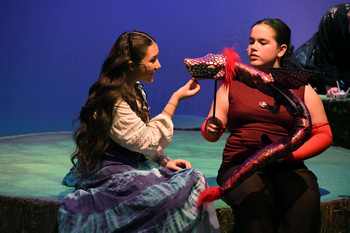
The Girl Who Drank the Moon is set in an invented world in which a kingdom called the Protectorate keeps its populace sorrowful through the annual practice of sacrificing the youngest newborn baby to Xan, a witch who lives in the swamp that cuts the Protectorate off from the rest of the known world. In exchange, the people are told, Xan refrains from inflicting her wrath upon the Protectorate. None of the people dare leave the Protectorate for fear of encountering Xan in the swam. Thus, they are trapped in compliance with this grief-inducing ritual. This serves the actual villain, a Sorrow-Eater named Ignatia, whose survival depends on sucking sorrow from the souls of the afflicted, like a vampire whose diet is based on emotional nutrients rather than blood. Xan actually is a witch, but with a good heart. She does take the baby left as a sacrifice to her each year, believing they have been abandoned, and she finds each a good home in the Free Cities. That is until, as the play unfolds, she mistakenly feeds a sacrificed infant on Moondust, rather than Stardust. Moondust places magic in the child, and Xan decides that she cannot risk placing this baby–whom she names Luna–in anyone's care but her own. She raises Luna deep in the swamp along with an amiable dragon named Fyrian and a swamp monster named Glerk. The story jumps ahead 13 years, as Luna's magic is about to reach maturity. Along with those already mentioned, the plot involves Gherland, corrupt head of the Protectorate's Council of Elders; Antain, who, as a boy, is forced to prove himself worthy of adulthood by carrying out the sacrifice of a baby, and as a grown man resists having his own newborn left on the alter; and Luna's unnamed mother, who is called the Madwoman, a condition that took hold on her after her baby was snatched away and sacrificed. The production is mounted in Stages' studio theater space, which limits the kind of elaborate stage effects that can be used on their larger proscenium stage. This works well for The Girl Who Drank the Moon, as Sarah Brandner's simple but evocative set design, a cluster of platforms made to resemble massive tree stumps of different heights, and Alex Clark's fluid lighting prompt the audience to use our imagination to visualize the context for the action throughout the play. Director Nora Montañez Patterson uses the space well, repositioning actors to identify changes in location as the narrative unfolds, and the cast members do a good job of bringing their characters to life. What is more challenging, though, is to follow the thread of that narrative in Larson's adaptation of the novel. The book is 386 pages long, which signifies a lot of plot to squeeze into a 75-minute-long play. I arrived at Stages knowing no more about the story than was provided in the press materials, accompanied by two buddies (ages 15 and 14) who were unfamiliar with the book, but are bright and avid readers, able to follow complex plotlines. All three of us were fairly stymied by what felt like abrupt shifts in the plot, knowing what power each character had, how characters accessed their magic powers, and how magic appeared, it seemed, without cause–a flock of paper cranes that seemed empowered with magic is a prime example–and the logic behind some of the story's occurrences. I have since read an online summary of the novel's plot, and learned that it has a much more complex narrative than this stage adaptation, with some characters and situations omitted altogether. This is completely to be expected when transferring a work of literature from one medium to another. It seems, though, that in this case, some connecting points needed to make the story whole were lost in the process. While this may not have been a problem for audience members familiar with the book, I like to think that a work for the stage should stand on its own merits. And this production of The Girl Who Drank the Moon has plenty of merits, especially in the performances, all of which are well played. The cast features two veteran actors, Wendy Freshman and Peter Colburn, along with its youth performers. Freshman creates an endearing and believable portrait of Xan, the empathetic witch with a generous heart, and Colburn is suitably sinister as Gherland. Penelope Talatinick is a persuasive Luna, the girl raised by a good witch she calls grandmama, as she strains to put together the missing pieces of her life. Solvel Hallstrom conveys the evil drive that animates Ignatia, the Sorrow-Eater, while Dominic Allard deftly expresses Antain's virtuous nature and courage. I was impressed with Siobhan Hellendrung's work providing the voice, and handling the movements, for Fyrian the dragon, endowing the creature with the sweet and rambunctious nature of a frisky kitten. Fyrian itself appears as a puppet, beautifully designed by Gustavo Boada, which is one of the show's premier delights. Caroline Amaral Zaltron's costume designs are well conceived to reflect each character's role in the story, with Xan's attire especially well suited for a witch who embodies the spirit of goodness and hope. Throughout the play, there is a lot said about "hope" as the antidote for "sorrow." As Ignatia and Gherland sow seeds of sorrow in order to nourish themselves, other characters, especially Luna and her mother, are sustained by hope. In the end, The Girl Who Drank the Moon delivers a message that hope will prevail over sorrow; therefore, we must nurture our hope. Even with some gaps in the path on the way to reaching this understanding, its staging is always engaging, the performances on point, and the message one that can serve us well in countering a world where the news of the day is balanced far more to sorrow than to hope. The Girl Who Drank the Moon runs through April 19, 2026, at Stages Theatre Company, at the Hopkins Center for the Arts, 1111 Main Street, Hopkins MN. For tickets and information, please call 952-979-1111 or visit stagestheatre.org. This show is recommended for ages 10 and above. Playwright: Melissa Leilani Larson, adopted from the book The Girl Who Drank the Moon by Kelly Barnhill; Director: Nora Montañez Patterson; Set Design: Sarah Brandner; Costume and Makeup Design: Caroline Amaral Zalton; Lighting Design: Alex Clark; Sound Design: Lucas Martin; Puppet Design: Gustavo Boada, Props Design: Marc Berg; Acting Coach: Anna Crace; Technical Director: Justin Anderson; Production Manager: Melanie Salmon-Peterson; Stage Manager: Grace Happe; Assistant Stage Manager: Samantha Nicholson. Cast: Dominic Allard (Antain), Zadie Bushman (ensemble), Peter Colburn (Gherland), Wendy Freshman (Xan), Solvel Hallstrom (Ignatia), Siobhan Hellendrung (Fyrian), Kira Lee (ensemble), Henry Muhs (ensemble), Sadie Nelson (Glerk), Vivian Nielsen (ensemble), Addie Piekarski (Madwoman), Penelope Talatinick (Luna). |