|
Regional Reviews: Minneapolis/St. Paul HMong Futures: The Future of Us Also see Arty's reviews The Postman's Daughter and Ada Lovelace: Bride of Science
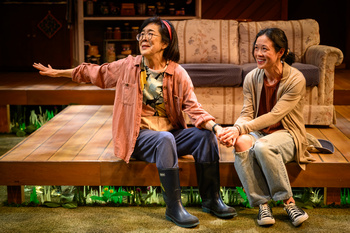
In front of the house, a drop down from the platform, are garden plots full of luscious-looking produce. Much of the play takes place in these gardens, which seem fertile and healthy. We also see ragged grass growing under the riser on which the home rests, a detail that attests to the uncultivated but robust life force that has been tamed by the gardens. The sumptuous set design is by Sarah Bahr. I describe the set at some length not only because its artistry merits this much attention, but because the sense of place it firmly establishes is central to the substance of HMong Futures. Vang was inspired to write the play by her mother's life. In an interview in the program, Vang describes her mother growing up in Laos, and, after emigrating to the United States as a young woman, being the primary provider as a farmer, growing crops to feed her family. This on-stage farm is the sustenance of life for everyone in the play, whether they have been living there or not. The play begins with Fhoua, about in her early 30s and nicely dressed, walking across the gardens at night (Ellie Simonett's lighting design serves the production extremely well) toward the house as she nervously rehearses the words she will use to greet her mother. Her mother, Zong, sees a shadowy figure in the garden and assuming it to be an intruder, makes the first move, armed with a fly swatter. In a well-crafted stage sequence, there is the abrupt lurch of a body from house to the garden, a frightful scream by both women, transiting into laughter at the sight of this old woman and her fly swatter. Fhoua explains that she just dropped her sixteen-year-old daughter, Maly, off at a three-day camp that happens to be nearby. She states that she decided to use these few days to visit her mother and, when camp is over, bring Maly back to see her grandma. But Zong is not an ecstatic, welcoming mom. She demands to know why it has been five years since Fhoua came to see her, or called, or written. Zong admits that she gave up trying to connect when Fhoua did not return any of her calls, and asks her daughter, with no trace of sympathy, "Do you want something?" Fhoua demurs, but it is obvious that she is holding back. She is chagrined to learn that her old room does not vacantly await her, for it is occupied by Aben, a boy who helps with work on the farm. Zong and Fhoua argue–for real–about which of them will set up a bed for Fhoua on the sofa. In the morning, Fhoua is dismayed to discover that Unclefrien–that is, the farmer next door (called Uncle because in HMong culture, as in many indigenous American cultures, adults of one's parents' generation are honorifically called Uncle or Auntie)–became widowed three years ago and has since taken up with Zong–both farming and showering together, though Zong insists the latter is merely to save water. Fhoua is not experiencing the homecoming she imagined. Then again, neither is Zong; she has no patience with her daughter's hemming and hawing, suspecting that something is afoot. When Maly leaves camp early and shows up at the farm, she becomes the catalyst that brings clarity to the tangle of relationships that are then reknit into a web strong enough to carry the weight of family. Vang has devised an engrossing and poignant family drama narrative that rings with authenticity while it is levitated by the humor inherent in complicated lives. Director Reena Dutt maintains a smooth fluidity from scene to scene, giving both the individual characters and the relationships among them the opportunity to be the center of our attention. In addition to the stunning set, Sarah Bahr designed the spot-on costumes. Pan-Pan Gou designed the sound and composed the evocative music that includes the sounds of traditional HMong instruments. Sharon Omi centers the play with a luminous performance as Zong, a matriarch who leaves no doubt that she runs the show. She is stubborn, but is also practical about accepting change, and reveals a tender heart beneath her tough outer skin. As Fhoua, Nancy Ma adeptly conveys the character's disarray, her struggle with the fear that she has fallen out of favor in both the traditional world of her childhood and the high-pressure world of the city she tried to conquer. Greg Watanabe, as Unclefriend, exudes kindness and affections, while providing much of the play's comic relief with self-deprecating remarks and buffoonish claims that he only says things of great importance. Melody Her is delightful as Maly, brimming with youthful idealism and directness. Her constant promotion of "Non-Violent Communication" (the theme of the camp she was attending) seems at first naïve, but in the end shows her to be the wisest of the family members. Mason Yang plays Aben as a good-hearted youth, eager to learn his place in the world in spite of a touch of the sloth common among teenage boys. The play omits information that would give us a better understanding of the characters. Maly is now sixteen, and she and Fhoua have not been to farm for five years, leaving us to wonder what was going on during Maly's first eleven years. What prompted Fhoua to break so harshly with her mother five years ago? What events led Fhoua to attain the high-pressure job that triggered a health crisis and sent her, feeling defeated, back to the farm? Fhoua and Aben each express strong feelings about their father, but nothing is ever mentioned about Maly's father, not even by Maly, which throws the play off balance. I have pondered the play's title, HMong Futures: The Future of Us. By the play's end, sparring Fhoua and Zong arrive at a warm and appealing resolution that eludes them through. The cohesion they reach as a family with space for all five characters is gratifying and healing in the present. Is this also meant to be a guidepost to the HMong future promised by the title? There are also conversations about Zong and Unclefriend, and other planters, removing the barriers between their plots in order to farm collaboratively. This could be a portent to an economic future for HMong farmers, but does it apply to the rest of the HMong populace? Not being HMong, I am not qualified to pursue this line of thinking too deeply, but it occurs to me that the play shows us that as HMong people move toward their future, they must not lose sight of their past. While those thoughts can be applied to the historic journey of any people in transition, that does not diminish the value of applying them, in this play, to the HMong people. After all, the subtitle "The Future of Us" addresses the question to a HMong audience, and not to me. HMong Futures: The Future of Us is a solid play from Katie Ka Vang. Its engrossing plot illustrates how families can stretch apart, then come back together in new configurations that maintain a place for cultural traditions. With smartly written dialogue, strong performances, and impressive design work, it is assuredly worth your attention. Note: Playwright Katie Ka Vang has opted to use HMong rather than the customary Hmong. HMong has been introduced as a form that is more inclusive of the language's different dialects. For consistency, I use HMong throughout my review. Theater Mu's HMong Futures: The Future of Us runs through May 3, 2026, at the Gremlin Theatre, 550 Vandalia Street, Saint Paul MN. For tickets and information, please call 651-789-1012 or visit www.theatermu.org. Playwright: Katie Ka Vang; Director: Reena Dutt; Scenic and Costume Design: Sarah Bahr; Lighting Design: Ellie Simonett; Sound Design and Composer: Pan-Pan Gou; Properties Design: Sarah Harris; dramaturg: Lynde Rosario; Cultural Consultant: Pang Foua Xiong; Technical Director: Austin Stiers; Production Manager: Jessica Goldade Swanson, Stage Manager: Haley Walsh; Assistant Stage Manager: Miles Latham. Cast: Melody Her (Maly), Nancy Ma (Fhoua), Sharon Omi (Zong), Greg Watanabe (Unclefriend), Mason Yang (Aben). |