|
Regional Reviews: Minneapolis/St. Paul Ada Lovelace: Bride of Science Also see Arty's reviews Gutenberg! The Musical!, of Suffs, The Girl Who Drank the Moon and Marie and Rosetta
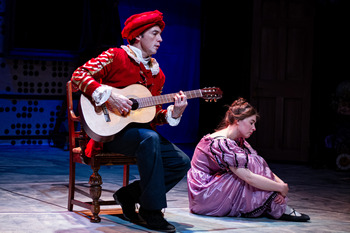
Nimbus Theatre, a local company that for over a decade has exclusively presented original plays, supported the development of Ada Lovelace: Bride of Science leading up to its current world premiere run at the Crane Theater. Among the most successful of Nimbus's laudable efforts have been those tackling big subjects based on history, such as The Storms of November (2015) based on the sinking of the Edmund Fitzgerald; Ludlow (2017), about the Colorado Coal Field War between corporate coal and organized labor; and Greenwood (2023) about the burning of Tulsa, Oklahoma's thriving "Black Wall Street." These are big stories that have had profound effects on our collective history. Unlike the subjects of those plays, Ada Lovelace: Bride of Science chronicles an individual life, not an event, but, like the those plays, her story contains vast significance in her prescient grasp of mathematical applications and the creation of machines that can compute and predict, leading to the ongoing digital revolution we are all swimming in today. Lovelace was also ahead of her time as a woman pursuing a career in what was then the exclusively male realm of math and science. Ada Lovelace lived an intense life riven by both, making her entire life a balancing act. The play, too, balances its depiction of breakthroughs Lovelace realized and their significance in the history of mathematical ideas, with its portrayal of a woman vexed by societal expectations of her role as a woman, particularly a woman born into the "leisure class," with her burning drive to achieve goals generated by her own intellect and aspirations. This is a massive undertaking for one play, and neither thrust completely hits its mark. Still, taken as a whole, Ada Lovelace: Bride of Science's holistic approach to a complex and ambitious individual's life is another great success. The play opens with an abstraction of a mechanical calculating machine with the cast planted near one another on stage, moving their limbs and heads in coordinating sequences. I have been told by director Josh Cragun (co-founder and currently one of three artistic directors of Nimbus) that these movements are patterned after the workings of computers. This motif is repeated throughout the play, with a new series of movements that appear to expand in scope each time. They are accompanied by an apt soundscape, part of Forest Godfrey's evocative work as sound designer. The first humans we meet are Ada's parents, Lord Byron and Lady Anabella Byron, the romantic poet. It is 1815 and Ada is just a baby, but Lady Byron is already deeply concerned that her husband's philandering and otherwise loose moral compass, his poetic (and at times frightening) forays into flights of fancy, and his growing debts, will have a calamitous influence on Ada. For those reasons she leaves him, keeping Ada from ever knowing her father, other than by his reputation. Though the real Lady Byron had deeply felt interests in educational reform and abolition (it was the abolitionist and author of "Uncle Tom's Cabin," Harriet Beecher Stowe, who published Lady Byron's journals after her death), these are not seen in the play. What we do see is a staunchly rationalistic woman who keeps young Ada from having any experience that would nurture imagination, cultivation of an esthetic life, or any signs of moral deviation. She limits Ada's tutoring to mathematics, a subject Lady Byron feels is based on indisputable fact. Lord Byron dies when Ada is nine years old, and when she expresses sadness, her mother upbraids her over the foolishness of being sad about someone she never knew. When she catches Ada rhapsodizing over butterflies, the punishment is severe. The play carries us forward with an inventive device showing the passage of years on a large chart resembling the punch cards used in the early computers, part of Ursula K. Bowden's well-conceived set design. Lord Byron appears to Ada as a spirit presence and returns intermittently, allowing her to have conversations with him she never had in his lifetime. Her tutor Mary Summerville introduces Ada to Charles Babbage, considered by many to be the father of the computer. Babbage becomes both a mentor and father figure to Ada, who does much of the mathematical work that enables Babbage's success, though he sees no need to give Ada, a woman, public credit for her contributions. Meanwhile, Ada marries William Baron King, a man born into wealth who is supportive of her continued interest in math and her uncredited work with Babbage. Norland, the playwright, includes more discussion of mathematical principles and the engineering behind early computers than my mind can track, but these remain brief enough to avoid bogging the play down, and serve the purpose of establishing the unique (especially for her time and her gender) world Ada occupied. Cragun, as director, presents these sequences with a breathless thrall, as, even without understanding (though I suppose I should only speak for myself) the math, we absorb the euphoria that accompanies each new discovery. That euphoria, along with a wide spectrum of other feelings, is wondrously portrayed by Gabi Jones as Ada, who runs the gamut from wistfully engaging with butterflies, to bitterly resenting her mother, to the delight felt in getting to know her father after his death, to the mix of pride and frustration she feels in her partnership with Babbage. This is really a massive role, and Jones succeeds brilliantly in it. Derek Lee Miller is superb as the flighty Lord Byron, embracing his large array of flaws but with genuine tenderness toward his daughter (of course, this is how the daughter, Ada, imagines it), and as the responsible, kind, and supportive William who, after being bestowed another rank in the English nobility, becomes Lord Lovelace, thus making Ada the Lady Ada Lovelace. Tara Lucchino is most convincing as Ada's stern mother, Lady Byron, who is unable to conceive of a more moderate approach to guiding Ada's moral and intellectual development. David Tufford takes the blustery professor bit a little too far as Charles Babbage, but he most clearly conveys the quandary Babbage faces between taking pride in, and promoting, Ada's work, yet unable–or unwilling–to publicly share credit with a woman. Victoria Pyan does fine work as Mary Summerville, conveying a feminist bent in her support for Ada. Other than Jones, all of the actors play other incidental characters in the course of the play, working seamlessly as an ensemble. Along with the mentioned contributions in set and sound design, Jackson Funke has effectively designed lighting for the production, and Krista J. Weiss's costume designs are splendidly in sync with the era and social class the play depicts. Ada Lovelace would likely have made far greater contributions to the development of computer technology if she were born one hundred years later. Nonetheless, the ideas she generated and the notes she left behind have inspired future generations of mathematicians and computer scientists, and in particular, of women in those fields. In 1980, the U.S. Department of Defense named the programming language devised to run its computer systems after her: it is called Ada. Ada Lovelace: Bride of Science is weighty play, perhaps not the choice for someone who just wants some hearty laughs, perhaps served with song and dance. That said, it is a well-structured play, crafted with great intelligence and a strong display of the way social strictures have limited the ability of so many gifted individuals from achieving their potential. Director Cragun, the design team, and the strong cast have given the play a sterling production, which will hopefully launch it on to be seen by other audiences. Nimbus Theatre's Ada Lovelace: Bride of Science, runs through April 19, 2026 at the Crane Theater, 2303 Kennedy Street N.E., Minneapolis MN. For tickets and information, please visit nimbustheatre.org or call 612-548-1379. Playwright: Nissa Nordland; Director: Josh Cragun; Set Design: Ursula K. Bowden; Costume Design: Krista J. Weiss; Lighting Design: Jason Funke; Sound Design: Forest Godfrey; Prop Design: Corinna Troth; Stage Manager: Alyssa Thompson. Cast: Gabi Jones (Ada Lovelace), Tara Lucchino (Lady Anabella Milbanke and others), Derek Lee Miller (Lord Byron, William King Baron of Lovelace), Victoria Pyan (Mary Summerville and others), David Tufford (Charles Babbage and others). |