|
Regional Reviews: Minneapolis/St. Paul Joan of Arc Also see Arty's reviews of Harry Potter and the Cursed Child and The Wizard of Oz
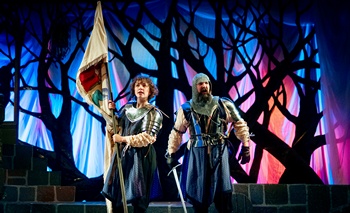
Of course, I long since learned that Joan of Arc was real. My comic book was about a real person, but how much of what I read was true and how much was legend that had grown up around the historical figure? How much could be true? Whether wholly true or laced with embellishments, there is a mountain of literary depictions including books, films, and plays (like George Bernard Shaw's Saint Joan and Jean Anouilh's The Lark). Now another play joins that august body of work. Joan of Arc is the straightforward title of Jeremy Stanbary's play, which is having its world premiere at Open Window Theatre. It is an impassioned, finely crafted drama. It lays out the saga of Joan in both historical and deeply emotional terms, drawing on recorded history and other historic persons, with an invented device that brings her story to life in our own world. Moreover, Joan of Arc is staged–Stanbary, Open Window's Artistic Director, directs his play–with a clear vision that this story must convey both the muscularity of war, ambition, and deceit among men, and the passion of true believers who seek glory not for themselves, but for a righteous cause. For Jehanne (Stanbary uses this French spelling and pronunciation), that cause is God and nation. Stanbary's astute direction supports an unwavering cast, led–as Jehanne led her nation–by Audryn Hegewald, giving a magnificent performance as the maiden. Hegewald is a young actress with little stage experience, but based on her work here, we ardently hope to see more of her on stage in the future. The play begins in 1431 as an angel sings in prayer at the end of Jehanne's life. She is brought to a pyre to be burned alive for heresy and blasphemy, which included the wearing of men's clothing, as judged by a court presided over by a Catholic bishop. Then we travel back two years earlier, as rival heralds (one British, the other French) proclaim the most recent events of the ongoing Hundred Years War. The haughty English herald casts aspersions upon his French counterpart, especially after a French supply line takes a drubbing from a greatly outnumbered English patrol. The Englishman also derides the rumor about a French maiden headed their way to lead the French to victory. The Frenchman has little to say in defense of his countrymen, and consoles himself with heavy drinking. Then Jehanne arrives, beseeching him to lead her to the French officers. Starting with little faith in her or her mission, her clever arguments and undeniable faith win him over, not only gaining faith in her cause, but in her belief in his capacity to swear off the bottle. He becomes Jehanne's personal herald. This is the device mentioned earlier that allows us to see Joan of Arc as both the unstoppable force moved by her faith that her officers and her followers see, and also as a person in an authentic human relationship. He speaks directly to the audience throughout the play, breaking the fourth wall, about the progress of his rehabilitation and his observations of Jehanne's struggles. Michael Quadrozzi instills this role with its own passion as he gains awareness of the power unleashed by his mistress's faith, blended with self-deprecating humor, creating a Sancho Panza-like everyman. Charles VII is the dauphin Jehanne believes must receive a traditional coronation to establish himself as the true King of France. Charles is an ill-at-ease young man, lacking confidence in his capacity to rule, for before his death, his own father denied him his birthright to the throne. Josh Zapata-Palmer, as Charles, skillfully evolves from the milquetoast-like Dauphine into an enthused defender of his birthright, stirred by Jehanne's strident confidence, and then, once he attains power, becoming uneasy with it, making choices based on fear of losing power. His fears are stoked by his Lord Chamberlain, Georges de la Trémouille, briskly played by Ian Hardy to convey the man's viperous duplicity. The Duke of Alençon (Dawson Ehlke), the Bastard of Orléans (Jonah Smith), and La Hire "The Wrath" (Rob Ward) are a trio of officers who, one by one, are won over by Jehanne's faith, as well as her ability to prove herself correct in matters of battlefield strategy. All three actors are wonderful in expressing an authentic conversion from detractors to followers of Jehanne. Ward, as the toughest of the three (he is called "The Wrath" for good reason) makes an especially strong impression that allows for a breath of humor in what is, overall, a profoundly serious work. Keith Prusak is effective as Bishop Pierre Cauchon, with the Burgundian faction who side with the English, and sees this maiden spouting divine inspiration to rally her army as a misguided nuisance, yet shows a final measure of mercy in hoping to save rather than condemn her. Sam Sweere as Duke of Bedford, fighting on behalf of England's claims to French territory, conveys the avarice that drives his cunning. Faith Winship Smith, as Charles' wife Marie Anjou, nicely expresses her confidence in both Jehanne and her husband, visibly capturing her later sense of betrayal at Charles' hand. Other than the herald, all of the characters named above, and several others who show up, are historical figures. The stage set, designed by Robin McIntyre, is an open space with stairs rising to platforms on either side, and simple furnishings brought in as needed from scene to scene. It works wonderfully paired with Sue Berger's lighting design, making it clear where we are in the narrative, even when scenes move quickly from one locale to another. Behind the playing area is a silhouette of trees, their limbs reaching outward and upward. Behind this "forest" are draped bolts of material on which changes in the lighting create a range of evocative, and often beautiful, effects. Bronson Talcott's costume designs are attentive to detail in capturing the early 15th century French setting. There are several battle scenes, primarily sword fights, and fight director Mason Tyer stages them with a sense of mayhem, so that we feel the tension and uncertainty of the outcome, yet controlled in a manner that creates a sense of grace even in the heat of battle. Jehanne d'Arc never expresses what she feels or what she thinks, only what she knows. What she "knows" comes, she believes with absolute faith, from the saints, who speak for God. She knows she can do what the voices tell her to do, because they would not issue these directions if it were not going to happen. Her logic–if you can consider logic in matters completely driven by faith–is circular, allowing no crack through which she could have any doubt, or give credence to doubts expressed by her followers. Whether or not the voices Jehanne heard were from heaven, or had some other source (much has been written conjecturing possible psychological causes), her complete faith and confidence serve as an inspiration that moves others to follow. They did not necessarily have to share her faith; it was enough to be emboldened by her certainty that they would prevail. This was wonderful for bolstering the noble struggle for French autonomy from the English, which the French eventually won, after 22 more years of war. Her martyrdom for her nation and her absolute faith led to her canonization by Pope Benedict XV as St. Joan in 1920. But it raises uneasy questions as well. In any conflict, assuming both sides believe they are right, could they not both draw on their faith to believe that God favors their righteous struggle, and feel empowered to wage their fight not only for their clan or country, but for God? We have leaders in office now who claim that their work is driven by their faith that they are doing God's will, yet some of those actions seem contrary to many notions of charity, justice, compassion, and peace. Unassailable faith can cut both ways. Raising difficult questions is, I believe, a good and desirable outcome for a work of art, and only adds to my view that Joan of Arc is an outstanding play. It has been beautifully staged at Open Window, embodied by excellent performances, in particular a breakout performance by Audryn Hegewald in the title role. I give Joan of Arc my highest recommendation. Joan of Arc runs through May 31, 2026, at Open Window Theatre, 5300 S Robert Trail, Inver Grove Heights MN. For tickets and information, please call 612-615-1515 or visit openwindowtheatre.org. Playwright and Director: Jeremy Stanbary; Set Design: Robin McIntyre; Costume Design: Bronson Talcott; Lighting Design: Sue Berger; Sound Design: Jeremy Stanbary, Props Design: Nate Farley; Fight Director: Mason Tyer; Dramaturg: Allison Hendrickson; Stage Manager: Stephanie Mogren; Assistant Stage Manager: Elle Row. Cast: Meg Bradley (Yolande of Aragon), Caleb Cabiness (English Herald/Pasquerel), Dawson Ehlke (Duke of Alençon), Thaxton Gamache (Servants/ensemble), Ian Hardy (Georges de la Trémouille), Audryn Hegewald (Jehanne d'Arc), Keith Prusak (Bishop Pierre Cauchon), Michael Quadrozzi (French Herald), Faith Winship Smith (Marie Anjou), Jonah Smith (Bastard of Orléans), Sam Sweere (Duke of Bedford), Rob Ward (La Hire "The Wrath"), Josh Zapata-Palmer (King Charles VII). |