|
Regional Reviews: Minneapolis/St. Paul Fefu and Her Friends Also see Arty's review of Pagliacci
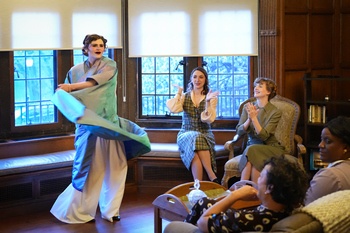
Theatre Pro Rata has a flair for coming up with little known titles that, once you see them, feel indispensable. Such is the case with its current production of Maria Irene Fornés' play Fefu and Her Friends, being given a site-specific staging at the elegant Searles Mansion near Lake of the Isles in Minneapolis. As a feminist work (Fornés was a lesbian and an avowed feminist) that premiered in 1977, it speaks to a moment in our social history in its depiction of relationships among women and the way women see themselves in relation to a world dominated by men. Moreover, Fornés is perhaps the most highly regarded figure among late 20th century dramatists who is unknown to the average theatregoer. She was born in Cuba and immigrated with her mother to the United States at the age of 15, in 1945. Drawn to the arts, she started out as an aspiring painter, but eventually found her voice as a playwright, writing her first play, The Widow, in 1961. From that point on, she was prolific writing forty plays by the year 2000, when failing health forced her to stop. Her influence was acknowledged by such celebrated playwrights as Edward Albee, Caryl Churchill, Tony Kushner, Paula Vogel, and Lanford Wilson, who said of Fornés, "Her work has no precedents; it isn't derived from anything. She's the most original of us all." Fefu and Her Friends certainly strikes the top of the pole for originality. The play is broken into three short acts. The first, running about 20 minutes, opens in the living room of a country estate owned by Fefu's husband Phillip. It is never stated that Fefu does not share in ownership of the house, but it is the 1930s and, though Fefu adopts the qualities of an emancipated woman–which in her mind means behaving like a man–she and the play overall make it clear that men hold the reins. Her opening line: "My husband married me to have a constant reminder of how loathsome women are," nicely gets the ball rolling in that direction. Fefu (Jessica Winingham) is welcoming two of her friends, Cindy (Brettina Davis) and Christina (Christy Johnson), the first to arrive for a weekend during which a group of eight women are going to plan their program for a fundraising event in support of an educational enterprise. We grasp, in the course of the play, that the women went to school together, perhaps to the very institution for which they are raising money. Over the years, some of them have stayed in close contact, others less so. Next to arrive is Julia (Jhax Berryhill), wheelchair-bound due to an accident a year ago that caused both physical and psychological damage. Soon they are joined by Emma (Gracie Nayman), Paula (Nora Sonneborn), and Sue (Nissa Nordland), who each convey the basic tenet of their distinctive personalities. The last to show up, uncertain if she is even in the right place, is Cecilia (Chesa Greene), who makes a first impression of seeming more properly put together than the others. The second act is presented as promenade theater. The audience is divided into four groups, each led by a guide who shepherds us through four different spaces in the home–patio, study, kitchen, and bedroom. Fefu and her guests divide into natural small groupings, and in each of the rooms we watch their markedly different conversations, ranging from outrageous to confessional to hallucinatory–all of which occur simultaneously. After our time in each room, less than ten minutes, our guide leads us to another, so the audience–unlike the characters in the play–are party to all four conversations that take place. In the third act we all return to the living room. It is now evening, and the guests engage in after-dinner chatter. Led by Fefu, they finally tend to business, a bare-bones rehearsal of the fundraising event program. One gets the feeling that the chance to be together is an end in itself, and planning the fundraiser merely the ruse to accomplish it. As the centerpiece of the program, the flamboyant and dramatic Emma is to deliver a recitation, which is the only part of the program rehearsed in full. Fornés excerpted this recitation from "The Science of Educational Dramatics" by Emma Sheridan Fry, who was an actor, journalist, playwright, and progressive educator in the late 19th and early 20th centuries. It is a passionate cry for education that releases the inner spirit of the individual. Emma's flair for the dramatic comes across full force, and her friends cheer her rhapsodic delivery of the piece. The group dissembles, with different characters coming in and out of the living room engaging in conversations, some revealing personal pain or sadness, others utterly frivolous, including a riotous water fight. The end arrives abruptly in a manner that could only be called magical realism. Pro Rata Artistic Director Carin Bratlie Wethern directs this production like a ringmaster, moving the actors through the house–at times during the stationary first and third acts, we hear actors calling our from different places within the house, even from outdoors–and orchestrating the promenade scenes in the second act with utmost precision. Moreover, she has knitted together these characters in a way that brings to life the distinct relationship each has with each of the others. Andrea Gross' stylish costume designs reflect the 1930s period and provide a distinctive appearance in line with each character's temperament. The ensemble does fantastic work in bringing out the unique qualities of each character. Among the stand-outs are Winingham as Fefu, wonderfully presenting an air of faux manliness and a thick skin, which is meant to protect deeply unfulfilled needs. Nayman, gives a luminous portrayal of Emma, who abandons concerns about the day-to-day of life, finding her balance on an ethereal plane of drama and sensuality. Berryhill, as Julia, conveys the brave face of someone who has lost both physical and mental stability, and anguish she can only bear alone. Sonneborn superbly presents Paula's protective exterior, making feeble jokes to appear cheery, while allowing us to see the wounds of a broken heart. Fornés has populated Fefu and Her Friends with distinctive characters who each are endowed with authentic voices. Her dialogue rings true, contains sharp humor, and takes fascinating forays into thought processes: the life cycle of a love affair, for one example, and the failure of education to instruct the student to recognize the differences between like-seeming events, for another. Her structure, with the promenade second act that allow us to see what is going on in different quarters of the house before reconvening in the third act to see how these separate pieces connect, is ingenious. The commentary about relationships between men and women, including their differing positions of power and capacities to effect change, are, from a current vantage point, interesting depictions of the state of the arguments being raised by feminists in the 1970s. Of course, Fornés was using a 1930s scenario as a means of making these points in the 1970s, forty years later. Here we are, fifty years later still, left to consider how much of what she presents is artifact and how much remains. All these things I found exhilarating about Fefu and Her Friends, and particularly in this terrific production from Theatre Pro Rata, staged in such a uniquely appropriate setting. I certainly am glad to become familiar with Maria Irene Fornés through a play that is considered one of her most notable works. But I left feeling that it was stuffed with perhaps too many ideas, with so many tangents that could lead in different directions. Its sudden conclusion addresses only one of these tangents. I wanted more more tying up of threads, I suppose, and was thus left less than fully sated. But wanting more is usually a better outcome than wanting less. Theatre Pro Rata's Fefu and Her Friends is an adventurous theatrical event, and I encourage any theatregoer with an adventurous spirit to make their acquaintance. Fefu and Her Friends, presented by Theatre Pro Rata, runs through May 28, 2026, at the Searle Mansion, 1915 Logan Ave., Minneapolis MN. For tickets and information, please call 612-234-7135 or visit theatreprorata.org. Playwright: Maria Irene Fornés; Director: Carin Bratlie Wethern; Costume Design: Andrea Gross; Sound Design: Jacob M. Davis; Prop Design: Jenny Moeller; AV Design: Emmet Kowler; Stage Manager: Clara Costello. Cast: Jhax Berryhill (Julia), Brettina Davis (Cindy), Chesa Greene (Cecilia), Christy Johnson (Christina), Gracie Nayman (Emma), Nissa Nordland (Sue), Nora Sonneborn (Paula), Jessica Winingham (Fefu). |