|
Regional Reviews: Minneapolis/St. Paul Pagliacci Also see Arty's reviews of The Imaginary Invalid, The Most Happy Fella, Promise of America
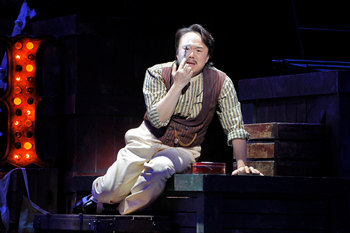
Minnesota Opera is leasing the sumptuous physical production from the acclaimed Glimmerglass Festival Opera that performs each summer in Cooperstown, New York. Glimmerglass mounted Pagliacci two years ago, and the set looks fresh as a daisy. Though Glimmerglass has about half the seating capacity of the Ordway Center for the Arts, where Minnesota Opera performs, the physical elements are substantial enough to easily fill the larger space. As operas go, Pagliacci is short, its prologue and two acts running just one hour and forty-five minutes. Traditionally, it is paired with another short piece to form a full evening, as Minnesota Opera did when the company last staged Pagliacci in its 2000-2001 season, paired with Carmina Burana>. This time Pagliacci stands alone, but the excellence of the production and performances, along with the intensity of its musical themes and heartbreaking story–both score and libretto are by Ruggero Leoncavallo–are more than sufficient for an enthralling evening. Leoncavallo said he was inspired by Pietro Mascagni's Cavalleria Rusticana in 1890, the opera that triggered the verisimo genre, a style of Italian opera and literature that peaked in the early 1900s and had run its course by the late 1920s. Verisimo aimed for greater naturalism and realism in its narratives, and addressed the lives of the poor not previously depicted. Two years after seeing Cavalleria Rusticana, Leoncavallo produced Pagliacci. This was to be not only his greatest work, but his only work to remain in the canon for future generations. While most operas are based on an existing novel, story, play, myth, or folktale (or, more recently, on a film), Leoncavallo created Pagliacci based on his memory of an incident from his childhood, regarding the murder of a family servant. He added complexity to the presentation of his story by having the tragic events of the opera take place among members of a travelling band of actors in a troupe led by Canio, who perform in the style of commedia dell'arte. Dressed as harlequins and clowns, the troupe enacts a play that parallels their real-life turmoil, but placed in a comedic, almost buffoonish, light. The interplay between harsh reality and the comedy that mirrors it is chilling. P>This "opera within an opera" device is given yet another perspective by way of a prologue, delivered by the character Tonio, who, ignoring the fourth wall, greets the audience years after the events to be depicted in Pagliacci, as he ruminates on his role in all that occurred. He appeals to the audience not to consider the characters in their bright costumes and gaudy makeup, but the human beings beneath those trappings, with feelings no different than our own. Reginald Smith Jr., as Tonio/Taddeo, sings "Si può? Si può?" with a vibrant baritone and a sense of heavy regret, as he declares that actors are real people with real feelings, underscoring the verisimo aspect. Won Whi Choi sings the role of Canio/Pagliacci with a stunningly clear tenor, expressing the pain behind the rage he feels with such conviction that, in spite of him being arrogant, possessive, and violent, one is drawn to feel sympathy for him, particularly in his impassioned delivery of the iconic aria "Vesti la giubba," sobbing as he applies the greasepaint that turns him into a clown. Of course, Canio doesn't start out in despair–earlier, Choi arrives in the town center, boasting of the entertainment his troupe will present, with the confident "Un tal gioco." Amanda Batista, as Canio's wife Nedda/Columbine, brings a beautiful soprano to her performance, with a range of emotions from her scorn for Tonio to her passion for her lover, Silvio, to the flippancy with which she puts off her husband while deceiving him, then apprehension and fear when his abusive nature is stoked. Batista, singing "Pagliaccio, mio marito" in the guise of Columbine, conveys the carefree nature of one who lives as a clown, free of constraints. As Nedda, Batista expresses her desperation for a better reality in "Silvio! A quest'ora," a stirring duet with Silvio. The latter is strikingly played as a besotted romantic by baritone David Wolfe, a stalwart Minnesota Opera resident artist. As the opera reaches is tragic end, Batista and Choi bring devastating fury to the duet "Versa Il Filtro." There are exceptionally well staged and sung crowd scenes, with the chorus–both adults and children–entering from both sides of the stage and down the aisles, gathering, in the first act, to greet Canio's troupe as the enter the town and be roped in by Canio's pitch, and then processing out to attend evening vespers. In the second act, the crowd gathers again, even more festively in anticipation of the evening's performance by the troupe. Stage director Brenna Corner creates exciting visual imagery, enveloped in James Rotonodo's scenic designs, Erik Teague's costumes, and Robert Wierzel's lighting design, all of which are exceptional. Annie Enneking's fight choreography brings authenticity to the bouts of violence, particularly in the final scene. One notable point in the staging is the presence of a young boy in the troupe, who is Nedda and Canio's son, at least based on the attentions they give him. Nedda in particular is frequently seen bestowing motherly affection on the boy, and looking pleased when the lad shows off sparks of fledgling theatrical talent. The libretto says nothing about the child, nor is he mentioned in any of several synopsis of Pagliacci that I've read. If this is an element added in the current production, it works well at invoking our sympathies for Nedda, yet calls into question her intent to run away with Silvio. Would she have left this beloved boy with the abusive Canio? Pagliacci translates to clowns, in the plural, accusing those characters who act as clowns for entertainment purposes of being clowns in a pejorative sense in their real lives: self-absorbed and clumsy with other people's feelings, giving in to passions without weighing the consequences. If one adopts this meaning, the child may represent innocent collateral damage, especially in light of how the concluding moments are staged. In so many of the classic operas, as I have opined before, the plot taken by itself is simplistic, almost to the point of being vapid. In Pagliacci, the plot can be boiled down to: the wife of a dangerously jealous man has an affair, and things end badly for them both." That's not much meat when considered that way, but the emotional resonance created by the soaring music and exquisite voices, along with a colorful context realized by stunning stage designs, makes this simple, tawdry story into something majestic. It taps something deeper than an outline of the plot, drawing human emotions at a primal level. At least, that is how it works for those who respond to the artistry and power of great opera. Minnesota Opera's current staging of Pagliacci rises to that high level. It is a must-see for opera lovers, and may well win over some new devotees. Pagliacci runs through May 17, 2026, at Minnesota Opera, Ordway Center for the Performing Arts, 345 Washington Street, Saint Paul MN. For tickets and information, please call 612-333-6699 or visit www.mnopera.org. Music and Libretto: Ruggero Leoncavallo; Principal Conductor: Christopher Franklin; Stage Director: Brenna Corner; Scenic Design: James Rotondo; Costume Design: Erik Teague; Lighting Design: Robert Wierzel; Wig, Hair and Make-Up Design: Priscilla Bruce; Original Choreographer: Eric Sean Fogel; Principal Coach and Chorus Director: Celeste Marie Johnson; Head of Music and Assistant Conductor: Mario Antonio Marra; Fight and Intimacy Director: Annie Enneking; Associate Stage Director: Nora Winsler Répétiteur: Fumiyasu Kawase; Stage Manager: Luci Burdick. Cast: Amanda Batista (Nedda), Won Whi Choi (Canio), Roland Hawkins II (Second Townsperson), John Mburu (First Townsperson), Dylan Morrongiello (Beppe), Reginald Smith, Jr. (Tonio), David Wolfe (Silvio). |