|
Regional Reviews: Minneapolis/St. Paul Courting Harry Also see Arty's reviews of A Chorus Line and Fefu and Her Friends
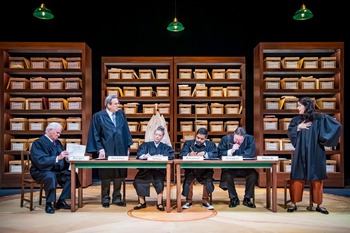
The play is about two childhood friends who grew up blocks apart in Dayton's Bluff, a working-class St. Paul neighborhood, attending the same grade school and Sunday school. Who would imagine that they would both become justices on the United States Supreme Court. Chief Justice Warren Burger (Pearce Bunting) was appointed by President Richard Nixon in 1969, replacing Chief Justice Earl Warren. Associate Justice Harry Blackmun (John Middleton) was appointed by Nixon the next year, having been recommended for the post by Burger after revelations about each of Nixon's first two picks for the seat torpedoed their confirmations. They served on the court together for sixteen years–Blackmun remained on the bench for six years after Burger's retirement. At the start, they usually voted the same way, in an Eisenhower-era Republican mode, so much that they were dubbed the court's Minnesota Twins. Over time, though, Blackmun veered increasingly to a contextual approach to the Constitution, away from Burger's originalist view that decisions before the court should follow the U.S. Constitution as it was originally written, and not take changing times and new contexts into account. This drew a wedge between them that not only affected the work of the court, but debilitated their life-long friendship. Joel Sass, who directed the 2013 run, is back for the remount of Courting Harry and it feels that, without sacrificing any of the play's solid construction, he has opened it up to reflect on ways our country is different in 2026 than it was in 2013. That was only thirteen years ago, but so much feels changed. Whether it is the elasticity of Blessing's writing, the adeptness of Sass's direction, or both, Courting Harry feels very much like a play meant to be seen–and talked about–right now. The play has a lot to say about old friendships and how they weather–or fail to weather–changes in one's political outlook, a challenge that has been felt by a great many Americans over the past decade. As boys, Blackmun and Burger played sports together, spent hours at each other's homes, and made plans together, first to go to medical school and switching later to pursue law degrees. Blackmun was best man at Burger's wedding. Burger stayed in Minnesota for college, while Blackmun accepted a scholarship to Harvard. This first separation might not seem like much–they corresponded frequently and gave each other career advice. But it was the first fissure that, under pressure, would split open when they found themselves working side by side on the Supreme Court. The play begins with both men having died. From wherever is is that we happen upon them–it appears, as realized by Joel Sass's splendid set design (Sass is a wizard at both direction and design) like a law library in the next world. Blackmun makes accusations against Burger which Burger denies, while also stating that Blackmun's charges can never be proven, as there are no records. At this moment, shelves and tables laden with document boxes appear, along with four clerks who, throughout the play, rummage through the boxes, finding letters from one man to the other, news clippings, and other forms of documentation kept by Blackmun. This dramatic device is very well conceived and works beautifully to provide memories that reconstruct the trail of Blackmun and Burger's friendship, their careers, and the effect they had on the nation. Among the most profoundly impactful outcomes of their time on the bench were their votes in favor of the plaintiff in the landmark Roe v. Wade case that made abortion legal across the nation. Burger, knowing he had taken a controversial stance, assigned Blackmun to write the ruling, which was to become the associate justice's most remembered work on the court. In addition to the interesting depiction of two men who made their marks on history, on the fragility of what seemed like a rock-solid friendship, and of the process by which Blackmun and Burger each made their decisions in the court, the play also provides a good thumbnail sketch of how the court operates. In scenes in which the four library clerks take the guise of different Supreme Court Justices, affecting well-practiced accents as appropriate, we are party to court discussions and protocol. Middleton and Bunting portray Blackmun and Burger, respectively, with absolute authenticity–not that I have a vivid memory of the men from their years on the bench, but the two actors are completely believable in their roles. Their camaraderie as childhood friends is genuine, and the slow erosion, almost drip by drip, of that friendship is incisively portrayed by both actors. I've seen both actors often enough to be very familiar with their appearance, and when they stepped onto the stage I thought, "Middleton looks like Middleton, and Bunting looks like Bunting." Well, why not? Only later when I saw photographs of Blackmun and Burger did I realize that, while the actors looked like their familiar selves, they also looked exactly like the men they were portraying, as if they were born into those roles. The four actors who portray the clerks, various Supreme Court justices, and other small roles all do excellent work, though I must cite E.J. Subkoviak for his terrific impersonations of two American presidents. The others in the cast are Bonni Allen, Jonathan Feld, and Eva Gemlo, all swell. At one point, Burger, in defense of his behavior toward Blackmun over the years, states that in any friendship one partner dominates. Thanks to excellent performances by both actors, we see that this was so early in their lives. Burger was more gregarious, decisive, and ambitious, Blackmun more deliberative, passive, and reserved. Burger relished the trappings of high office, Blackmun disdained them. An example is when Burger hands Blackmun a top hat to wear to his swearing-in ceremony, and Blackmun rebuffs him, saying, "It looks like a target for a snowball." But Middleton also shows us that it was never Blackmun's intent to cede his autonomy. I found this to be a crucial point, whether talking about friendships or those entrusted with leadership of the government. I have found no subsequent productions of the play since its successful run here in 2013, in spite of the playwright's reputation. Nor could I find a published edition of the play available online. Many shows mounted by History Theatre are built around Minnesota lore, incidents, or personalities, so that, good as they may be, they are unlikely to find audiences outside the state. Even Glensheen, a marvelous musical satire that has been brought back for numerous return engagements, is quite Minnesota-centric. But Courting Harry deals with a subject rarely treated on stage, friendship between men through the stages of life, that should have wide appeal. It also illuminates the workings of the Supreme Court and the thinking–and politics–that go into judicial decision making, something that our current Court has brought foursquare to our attention. Perhaps the difference in our national complexion now versus thirteen years ago makes Courting Harry seem much more important, not just to Minnesota, but to the nation, than it did then. If so, I hope this excellent remount by History Theatre brings Blessing's play attention outside the Land of 10,000 Lakes. If it means anything, the playwright, born and raised in the Twin Cities and now based in New York, was present for the opening night performance. In any case, Minnesota audiences are fortunate to have Courting Harry now. I highly recommend this play to all serious theater goers. Courting Harry runs through June 7, 2026, at History Theatre, 30 East 10th Street, Saint Paul MN. For tickets and information, please visit historytheatre.com or call 651-292-4323. Playwright: Lee Blessing; Director and Scenic Design: Joel Sass; Costume Design: Meghan Kent; Lighting Design: Grant E. Merges; Sound Design: C. Andrew Mayer; Properties Design: Kirby Moore; Technical Director: Gunther Gullickson; Stage Manager: Samantha Fairchild Poppen; Assistant Stage Manager: Elijah Virgil Hughes. Cast: Bonni Allen (Actor C), Pearce Bunting (Warren Burger), Jonathan Feld (Actor B), Eva Gemlo (Actor D), John Middleton (Harry Blackmun), E..J. Subkoviak (Actor B). |